Indonesia blocks Internet access amid violent protests in Papua

Indonesia has blocked Internet access in eastern Papua to prevent provocative posts online from fueling violence, after a wave of protests against mistreatment of students and ethnic discrimination turned into riots.

The country’s Communications and Informatics Ministry has cut off access to telecommunication data and Internet to prevent people in Papua from accessing social media since August 21 night, though calls and text messages will still work, said ministry spokesman Ferdinandus Setu. 

It was an effort to stop people from sharing offensive messages that can spark racial hatred, he noted, adding that the restriction may be removed if the situation is back to normal.

Indonesian security minister, police chief and military commander visited the port city of Sorong in Papua province to inspect where the protests erupted, but there was no report of fresh demonstrations there.

Demonstrations have spread across Papua after thousands of people, mostly university students, took to the street on August 19 to protest racism and discrimination. They blocked roads, damaged an airport and set fire to the headquarters of the Regional Legislative Council. 

Authorities are hunting for more than 250 inmates who had escaped from a prison in Sorong that was torched during the riots.

Over 1,000 policemen have been deployed to Papua to maintain security there.

According to national police spokesman Dedi Prasetyo, anger boiled over at reports that authorities tear-gassed and detained some 43 Papuan university students in the country's second biggest city, Surabaya, on August 17 - Indonesia's Independence Day. The students were detained but released hours later after no evidence was found that they had damaged the flag.

Papua is a former Dutch colony in the western part of New Guinea that is ethnically and culturally distinct from much of Indonesia. It was incorporated into Indonesia in 1969 after a U.N.-sponsored ballot.
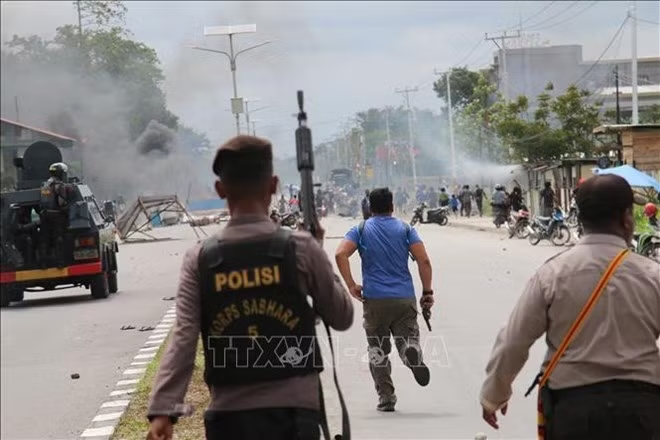
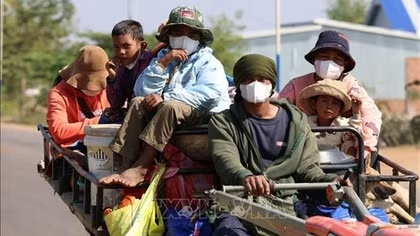
Indonesia has blocked Internet access in eastern Papua to prevent provocative posts online from fueling violence, after a wave of protests against mistreatment of students and ethnic discrimination turned into riots. (Photo: VNA)
Vietnamplus

Other News

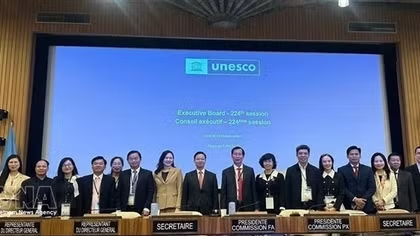
Vietnam supports UNESCO's people-centred approach, multilateral cooperation: official

Vietnam supports UNESCO's people-centred approach, multilateral cooperation: official

Van affirmed Vietnam’s support for the UNESCO80 reform roadmap, focusing on the organisation’s core mandate, priority areas, interdisciplinary approach, and the special status of the Vietnam National Commission for UNESCO, and UNESCO representative offices, alongside efforts to diversify resources and strengthen global partnerships to enhance the organisation’s effectiveness.

Regional media highlight significant step in Vietnam’s leadership structure

Regional media highlight significant step in Vietnam’s leadership structure

Under General Secretary and President Lam’s leadership, Vietnam is expected to maintain a balanced foreign policy, strengthen its regional standing and accelerate economic development, thereby improving living standards and creating new opportunities for international investors, according to the India-based platform Devdiscourse.

Laos identifies 10 key tasks to build independent, self-reliant economy

Laos identifies 10 key tasks to build independent, self-reliant economy

Laos will step up agricultural production to ensure food security, meet domestic demand and expand exports; encourage the development of agro-processing industries, including those related to rubber, aquatic products, cassava and sugarcane, as well as fertiliser and animal feed production, in order to increase added value and create jobs in rural areas.

Malaysia steps up cyber security resilience

Malaysia steps up cyber security resilience

To ensure accountability, Malaysia plans to finalise the Cybercrime Bill this year which addresses both cyber-dependent and cyber-enabled offences, introducing stricter penalties and prison terms to enhance deterrence.

US public opinion positive about PM Pham Minh Chinh’s visit

US public opinion positive about PM Pham Minh Chinh’s visit

Public opinion in the US is generally positive about Vietnamese Prime Minister Pham Minh Chinh’s trip to the US from September 17-23 to attend the 78th session of the United Nations General Assembly, which took place immediately after the upgrading of the Vietnam - US relations to a comprehensive strategic partnership on the occasion of US President Joe Biden’s official visit to Vietnam.