 |
| Iran makes new nuclear threats that would reverse steps in pact |
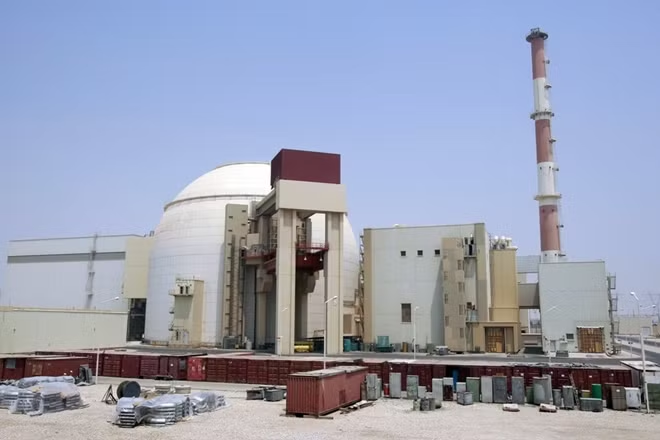
The threats to ramp up enrichment, made by Tehran’s nuclear agency spokesman, would go far beyond the small steps Iran has taken in the past week to nudge stocks of fissile material just beyond limits in the pact that Washington abandoned last year.
They would reverse the major achievements of the agreement, intended to block Iran from making a nuclear weapon, and raise serious questions about whether the accord is still viable.
Iran omitted important details about how far it might go to returning to the status quo before the pact, when Western experts believed it could build a bomb within months.
But Major General Hossein Salami, the head of the Revolutionary Guards, denied Iran was pursuing a nuclear weapon.
“Why do they globally sanction us about the nuclear issue when the world knows that we are not pursuing a weapon? In reality they are sanctioning us because of knowledge,” Salami was quoted as saying by the semi-official Tasnim news agency.
“Nuclear weapons have no place in Islam. Islam never approves of weapons of mass destruction,” he added.
Despite the Iranian threat to boost enrichment, the United States said its renewed sanctions against Tehran were working and warned Iranian leaders not to underestimate U.S. resolve.
“President Trump’s maximum pressure campaign against Iran is working,” White House national security adviser John Bolton told a pro-Israel group in Washington. “We’re just getting started. ... The president’s goal is to get a new deal that would be negotiated in the best interests of the United States.”
U.S. Vice President Mike Pence, who spoke to the same group, added a warning: “Iran should not confuse American restraint with a lack of American resolve,” reiterating Washington’s resolve to protect U.S. personnel and citizens in the Middle East.
Nuclear diplomacy is one aspect of a wider confrontation between Washington and Tehran that has threatened to spiral into open conflict since the United States tightened sanctions from May.
Behrouz Kamalvandi, spokesman for Iran’s Atomic Energy Organisation (IAEA), confirmed that Tehran had enriched uranium beyond the 2015 deal’s limit of 3.67% purity, passing 4.5%, according to news agency ISNA.
The IAEA - the U.N. nuclear watchdog - confirmed it had verified Iran’s enrichment was beyond 3.67%.
Iran has said it will take another, third step away from the deal within 60 days. Kamalvandi said options included enriching uranium to 20% purity or beyond, and restarting IR-2 M centrifuges dismantled under the deal.
Such threats put new pressure on European countries, which insist Iran must continue to comply with the agreement even though the United States is no longer doing so.
French President Emmanuel Macron was sending his top diplomatic advisor to Iran on Tuesday and Wednesday to try to help defuse tensions, a presidential official said. The White House said Trump had spoken to Macron on Monday to discuss efforts to ensure Iran does not obtain a nuclear weapon.