Leading Republicans, Democrats reject Trump's Obama wiretap assertion

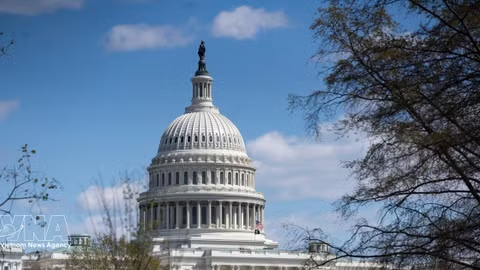
The leaders of the U.S. Senate Intelligence Committee issued a bipartisan statement on Thursday rejecting President Donald Trump's assertion that the Obama administration tapped his phones during the 2016 presidential campaign.

The top Republican in Congress, House of Representatives Speaker Paul Ryan, added his voice to a growing chorus of lawmakers saying there was no sign of a wiretap.

In a testy briefing with reporters, White House spokesman Sean Spicer forcefully defended the president, citing news reports of intelligence collection on possible contacts between Trump associates and Russia in the presidential campaign.
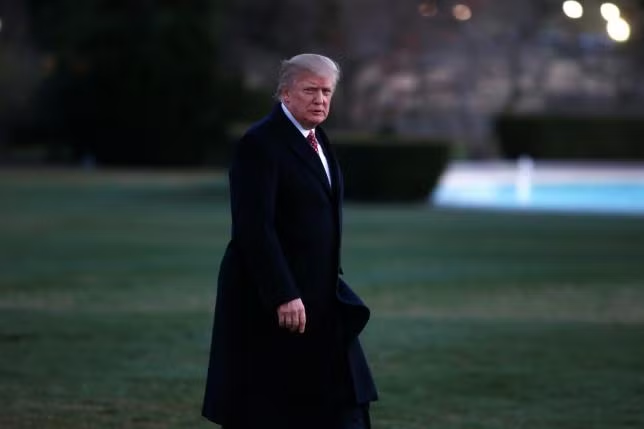
U.S. President Donald Trump walks from Marine One as he returns to the White House in Washington. REUTERS/Joshua Roberts

"There is no question that there were surveillance techniques used throughout this," Spicer said.

The Republican president, without providing evidence, has accused his predecessor, Democrat Barack Obama, of wiretapping him near the end of the campaign. An Obama spokesman said that was "simply false."

"Based on the information available to us, we see no indications that Trump Tower was the subject of surveillance by any element of the United States government either before or after Election Day 2016," Richard Burr, the Republican chairman of the Senate Intelligence Committee, and Senator Mark Warner, the committee's Democratic vice chairman, said in a statement.

Ryan also said there was no evidence of surveillance.

"The point is, the intelligence committees in their continuing, widening, ongoing investigation of all things Russia, got to the bottom - at least so far - with respect to our intelligence community that - that no such wiretap existed," the House speaker told reporters.
Reuters

Other News

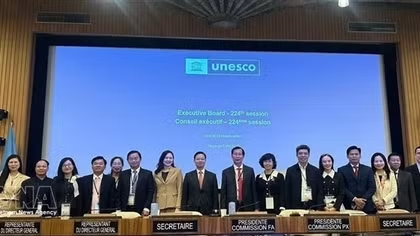
Vietnam supports UNESCO's people-centred approach, multilateral cooperation: official

Vietnam supports UNESCO's people-centred approach, multilateral cooperation: official

Van affirmed Vietnam’s support for the UNESCO80 reform roadmap, focusing on the organisation’s core mandate, priority areas, interdisciplinary approach, and the special status of the Vietnam National Commission for UNESCO, and UNESCO representative offices, alongside efforts to diversify resources and strengthen global partnerships to enhance the organisation’s effectiveness.

Regional media highlight significant step in Vietnam’s leadership structure

Regional media highlight significant step in Vietnam’s leadership structure

Under General Secretary and President Lam’s leadership, Vietnam is expected to maintain a balanced foreign policy, strengthen its regional standing and accelerate economic development, thereby improving living standards and creating new opportunities for international investors, according to the India-based platform Devdiscourse.

Laos identifies 10 key tasks to build independent, self-reliant economy

Laos identifies 10 key tasks to build independent, self-reliant economy

Laos will step up agricultural production to ensure food security, meet domestic demand and expand exports; encourage the development of agro-processing industries, including those related to rubber, aquatic products, cassava and sugarcane, as well as fertiliser and animal feed production, in order to increase added value and create jobs in rural areas.

Malaysia steps up cyber security resilience

Malaysia steps up cyber security resilience

To ensure accountability, Malaysia plans to finalise the Cybercrime Bill this year which addresses both cyber-dependent and cyber-enabled offences, introducing stricter penalties and prison terms to enhance deterrence.

US public opinion positive about PM Pham Minh Chinh’s visit

US public opinion positive about PM Pham Minh Chinh’s visit

Public opinion in the US is generally positive about Vietnamese Prime Minister Pham Minh Chinh’s trip to the US from September 17-23 to attend the 78th session of the United Nations General Assembly, which took place immediately after the upgrading of the Vietnam - US relations to a comprehensive strategic partnership on the occasion of US President Joe Biden’s official visit to Vietnam.