Let down by U.S., Syrian Kurdish leaders look to Russia and Assad

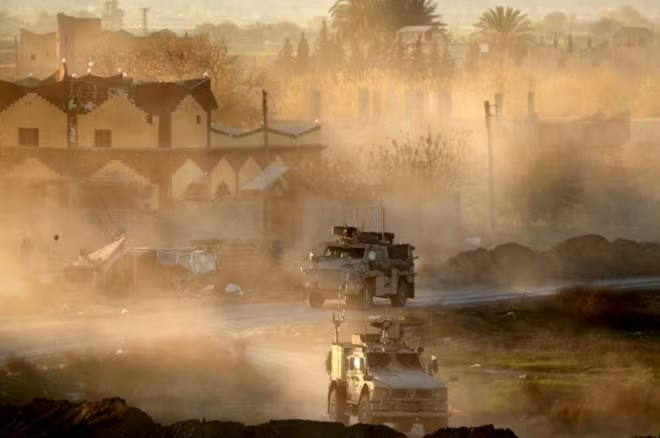
Alarmed by a U.S. decision to leave Syria, Kurdish leaders who run much of the north are urging Russia and its ally Damascus to send forces to shield the border from the threat of a Turkish offensive.

Their call for a return of Syrian government forces to the border, which Kurdish fighters have held for years, points to the depth of their crisis in the wake of U.S. President Donald Trump’s abrupt decision to withdraw forces.
Let down by U.S., Syrian Kurdish leaders look to Russia and Assad ảnh 1
Let down by U.S., Syrian Kurdish leaders look to Russia and Assad

While little has changed on the ground yet - U.S. forces are still deployed and Trump says the pullout will be slow - Kurdish officials are scrambling for a strategy to protect their region from Turkey before the United States leaves.

Talks with Damascus and Moscow appear to be the focus for the Kurdish leadership. Their worst fear is a repeat of a Turkish attack that drove Kurdish residents and the YPG militia out of Afrin city in the northwest earlier this year.

They are also trying to convince other Western countries to fill the vacuum when Washington withdraws some 2,000 troops whose presence in northern and eastern Syria has deterred Turkey so far.

The territory at stake spans about a quarter of Syria, most of it east of the Euphrates River, controlled by the Syrian Democratic Forces (SDF), an umbrella group dominated by the Kurdish YPG. The area borders Iraq to the east and includes three major cities - Qamishli, Hasaka and Raqqa.

The SDF has been Washington’s main Syrian partner in the fight with Islamic State, but Turkey views the YPG fighters that form its backbone as a threat and has vowed to crush them.

Officials from northern Syria, who went to Moscow last week, will soon make another trip, hoping Russia will push Damascus to “fulfill its sovereign duty”, top Kurdish politician Aldar Xelil told Reuters.

“Our contacts with Russia, and the regime, are to look for clear mechanisms to protect the northern border,” said Xelil, an architect of autonomy plans in northern Syria. “We want Russia to play an important role to achieve stability.”
Reuters

Other News

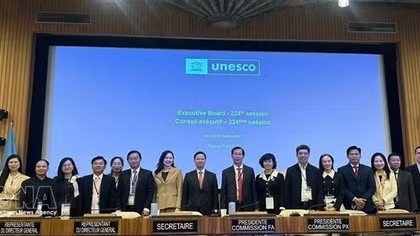
Vietnam supports UNESCO's people-centred approach, multilateral cooperation: official

Vietnam supports UNESCO's people-centred approach, multilateral cooperation: official

Van affirmed Vietnam’s support for the UNESCO80 reform roadmap, focusing on the organisation’s core mandate, priority areas, interdisciplinary approach, and the special status of the Vietnam National Commission for UNESCO, and UNESCO representative offices, alongside efforts to diversify resources and strengthen global partnerships to enhance the organisation’s effectiveness.

Regional media highlight significant step in Vietnam’s leadership structure

Regional media highlight significant step in Vietnam’s leadership structure

Under General Secretary and President Lam’s leadership, Vietnam is expected to maintain a balanced foreign policy, strengthen its regional standing and accelerate economic development, thereby improving living standards and creating new opportunities for international investors, according to the India-based platform Devdiscourse.

Laos identifies 10 key tasks to build independent, self-reliant economy

Laos identifies 10 key tasks to build independent, self-reliant economy

Laos will step up agricultural production to ensure food security, meet domestic demand and expand exports; encourage the development of agro-processing industries, including those related to rubber, aquatic products, cassava and sugarcane, as well as fertiliser and animal feed production, in order to increase added value and create jobs in rural areas.

Malaysia steps up cyber security resilience

Malaysia steps up cyber security resilience

To ensure accountability, Malaysia plans to finalise the Cybercrime Bill this year which addresses both cyber-dependent and cyber-enabled offences, introducing stricter penalties and prison terms to enhance deterrence.

US public opinion positive about PM Pham Minh Chinh’s visit

US public opinion positive about PM Pham Minh Chinh’s visit

Public opinion in the US is generally positive about Vietnamese Prime Minister Pham Minh Chinh’s trip to the US from September 17-23 to attend the 78th session of the United Nations General Assembly, which took place immediately after the upgrading of the Vietnam - US relations to a comprehensive strategic partnership on the occasion of US President Joe Biden’s official visit to Vietnam.