- Israel supports stronger defence ties with Vietnam
- Netanyahu pledges to promote 'responsible policies' at Trump meeting
- Israel to re-assess U.N. ties after settlement resolution, says Netanyahu
In the first face-to-face meeting between the two leaders since Trump’s victory in the 2016 election, the Republican president backed away from a U.S. embrace of the eventual creation of a Palestinian state, upending a position taken by successive administrations and the international community.
"I'm looking at two states and one state, and I like the one both parties like," Trump told a joint news conference with Netanyahu. "I can live with either one."
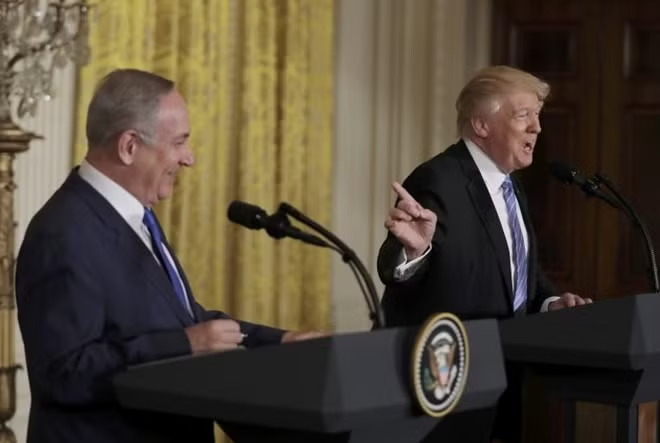 |
| U.S. President Donald Trump (R) laughs with Israeli Prime Minister Benjamin Netanyahu at a joint news conference at the White House in Washington, U.S., February 15, 2017. REUTERS/Kevin Lamarque |
Trump vowed to work toward a peace deal between Israel and Palestinians but said it would require compromise on both sides, leaving it up to the parties themselves ultimately to decide on the terms of any agreement.
But he offered no new prescription for achieving an accord that has eluded so many of his predecessors, and Palestinian anger over his abandonment of their goal of statehood could scrap any chance of coaxing them back to the negotiating table.
Dropping a bombshell on Netanyahu as they faced reporters just before sitting down for talks, Trump told him: “I'd like to see you hold back on settlements for a little bit.”
The right-wing Israeli leader appeared momentarily startled. It was a rare concession sought by Trump as the two leaders tried to set a new positive tone after eight years of friction under Trump's Democratic predecessor, President Barack Obama.
Netanyahu insisted that Jewish settlements were “not the core of the conflict” and made no public commitment to reduce settlement building in the occupied West Bank. He later told reporters traveling with him that he hoped to "reach an understanding" with Trump on settlements.
Trump echoed Netanyahu’s calls for Palestinians to recognize Israel as a Jewish state – something they have refused to do – and to halt incitement against Israelis.
But even as Trump promised to pursue peace, saying "it might be a bigger and better deal than people in this room even understand," he made no effort to address the deep distrust and other obstacles that have prevented any substantive negotiations since 2014.
Setting an initially chummy tone, Trump greeted Netanyahu on a red carpet rolled out to the White House driveway. The two leaders smiled, shook hands and chatted amiably before heading inside, accompanied by first lady Melania Trump and Netanyahu’s wife, Sara.
Among the questions that figured prominently on the agenda was the future of the two-state solution – the idea of creating a Palestine living peacefully alongside Israel.
Foreshadowing Trump’s policy shift, a senior White House official said on Tuesday that peace did not necessarily have to entail Palestinian statehood. Palestinians responded by warning Trump that such a move would seriously damage U.S. credibility.
Giving a meandering response to a question on the issue, Trump suggested that he could abide by whatever path the two sides decided. "I'm happy with the one they like the best," he said.
Palestinian President Mahmoud Abbas seized on Trump's settlements comment to demand a complete halt to such building - which Palestinians see as meant to deny them a viable state - and said he remained committed to "the two-state solution and to international law."
United Nations Secretary-General Antonio Guterres warned against abandoning the idea of a sovereign Palestinian state alongside Israel, saying there was "no alternative."
Netanyahu committed, with conditions, to the two-state goal in a speech in 2009 and has broadly reiterated the aim since. But he has also spoken of a "state minus" option, suggesting he could offer the Palestinians deep-seated autonomy and the trappings of statehood without full sovereignty.