The CDU (Christian Democratic Union) and its Bavarian sister party the CSU (Social Christian Union) together scored 33 percent of the vote to win a plurality in the election.
However, in terms of historical perspective, the CDU/CSU alliance sank to an all-time low since 1949. Four years ago, it produced a far more convincing result with 41.5 percent of the vote.
The SPD (Social Democratic Party) came in second with 20.5 percent, its worst post-war performance as well.
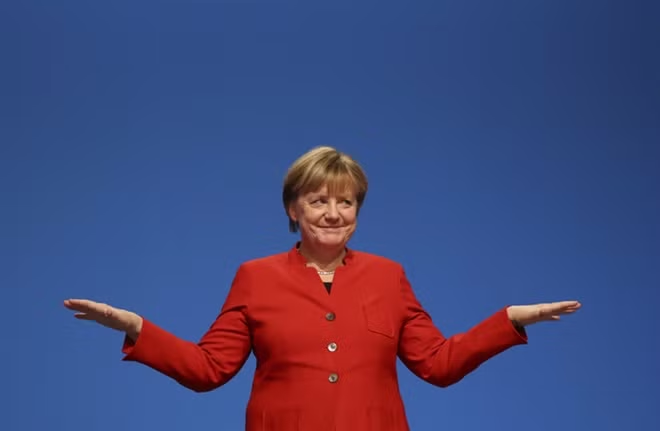 |
| The right-wing Alternative for Germany (AfD) party entered parliament for the first time in its history with 12.6 percent of the vote in the German election, according to final results. Angela Merkel’s CDU, allied with Bavaria’s CSU, won with 33 percent. |
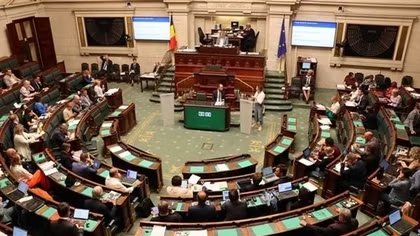
The newly elected German parliament will see a significant expansion, from 631 seats in 2013 to 709 in the next legislature, according to the estimates published by the official electoral authority. Merkel’s CDU (Christian Democratic Union) will keep 200 seats, 55 fewer than it had previously. Its Bavarian ally, the CSU (Christian Social Union), lost 10 seats, taking 46.
The centrist SPD (Social Democratic Party) has also lost ground and will take 153 seats, as opposed to 193 in the outgoing legislature. The right-wing Alternative for Germany (AfD) is entering parliament for the first time with 94 deputies, while the FDP is making its return with 80.
A total of 69 seats went to The Left party, and 67 to Alliance 90/The Greens party.
Some Germans seemed to be uncomfortable about Merkel’s fourth victory in a row. They told Ruptly news agency that the country needs “change” following so many years of what they described as a “stalemate.”
“Politicians, our Chancellor, she is pretty good on the one hand, on the other hand she’s had 12 years in office now and so I think this is definitely time for a change to have fresh power, even if she is a powerful woman, but we need some fresh people. We need fresh ideas,” one Berlin resident said, adding, “We have kind of a stalemate, you know, [where] nothing is really moving.”
The anti-immigrant party AfD made a breakthrough, commanding 12.6 percent of vote. It is the first time the AfD has secured MPs, with the party failing to enter the legislative body back in 2013.
The party’s political success appears to not sit well with some Germans either.
“It's ridiculous, if you think about it, in my opinion it's a country that started two world wars,” a young man told Ruptly, commenting on the AfD election result.
“There's no guilt but there's always responsibility, and now we're going to have 90, I think it's up to 90, well I say openly racist people, in the Bundestag. And that's a shame for this country in my opinion,"he added.
The current elections appear to have ended in failure for the Social Democrats (SPD), who only gained around 20 percent of the vote, their lowest return in the last 20 years.
However, even their losses look like turning out to be smaller than those of Merkel’s CDU, as the SPD lost 5.5 percent of votes compared to the last parliamentary polls, while for the CDU this figure amounts to as much as around 9 percent.
The SPD leader, Martin Schulz, meanwhile admitted defeat and announced that it was a “bitter day” for his party.
Following the publication of the exit poll results, Merkel gave a speech vowing to win back voters from the AfD.
Merkel also said that her party now has two coalition options, naming a potential coalition with the Social Democrats as one of them and giving no details about the second option.
At the same time, the leader of the Social Democrats, Martin Schulz, announced that his party had decided to “go into opposition” to prevent the AfD from leading the opposition in the parliament, thus ruling out a potential coalition with Merkel’s CDU.
The leader of the Free Democrats, Christian Lindner, criticized the Social Democrats for their decision and said that his party would not be dragged into the coalition by the simple fact that the SPD refused to join it. However, he said that the FDP is open to any coalition talks.
The position of the Greens concerning any future coalition options remains somewhat controversial as one of their leaders, Cem Ozdemir ruled out any potential coalition with Angela Merkel’s CDU and the Free Democrats by saying that his party would not take part in what he called "anti-European populism” while the second leader, Katrin Goering-Eckardt, did not rule out such a coalition by saying that the party would see “if there can be cooperation.”
The elections were successful for the Free Democrats (FDP), who will now enter parliament with 10.5 percent support. Back in 2013, the party failed to clear the 5-percent threshold and did not enter the Bundestag.
Crowds of people have in the meantime gathered in front of the AfD HQ in Berlin, carrying banners reading “Racism kills”and chanting “Go away.”
Established in 2013 as a Euroskeptic party, the AfD became increasingly popular during the 2015 refugee crisis as it hijacked the anti-immigrant and anti-Islamist agenda, emerging as a right-wing populist force.
However, it also provoked discontent among a significant section of German society, with the provocative statements of its members leading to the party being repeatedly accused of Nazi sympathies – something that its leaders have always denied, instead portraying themselves as “concerned citizens.”