- Saigon Classical to stage Passionato concert
- U.S. Senate to vote on Montenegro's NATO membership
- U.S reverses course and offers new dates for NATO talks
Rex Tillerson arrived in Brussels to an expectant crowd of NATO foreign ministers, who eagerly waited to hear the US approach to maintaining the future of the alliance. Besides urging NATO members to contribute 2 percent of their GDP on collective defense, the US's top diplomat reassured colleagues that Washington will back NATO against Russia.
During his debut speech, the newly appointed US Secretary of State also emphasized that the United States is committed to supporting NATO’s capabilities in the collective defense. Separately, Tillerson also met with the NATO-Ukraine Commission, where he promised to maintain the Russian sanctions.
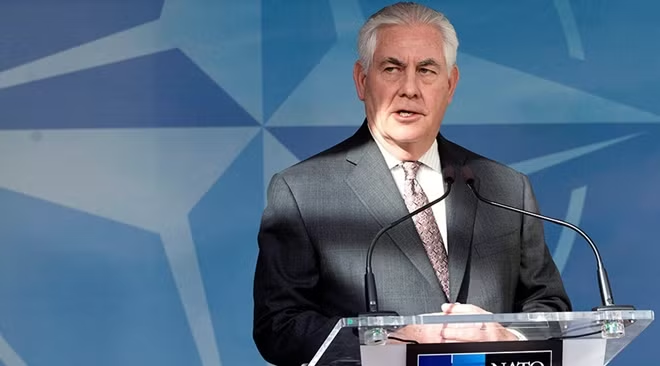 |
| US Secretary of State Rex Tillerson © Virginia Mayo / Reuters |
During his debut speech, the newly appointed US Secretary of State also emphasized that the United States is committed to supporting NATO’s capabilities in the collective defense. Separately, Tillerson also met with the NATO-Ukraine Commission, where he promised to maintain the Russian sanctions.
Tillerson's remarks prompted a strong reaction from the Russian Foreign Ministry, which said it was “baffled” by the Secretary’s rhetoric, especially considering the timing of the remarks which came a day after the ambassadorial meeting of the Russia-NATO Council – the first such contacts in almost three years.
“They always have one thing on their mind: the ‘Russian threat’ myth, ‘Russian aggression’ slander and endless mantras about the need to confront it collectively,” the Ministry said.
The ministry expressed disappointment that NATO decided to perform the traditional anti-Russia “ritual dance” a day after Secretary-General Jens Stoltenberg called the talks with Moscow “frank” and “constructive.”
During the meeting in Brussels, NATO members agreed on a “dual track approach” to Russia. Such an approach, according to Stoltenberg, means maintaining a “strong NATO” with “credible deterrence and defense as a platform for engaging with Russia in a political dialogue.”
Stoltenberg acknowledged during the press conference on Friday that the military alliance “implemented the biggest re-enforcement to our collected defense since the end of the Cold War,” by “tripling” the size of the NATO response force in Europe, which saw the deployment of four battle groups to Poland and the Baltic countries.
“We have established eight new headquarters in the eastern part of the Alliance and we are increasing defense spending. So, we are delivering on deterrence and defense, the strength pillar,” said the Norwegian.
Commenting on the two-tier approach, Moscow said that it's essentially being forced to assume a confrontational stance in relations with NATO.
“We have a legitimate question: can we expect any constructive approaches in the Russian-NATO relations when the alliance is stubbornly sticking to its old patterns, when the United States and its allies are obsessed with building up their military presence at our borders justifying it with the necessity of ‘containing Russia’?,” the ministry noted.
“In fact, we are being drawn into a confrontational paradigm of relations based on the logic of military confrontation,” the ministry said.
Furthermore, the ministry noted that it sees “no signs” that NATO is willing to resume practical cooperation in areas where common interests overlap, such as security challenges and terrorist threats.
The foreign ministry statement summarized all the Russian concerns voiced on Thursday leading up to and following the NATO-Russia Council meeting, where the issues of Ukraine, NATO's military buildup, and wider European security were discussed.
Moscow, for instance, briefed NATO on the deployment of two divisions in the Western Military District in addition to a mechanized infantry division in the Southern Military District. NATO for its part provided information on the implementation of the plan concerning the forward deployment on NATO’s eastern flank.
Last month, NATO member nations also agreed to expand the alliance’s presence in the Black Sea. At the same time, apart from deploying troops to Eastern Europe and Poland, the US and NATO have actively built up anti-ballistic missile (ABM) systems in Europe and on warships patrolling Russia’s borders.
Moscow’s envoy to NATO insisted that building bilateral confidence in such an environment is not possible until the alliance stops threatening and drops its policy of restraining Russia.
“It is not possible to build confidence until NATO abandons its military domination policy,” Russia’s Permanent Representative to NATO Alexander Grushko said on Thursday, according to TASS.
NATO members “were unable to answer the question how to combine that [security confidence-building measures] with their policy aimed at restraining Russia and demonstrating their military capabilities near our borders,” the envoy said.
“Dialogue for the sake of dialogue will not produce any results if no specific decisions are made and no steps are taken,” he added.
Prior to the meeting, Russia’s Foreign Minister Sergey Lavrov warned that Brussels might use the Council’s platform to engage in confrontational games with Moscow.
“However, if our counterparts in the alliance tell us every time, ‘Yes, we will gather in the NATO-Russia Council, but we will only discuss Ukraine,’ that will be a continuation of this paranoid aggressive policy. NATO has nothing to do with efforts on the Ukrainian settlement,” Lavrov said according to TASS. “If the essence of these ideas is using the NATO-Russia Council for another confrontation, we do not want to indulge in such games.”