- Covert Gov't Report Reveals Brexit to Hurt UK Regardless of Scenarios
- Challenged on all fronts, May faces pressure over Brexit law
- If the EU Fails to Clinch Brexit Deal Soon, 'UK May Just Walk Away' - Scholar
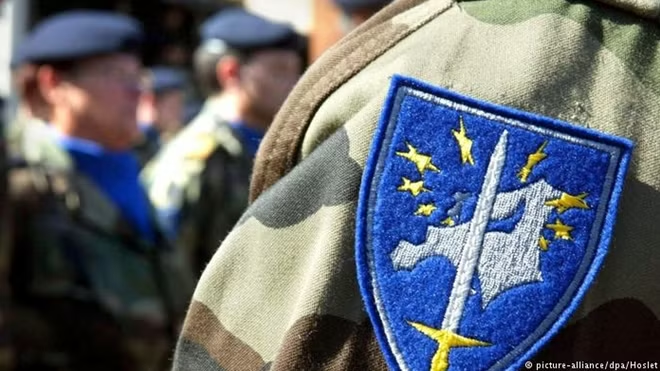
European leaders appear to agree on the need for a common EU security policy. At the Munich Security Conference, ministers and senior officials from across the continent offered their proposals and visions to secure the bloc in an ever more insecure world.
But the variety of proposals raises questions about whether their leaders agree enough on the bloc's basic security priorities to be able to establish a common policy.
 |
German Foreign Minister Sigmar Gabriel seemed to acknowledge this when he said the EU not only needed to develop joint foreign policy tools, but also needed to "generate internal cohesion” on common interests.
But how can cohesion be achieved when countries define security challenges so differently and prioritize their own national interests?
Borders or 'root causes'?
Comments by Austrian Prime Minister Sebastian Kurz and French Prime Minister Edouard Philippe on irregular migration were emblematic of this basic problem.
For Kurz, securing the EU's external borders and stopping irregular migration is a top priority. It represents an apparent existential threat to what Kurz sees as Austria's as well as Europe's cultural heritage.
The EU, Kurz said, needs to focus on "that which defines us — a Europe characterized by its Judeo-Christian and Enlightenment heritage in which the foundational rights such as the rule of law, democracy and human rights are not up for negotiation."
"Sometimes it feels like we took a wrong turn somewhere," said Kurz. "Without proper protection of external borders, internal borders are in danger."
But for French Prime Minister Edouard Philippe, the EU shouldn't develop a common security policy based on short-term goals targeting irregular migration. Instead, the EU must address the "root causes” of its security risks, including migration.
The "threats to European security" go beyond questions of defense or law enforcement, Philippe said, noting that France was prioritizing major aid and investment projects in Africa to tackle growing migration from the continent to Europe.
"Europe needs to get used to interdependencies," Philippe said. "We feel the tensions in the world."
A more holistic approach is needed
European leaders of course need to look beyond border security — and their differences on how to best manage people trying to cross its external border — as they attempt to define a common European security policy.
A comprehensive strategy would be holistic, looking at a host of common threats such as election-influencing operations, radicalization, or terrorism as well as irregular migration. Stress would also be placed on how risks are interconnected and how they have knock-on effects that threaten the bloc's very integrity.
A truly holistic security policy would be centered on the concerns of EU citizens, thereby bolstering the bloc's popular legitimacy across the continent. A lack of legitimacy is in its own way a security risk as evidenced by Brexit — a transformative decision based on a popular vote.
The EU in this vision would not only try to protect its power and its territory, but also protect the values its citizens hold dearest.
But as this year's Munich Security Conference has indicated, we may be a long way off such a fully-fledged "security union."