Muslim population in Europe to triple by 2050, even with ‘zero migration'

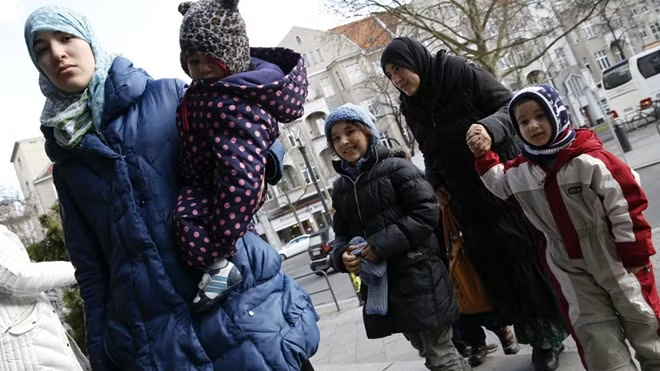
Europe’s Muslim population will multiply even if all migration stops permanently, a study has found. On the other hand, high migration sees predictions of some 76 million Muslims dwelling in Europe by 2050.

A revealing survey by Pew Research Center, ‘Europe’s Growing Muslim Population’, looks at the future of the 25.8 million Muslims currently residing in European countries. Citing a comprehensive swath of data, it is an attempt to see how the size of Europe’s Muslim population may change in the coming decades, depending on levels of migration.
Muslim population in Europe to triple by 2050, even with ‘zero migration' ảnh 1
Muslim population in Europe to triple by 2050, even with ‘zero migration'

All three scenarios – zero, moderate and high – considered by researchers produced a thought-provoking outcome: the number of Muslims in Europe will rise at any rate of migration, as they are younger and “have higher fertility (one child more per woman, on average) than other Europeans, mirroring a global pattern.”

Under a first, “zero migration” scenario, the Muslim population of Europe still would be expected to rise from the current level of 4.9 percent to 7.4 percent (roughly 36 million) by the year 2050 even “if all migration into Europe were to immediately and permanently stop.”

A second, “medium” migration scenario assumes that the flows of refugees stop, but “regular” migrants continue to come for reasons other than fleeing wars and instability. Under these conditions, Muslims could comprise 11.2 percent (59 million) of Europe’s population in 2050.

A third, “high” migration scenario, in which the heavy influx of predominantly Muslim migrants recorded between 2014 and 2016 continues indefinitely, paints a far more pessimistic picture. In this case, Muslims could make up 14 percent (75 million) of Europe’s population by 2050 – nearly triple the current figure.

Should that happen, several major European countries are expected to shoulder most of the burden. In Sweden, nearly a third of the population (4.5 million, or 30 percent) would be Muslims, whereas in Austria and Germany Muslims would represent up to 19 percent of the population.

Also, if high migration continues until 2050, Britain’s Muslim share will grow to 17.2 percent, Finland’s to 15 percent and Norway’s to 17 percent.

RT

Other News

Vietnam supports UNESCO's people-centred approach, multilateral cooperation: official

Vietnam supports UNESCO's people-centred approach, multilateral cooperation: official

Van affirmed Vietnam’s support for the UNESCO80 reform roadmap, focusing on the organisation’s core mandate, priority areas, interdisciplinary approach, and the special status of the Vietnam National Commission for UNESCO, and UNESCO representative offices, alongside efforts to diversify resources and strengthen global partnerships to enhance the organisation’s effectiveness.

Regional media highlight significant step in Vietnam’s leadership structure

Regional media highlight significant step in Vietnam’s leadership structure

Under General Secretary and President Lam’s leadership, Vietnam is expected to maintain a balanced foreign policy, strengthen its regional standing and accelerate economic development, thereby improving living standards and creating new opportunities for international investors, according to the India-based platform Devdiscourse.

Laos identifies 10 key tasks to build independent, self-reliant economy

Laos identifies 10 key tasks to build independent, self-reliant economy

Laos will step up agricultural production to ensure food security, meet domestic demand and expand exports; encourage the development of agro-processing industries, including those related to rubber, aquatic products, cassava and sugarcane, as well as fertiliser and animal feed production, in order to increase added value and create jobs in rural areas.

Malaysia steps up cyber security resilience

Malaysia steps up cyber security resilience

To ensure accountability, Malaysia plans to finalise the Cybercrime Bill this year which addresses both cyber-dependent and cyber-enabled offences, introducing stricter penalties and prison terms to enhance deterrence.

US public opinion positive about PM Pham Minh Chinh’s visit

US public opinion positive about PM Pham Minh Chinh’s visit

Public opinion in the US is generally positive about Vietnamese Prime Minister Pham Minh Chinh’s trip to the US from September 17-23 to attend the 78th session of the United Nations General Assembly, which took place immediately after the upgrading of the Vietnam - US relations to a comprehensive strategic partnership on the occasion of US President Joe Biden’s official visit to Vietnam.