 |
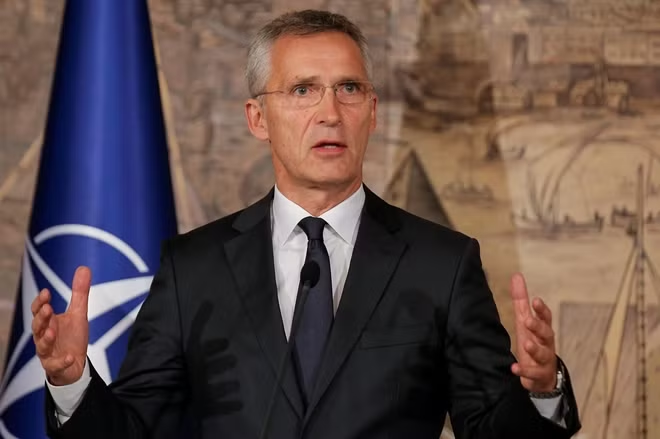
| NATO Secretary-General Jens Stoltenberg attends a news conference in Istanbul, Turkey, October 11, 2019. REUTERS/Huseyin Aldemir |
Splits in the military alliance have emerged after NATO member Turkey began its offensive in Syria last week, with the governments of EU countries that are also NATO members suspending weapon sales to Turkey.
Appearing in London at a plenary session of the NATO Parliamentary Assembly, a body made up of delegates from the legislatures of member states, Stoltenberg said he had expressed deep concerns to Turkish President Tayyip Erdogan when he saw him in Istanbul on Friday.
Stoltenberg said he had told Erdogan and his foreign minister, Mevlut Cavusoglu, that Turkey’s military operations in northern Syria risked further destabilizing the region, escalating tensions and causing more human suffering.
“I expect Turkey to act with restraint and in coordination with other allies so that we can preserve the gains we have made against our common enemy, Daesh (Islamic State),” he said, adding that one imminent concern was that captive fighters from the jihadist group should not be allowed to escape.
But during a question-and-answer session after his speech, Stoltenberg faced robust remarks from several delegates, particularly those from France and Belgium, both countries where deadly attacks linked to Islamic State have taken place.
Christian Cambon, a member of the French Senate, said the situation was unacceptable and suggested that Stoltenberg was being too soft on Turkey.
“We were surprised by the tone of your statement in Istanbul, I have to tell you. Was that in consultation with our great American ally?” Cambon asked, to applause from some of the other delegates.
He was referring to President Donald Trump’s abrupt decision to pull U.S. troops out of northeastern Syria, which was the catalyst for the Turkish offensive. Ankara views the YPG Kurdish militia in northern Syria as terrorists linked to a Kurdish insurgency being waged inside Turkey.
TURKEY’S ROLE
U.S. and Kurdish troops previously fought together against the Islamic State, and the Kurds have accused Trump of stabbing them in the back.
Cambon called on the North Atlantic Council, NATO’s main decision-making body, to convene. He said it should “speak loudly and clearly in defense of the values of democracy and peace that characterize NATO’s work”.
In response, Stoltenberg reiterated that he had expressed his deep concerns during his meetings in Istanbul.
“The only way you can understand what is going on there is also to understand the important role Turkey has played,” said Stoltenberg, a former Norwegian prime minister.
“Turkey is important for NATO. It has proven important in many ways, not least in the fight against Daesh. We have used, as NATO allies, the global coalition, all of us have used infrastructure in Turkey, bases in Turkey in our operations to defeat Daesh.
“And that’s exactly one of the reasons why I’m concerned about what is going on now. Because we risk undermining the unity we need in the fight against Daesh.”