- New ferry links North Korea and Russia despite U.S. calls for isolation
- North Korea demands handover of suspects in assassination plot: Xinhua
- North Korea detains another American citizen, KCNA reports
- U.S. House approves tighter North Korea sanctions
The North's KCNA news agency said leader Kim Jong Un supervised the test which also verified the functioning of the solid-fuel engine for the Pukguksong-2 missile and ordered it for deployment in field action.
North Korea has defied all calls to rein in its nuclear and missile programs, even from China, its lone major ally, saying the weapons are needed for legitimate self-defense. The North last conducted a ballistic missile test a week ago.
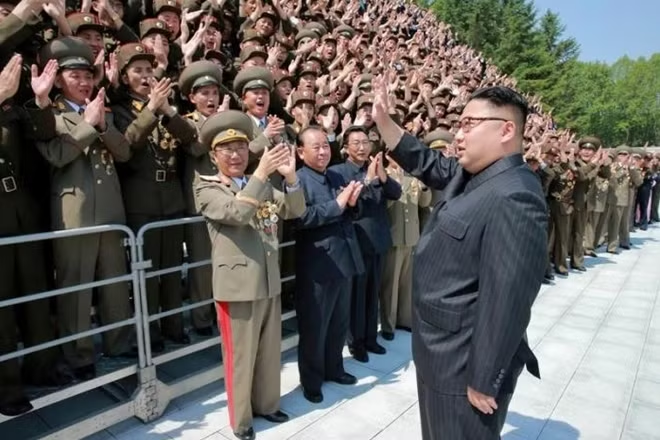 |
| North Korean leader Kim Jong Un waves to North Korean scientists and technicians, who developed missile 'Hwasong-12' in this undated photo released by North Korea's Korean Central News Agency (KCNA) May 20, 2017. KCNA/via REUTERS |
"Saying with pride that the missile's rate of hits is very accurate and Pukguksong-2 is a successful strategic weapon, he approved the deployment of this weapon system for action," KCNA said, quoting leader Kim Jong Un.
The launch verified the reliability and accuracy of the solid-fuel engine's operation and stage separation and the late-stage guidance of the nuclear warhead which was recorded by a device mounted on the warhead, KCNA said.
"Viewing the images of the Earth being sent real-time from the camera mounted on the ballistic missile, Supreme leader Kim Jong Un said it feels grand to look at the Earth from the rocket we launched and the entire world looks so beautiful," KCNA said.
The missile flew about 500 kilometers (310.69 miles), reaching an altitude of 560 km, and landed in waters off the North's east coast, South Korea's military said on Sunday.
The reclusive state has been working to develop a nuclear-tipped missile capable of striking the U.S. mainland. On Saturday, it said it had developed the capability to strike the U.S. mainland, although Western missile experts say the claim is exaggerated.
On Monday, KCNA said the latest test follows the successful test last week of another missile that has put Hawaii and Alaska within range.
Experts say solid fuel engines and mobile launchers make it more difficult to detect signs of launch preparations.
"For military purposes, solid-fueled missiles have the advantage that they have the fuel loaded in them and can be launched quickly after they are moved to a launch site," David Wright, co-director of the Global Security Program at the U.S.-based Union of Concerned Scientists, said in a blog post.
"Building large solid missiles is difficult," he said, adding it took decades for major superpowers such as France and China to go from a medium-range missile to an intercontinental ballistic missile.
"So this is not something that will happen soon, but with time North Korea will be able to do it," Wright said.
An official traveling with U.S. President Donald Trump in Saudi Arabia said the White House was aware of the latest launch and noted that the missile had a shorter range than the three previous missiles that North Korea had tested.
U.S. Secretary of State Rex Tillerson said economic and diplomatic pressure would continue to be applied to North Korea.
The two missile tests in a week complicate plans by South Korea's new President Moon Jae-in to seek ways to reduce tension on the peninsula.
Moon took office on May 10 after winning an election on a platform of a more moderate approach to the North, with which the South is still technically at war since no peace treaty was signed at the end of their 1950-1953 conflict.