- OPCW backs UK findings over nerve agent used in Salisbury poisoning
- Yulia Skripal, poisoned daughter of Russian agent, leaves British hospital
- Russia Expels 23 British Diplomats, Escalating Row Over Ex-Spy’s Poisoning
Two people, this time a British couple in their 40s with no link to Russian intelligence, were affected by a chemical substance on Saturday. Four days later, the UK's counter-terrorism chief said the chemical that hit them was the same that sent former Russian double agent Sergei Skripal and his daughter, Yulia, into a coma in early March.
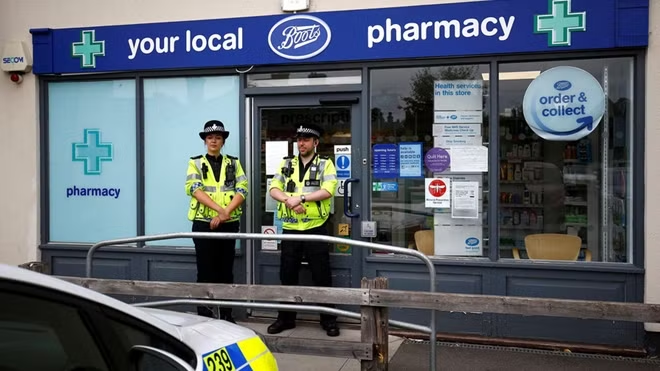 |
| Police officers guard outside a branch of Boots pharmacy in Amesbury, UK © Henry Nicholls / Reuters |
Back then, it took mere hours for the UK government to pin the blame on Moscow and unleash a massive diplomatic offensive together with its allies. Moscow, still waiting for compelling evidence to be produced, has been shut out of the investigation, and it has raised a number of questions about the poisoning – none of which have been answered.
Linking the two poisonings "is clearly a line of enquiry" for UK investigators, but the new incident doesn't look likely to answer any of those concerns either.
Location, location, location
The new victims, 45-year-old Charlie Rowley and his 44-year-old girlfriend Dawn Sturgess were discovered in Amesbury, some 12 km (7 miles) north of Salisbury. Both scenes, though, are located around Porton Down, which houses a secretive government chemical lab.
Porton Down has been a crucial part of the Skripal case investigation. It was there that the chemical agent was identified as Novichok in both cases. Back in March, UK officials cited this as proof that the substance came from Russia – only to later be contradicted by the lab's chief executive, who said they weren't really able to verify the agent's origins.
As for the location of the new scene relative to the old one, 12 km doesn't seem like an improbably large distance. Plus, a friend of the victims said the couple had been to Salisbury before they fell ill. The UK Home Secretary's working theory is that the exposure was accidental, which begs the question: how would that be possible after four months and a massive clean-up operation? Also, why were there only two random people in the whole 12km radius that were affected?
Curious timing
Investigators say it's unclear if the supposed Novichok came from the same batch that poisoned the Skripals in March. But, according to experts, the nerve agents of the Novichok family lose their potency very quickly, which makes it unlikely that a trace powerful enough had survived for four months to strike again at this particular moment.
And the moment is significant for two reasons – two events key to Russia's international image. One is the hugely successful FIFA World Cup, where the English team just secured a quarter-final spot. British fans seem to be enjoying themselves in Russia, and berating British politicians and media for their efforts to scare them away from the event.
The other is the preparations for a summit between US President Donald Trump and Russia's Vladimir Putin. A date and a place for the meeting – Helsinki, Finland, July 16 – were set just last week, and a possible rapprochement between the two rival superpowers seems to be keeping British officials up at night.
Nobody died, again
One of the key questions asked back in March was: why did the Skripals survive if they were indeed exposed to a military-grade nerve agent? While UK officials peddle Novichok as a deadly nerve agent manufactured by the Soviets, claiming its recent use was the first chemical attack in Europe since World War Two, it appears to have a surprisingly low lethality rate.
A friend of the couple described Rowley becoming increasingly ill over the course of the day, before finally being taken to the hospital. There, the supposedly deadly Novichok gave doctors enough time to treat the couple for a completely different diagnosis: the medics initially believed that the couple had taken contaminated drugs (Rowley is a registered heroin addict). Samples from the two were only sent to Porton Down on Monday, two days after they were admitted.
Back in March, the Skripals were similarly discovered slipping in and out of consciousness on a park bench. They were also treated for an opioid overdose at first, before the diagnosis switched to nerve agent poisoning. Both ultimately survived and have now been discharged from the hospital.
Analysts have repeatedly questioned the apparent low lethality of the supposed "military-grade nerve agent." Russian officials, as well, have said that if such a deadly substance had indeed been used, survival would be impossible.
British officials are still investigating the incident. However, this time – now that Novichok has been brought up – they seem less inclined to point fingers, even as England fans frolic in Russia and Theresa May’s handling of Brexit continues to divide the public.