Optimizing UNCLOS 1982 to transform Vietnam into a powerful maritime country

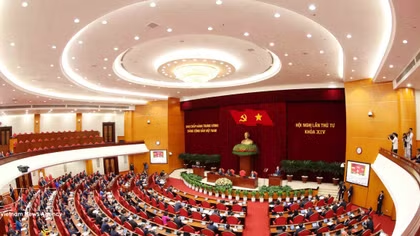
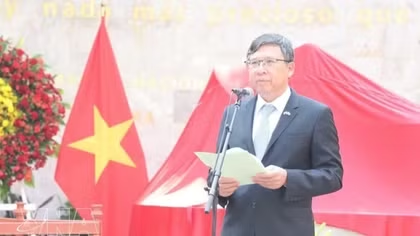
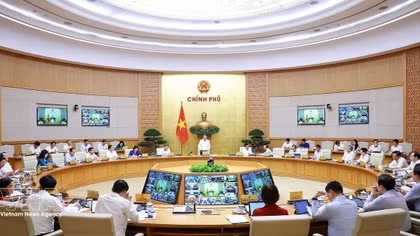
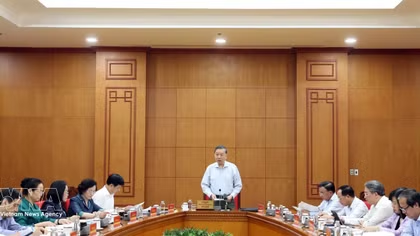
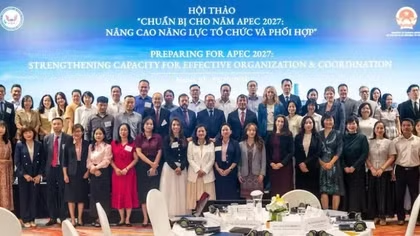
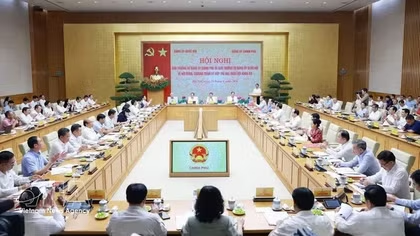
A seminar running theme "Việt Nam – Đất nước nhìn từ biển” (Vietnam - the country seen from the sea) was held recently to celebrate the 40th anniversary of the signing of the 1982 UN Convention on the Law of the Sea (UNCLOS) and ten years of the enforcement of the Law of the Sea of Vietnam.

optimizing unclos 1982 to transform vietnam into a powerful maritime country picture 1

The event was co-hosted by the Commission for Information and Education of the Communist Party of Vietnam (CPV) Central Committee and Vietnam National Assembly Television.

At the seminar, the participants affirmed that December 10, 1982 marked an important legal event in the development of international law, with the birth of a legal document which is considered as the Constitution of the Seas and Oceans- the United Nations Convention on the Law of the Sea 1982 (UNCLOS).

The UNCLOS 1982 came into force on November 16, 1994. Four decades after its birth, the Convention is still valid. To date 167 countries have joined the Convention, of which 164 are members of the United Nations.

The UNCLOS 1982  laid the foundation for establishing a new international order at sea and balancing the interests of all developed and developing nations. It was the first Convention to define all territorial waters in the world.

The Convention is also seen as the charter for the establishment of all major international organizations on the sea such as the International Tribunal for the Law of the Sea (ITLOS), and the Commission on the Limits of the Continental Shelf (CLCS).

In particular, the Convention also provides a mechanism for the settlement of maritime disputes.

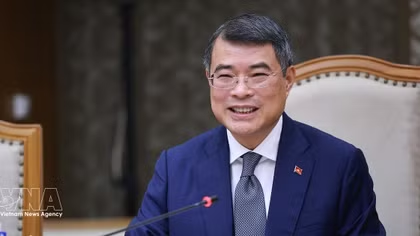
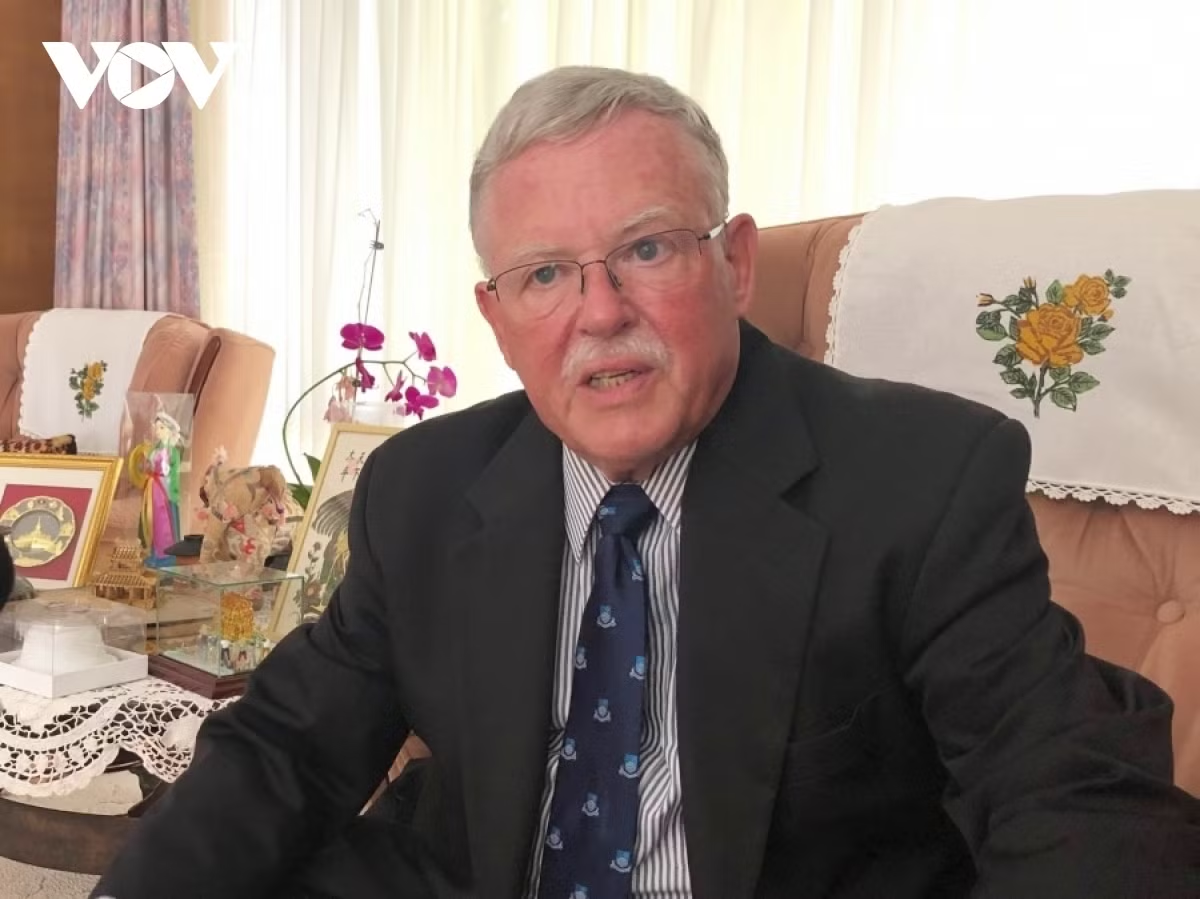
According to Professor Carl Thayer, an expert from Australia’s New South Wales University, the unique feature of UNCLOS is that it has established a compulsory mechanism for dispute settlement.

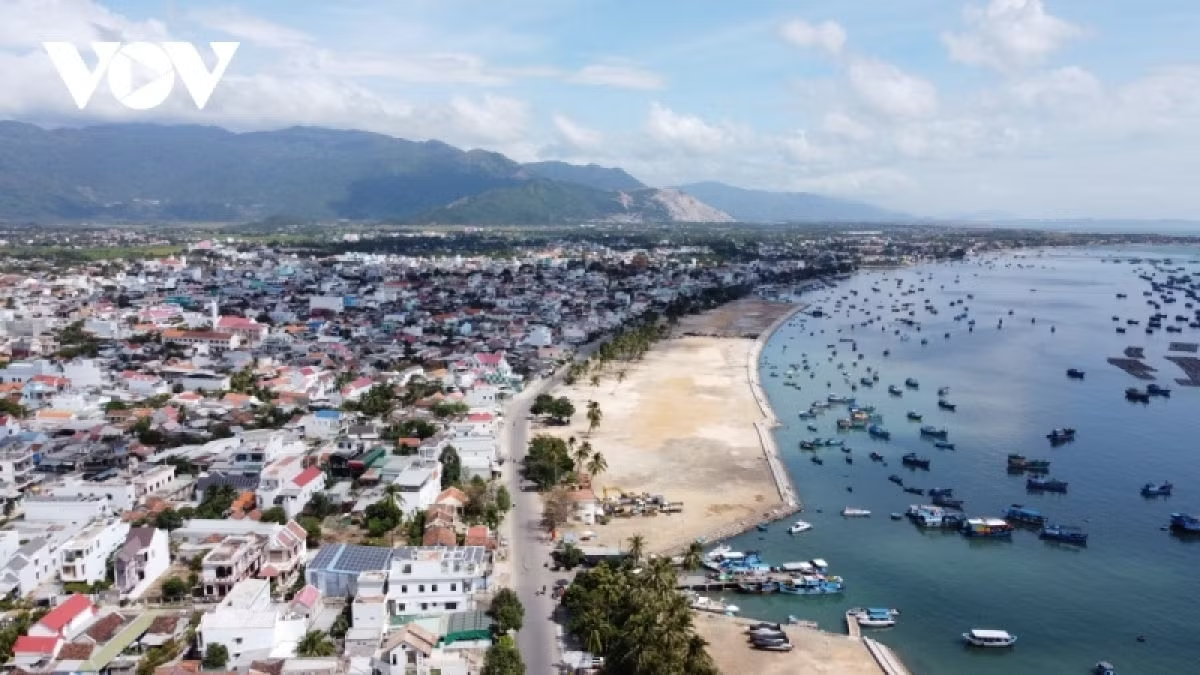
Emphasizing that Vietnam is a maritime country, with a coastline of more than 3,260 km,  and 4,000 large and small islands, including Hoang Sa (Paracel) Truong Sa (Spratly) archipelagos, Associate Professor. Dr. and Ambassador Nguyen Hong Thao,  right after national reunification in 1975, only two years later, Vietnam had dispatched a delegation of officials to attend United Nations conferences on the Law of the Sea and absorb the spirit of the draft document of the UNCLOS 1982.
optimizing unclos 1982 to transform vietnam into a powerful maritime country picture 2

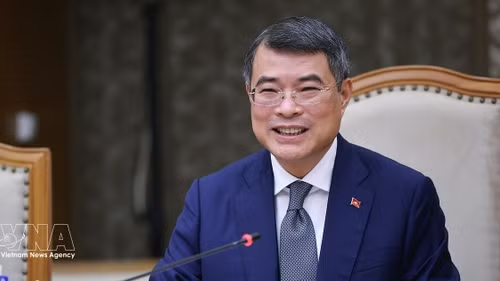
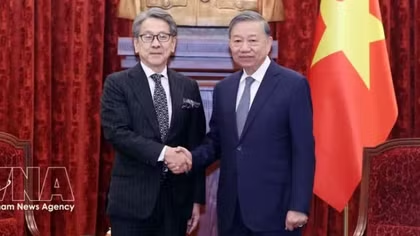
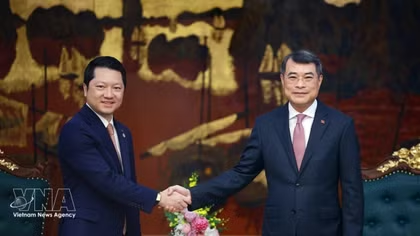
Professor Carl Thayer, an expert from Australia’s New South Wales University

This has contributed to the fact that on May 12, 1977, Vietnam became the first Southeast Asian nation to issue a declaration on the territorial sea, contiguous zone, exclusive economic zone, and continental shelf.  Then, when the nation promulgated the Law of the Sea in 2012, it had more than 500 legal documents at the central and local levels related to State management of seas and islands, Thao said.

After the UNCLOS 1982 was ratified, Vietnam was one of the first 107 countries to sign and soon carry out ratification procedures.

On June 23, 1994, the National Assembly of the Socialist Republic of Vietnam issued a resolution on the ratification of the UNCLOS 1982.

By ratifying the Convention, Vietnam has demonstrated its will to exercise its rights within the limits permitted by the Convention, while taking into account the freedoms of other states.

Regarding the Law of the Sea of Vietnam, the delegates affirmed that becoming a member of the UNCLOS 1982 requires the country to have a separate and comprehensive law on the sea.

In that context, on June 21, 2012, the Law of the Sea of Vietnam was approved by the National Assembly of Vietnam and it took effect from January 1, 2013.

The Law of the Sea of Vietnam is built on the basis of the provisions of UNCLOS and international law. This is viewed as an important milestone in the development of Vietnam's legal system in general, as well as in the process of building and fine-tuning legal regulations related to seas and islands.

During the course of the seminar, the delegates gave their opinions and suggestions for Vietnam to promote the value of the UNCLOS 1982), and the 2012 Law of the Sea of Vietnam in order to realize the goals set by the Eighth Conference of the 12th Party Central Committee on sustainable development of Vietnam's marine economy to 2030, with a vision to 2045.

This is also in line with the Resolution of the 13th National Party Congress, which aims to turn Vietnam into a strong maritime nation by 2030 and a strong maritime nation, with sustainable development, prosperity and security and safety by 2045.

They also emphasized the development of the marine economy, marine tourism closely associated with sustainable protection of the marine environment.

It is essential to clearly identify and invest in key marine economic sectors, and apply the achievements of the 4th Industrial Revolution in developing the marine economy, and protecting national sovereignty at sea, they added.
VOV

Other News

First working day of Party Central Committee's fourth plenum

First working day of Party Central Committee's fourth plenum

Delegates held group discussions on the CPV Central Committee resolution calling for stronger building and rectification towards a clean, strong and comprehensive Party and political system able to meet the country's development needs in the new era.

Key Party leader hosts Hungarian Workers' Party chief

Key Party leader hosts Hungarian Workers' Party chief

The Communist Party of Vietnam always values its solidarity and friendship with the Hungarian Workers' Party and communist and workers' parties worldwide, which helps build political trust and supports Vietnam's relations with other countries, said key Party leader Tran Cam Tu.

14th Party Central Committee convenes fourth plenum

14th Party Central Committee convenes fourth plenum

In his opening remarks, General Secretary and President To Lam said that the 14th National Party Congress set out major orientations and strategic goals, while the second and third plenums adopted important policies on Party building, personnel, development and national defence. The fourth plenum must focus on creating conditions for effective implementation while preparing the theoretical, organisational and human resources foundations for the country’s long-term development.

Panamanian President's Vietnam visit offers new opportunity to deepen bilateral ties

Panamanian President's Vietnam visit offers new opportunity to deepen bilateral ties

Vietnamese Ambassador to Mexico and Panama Nguyen Van Hai noted that the visit is particularly significant as the first high-level exchange between the two countries in nearly 15 years, following then-President Ricardo Martinelli’s visit to Vietnam in 2012, and came shortly after the 50th anniversary of diplomatic relations in 2025.

Vietnam and Panama can become gateways linking two regions

Vietnam and Panama can become gateways linking two regions

"Panama can serve as a strategic platform for Vietnamese companies seeking greater access to Latin America and the Caribbean, while Vietnam represents an important gateway for strengthening Panama’s engagement with Southeast Asia", Ambassador Nubiela Ayala Modes confirmed.

Localities committed to achieving 2026 growth targets

Localities committed to achieving 2026 growth targets

Localities nationwide hailed effective and flexible directions delivered by the Government so far this year, resulting in positive nine-month socio-economic growth, and reaffirmed their commitment to achieving targets set for the whole 2026 at an online Government-locality conference on October 3.

Creating new drivers for Vietnam-Canada cooperation

Creating new drivers for Vietnam-Canada cooperation

The elevation of bilateral ties to a Strategic Partnership shows that Vietnam and Canada increasingly view each other not simply as trading partners, but as long-term partners in addressing economic, technological and regional challenges.

Top leader asks for sports development to build national strength

Top leader asks for sports development to build national strength

The top leader applauded the efforts of ministries, sectors, localities, social organisations, coaches, athletes, experts in developing physical education and sports in recent times, stressing that Resolution No. 08 has provided an important political foundation for sports development over the past 15 years, while Conclusion No. 70 set important orientations for the new period.

Vietnam mobilises resources to affirm its leadership role in APEC 2027

Vietnam mobilises resources to affirm its leadership role in APEC 2027

PSNews - Vietnam is recognised by its partners as an influential member of the Asia-Pacific Economic Cooperation (APEC) forum, with expectations that it will continue to demonstrate leadership when it hosts APEC for the third time in 2027, according to Standing Deputy Minister of Foreign Affairs Nguyen Minh Vu.

Top Vietnamese leader receives Chairman of Japan Bank for International Cooperation

Top Vietnamese leader receives Chairman of Japan Bank for International Cooperation

General Secretary and President Lam urged JBIC to continue promoting the substantive implementation of projects under the Asia Zero Emission Community (AZEC), and step up discussions on potential cooperation within the framework of the POWERR Asia (Partnership on Wide Energy and Resources Resilience Asia) initiative, including the development of strategic energy reserves.

NA, Government's Party committees meet on legislature's second session agenda

NA, Government's Party committees meet on legislature's second session agenda

National Assembly President Tran Thanh Man coordination must go beyond finishing the agenda to improve the quality of NA decisions and Government enforcement; deal with policies rather than just paperwork, especially in the fight against corruption and other negative phenomena; and pin down final responsibility for each product, not just progress.

Prime Minister receives Cambodian Minister of Inspection

Prime Minister receives Cambodian Minister of Inspection

Prime Minister Le Minh Hung asked the two countries' inspection agencies to build on their achievements by regularly exchanging information and experience, maintaining delegation exchanges, and coordinating inspections in areas related to bilateral economic, trade and investment cooperation.