The need to restart production lines and reopen offices idled by the coronavirus pandemic mean issues such as sick pay and working conditions are suddenly a top priority for the C-suite and, for some investors, a golden opportunity to apply the principles of ethical investing.
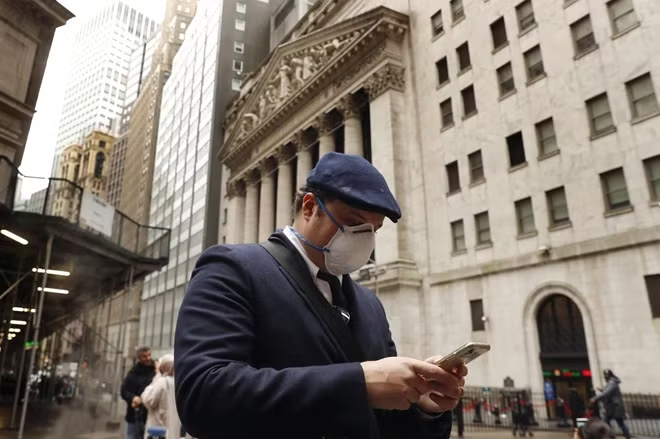 |
| Pandemic stirs Wall Street’s social conscience |
Buying into companies based on environmental, social and governance (ESG) factors was growing in popularity before the virus started spreading. But the focus was largely on how companies were dealing with climate change and overly generous executive pay – the E and G – rather than social issues such as the well-being of staff.
The virus is driving a reassessment.
“Someone the other day said ‘has environment taken a back seat? And my reply was ‘no, it’s more the ‘S’ has climbed into the front seat’,” John Goldstein, head of the Sustainable Finance Group at Goldman Sachs, told a media conference call in April.
Investors initially baulked when Amazon founder Jeff Bezos said last month that he expected to spend $4 billion on virus-related expenses including protecting staff. The online retailer needs to convince employees, unions and governments that it can keep workers safe or risk warehouse closures at a time of unprecedented demand from shoppers.
Amazon shares plunged over 7% when Bezos announced the outlay would wipe out its next quarterly profit but have since pared much of those losses and are up 28% since the start of this year.
Portfolio manager Lewis Grant at Federated Hermes said the move would help Amazon improve “its ability to deliver in the long-term”.
“For the cynics, it is also a smart PR move,” he added.
Companies which have chosen to cut jobs rather than investor payouts have drawn criticism and, taking note of the mood and welter of government supports on offer, many have taken steps to ease the financial impact on staff from the crisis.
Around 400 companies have launched initiatives ranging from paid leave for casual companies to halting redundancies, according to a Bank of America-Merrill Lynch report in late April.
Corey Klemmer, director of engagement for Domini Impact Investments in New York, helped organise an investor letter in late March calling on companies to prioritise workers’ welfare amid the pandemic, both for humanitarian concerns and also “the systemic risk it poses to our portfolios”.
The letter now has 322 signatories from managers overseeing some $9.2 trillion in assets - nearly double the assets at the time the letter was first released on March 26.
A Reuters analysis of British regulatory filings between March 23 and April 29 showed of the 98 companies to announce they had furloughed workers because of the virus, 76 had also cut executive pay in some form, despite there being no legal obligation to do so.
Companies which are seen to be ‘doing good’ do get rewarded. Europe’s sustainable fund universe pulled in 30 billion euros in the first quarter of 2020 compared with an outflow of 148 billion euros for the overall European fund sector, according to research by Morningstar.
Issuance of so-called “social bonds”, used to raise money for projects with positive social outcomes such as boosting community health, meanwhile, hit consecutive record highs in March and April, Refinitiv data showed.
A TEMPORARY TREND?
Often viewed as a cost centre to cull, the emphasis on staff as a stakeholder to shield, is a departure for Wall Street and may well be a temporary feature of the coronavirus pandemic.
“It is too early to know how the pandemic will affect the balance between corporate social responsibility and pursuit of shareholder value above all else,” said Beth Allen, spokeswoman for the Communications Workers of America.
Recent research from Boston Consulting found 52% of investors in a U.S. survey disagreed or strongly disagreed with the view that it was important for healthy companies to “fully pursue their ESG agenda and priorities as they navigate the crisis, even if it means guiding to lower EPS or delivering below consensus”.
Indeed, the longer it takes economies to recover from the pandemic, the greater the pressure on companies to cut costs, including jobs.
Thousands of jobs have already been lost in the aviation and airline sectors as the virus forces companies to ground flights and slash schedules.
But whatever the nature of the recovery, funds that follow ESG strategies say companies that do right by the community perform better.
Federated Hermes said companies with poor or worsening social practices consistently underperformed their peers by 15 basis points a month, based on data since 2008.
Research from Bank of America Merrill Lynch, meanwhile, showed the stock of companies receiving the most positive employee feedback on workplace rating website Glassdoor outperformed the S&P 500 .SPX by 5 percentage points during the recent sell-off.
But will ‘do gooder’ companies automatically become more attractive for investors?
“The short answer is no,” said Will Baylis, a portfolio manager at Martin Currie Australia, which has A$9 billion ($5.9 billion) in assets under management, pointing out that other factors such as debt, profitability and ability to maintain liquidity in stress also influence investment decisions.
“But if you ask do you think investors would be attracted to companies who have a stronger social awareness over the next 5 to 10 years, the answer is definitely yes.”