- DeVos confirmed as U.S. education secretary as Pence breaks tie
- As Trump emissary to Congress, Mike Pence faces potential obstacle - his boss
- US vice-president debate: Trump, Clinton attacked by Kaine and Pence
- Facebook công bố OpenCellular giúp kết nối Internet miễn phí
Pence flew to South Korea on the first stop of a four-nation Asia tour intended to show America's allies - and remind its adversaries - that the Trump administration is not turning its back on the increasingly volatile region.
The demilitarized zone (DMZ) is a heavily mined, four-km-wide (2.5-mile-wide) strip of land lined with barbed wire running across the Korean peninsula, with soldiers on both sides in a continual eyeball-to-eyeball standoff.
Pence, whose father served in the 1950-53 Korean War, said he was humbled to be at the DMZ and hailed the alliance with South Korea.
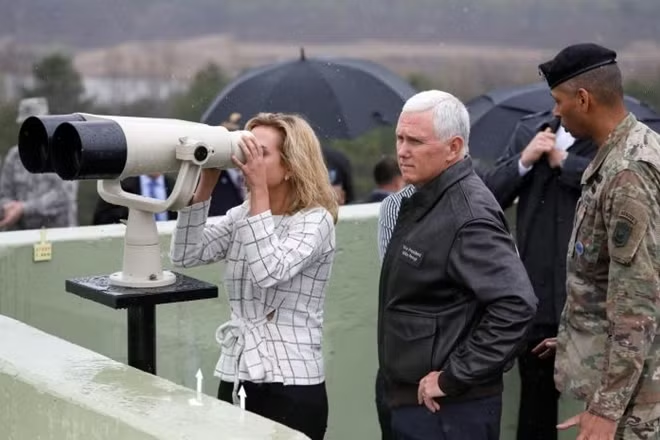 |
| U.S. Vice President Mike Pence stands next to her daughter looking toward the north through a pair of binocular from an observation post inside the demilitarized zone separating the two Koreas, in Paju, South Korea, April 17, 2017. REUTERS/Kim Hong-Ji. |
"It is a testament to the unshakeable bond between our people," he said.
The United States, its allies and China are working together on a range of responses to North Korea's latest failed ballistic missile test, U.S. President Donald Trump's national security adviser said on Sunday, citing what he called an international consensus to act.
H.R. McMaster indicated that Trump was not considering military action for now, even as a nuclear-powered aircraft carrier strike group was heading for the region.
"It's time for us to undertake all actions we can, short of a military option, to try to resolve this peacefully," he said on ABC's "This Week" program. "We are working together with our allies and partners and with the Chinese leadership to develop a range of options."
"There is an international consensus now, including the Chinese leadership, that this is a situation that just cannot continue," McMaster said.
The Trump administration is focusing its North Korea strategy on tougher economic sanctions, possibly including an oil embargo, a global ban on its airline, intercepting cargo ships and punishing Chinese banks doing business with Pyongyang, Reuters reported last week, citing U.S. officials.
While Trump has employed tough rhetoric in response to North Korea's recent missile tests, the new U.S. president's options appear limited in dealing with a challenge that has vexed his Oval Office predecessors.
Most options fall into four categories: economic sanctions, covert action, diplomatic negotiations and military force.
The North Korean missile blew up almost immediately after its test launch on Sunday, the U.S. Pacific Command said.
Hours later, Pence landed for talks on the North's increasingly defiant arms program. His visit came a day after North Korea held a military parade in its capital, Pyongyang, marking the 105th anniversary of the birth of founding father Kim Il Sung. What appeared to be new long-range ballistic missiles were on display in the parade.