Vietnamese Prime Minister Le Minh Hung has instructed ministries to prevent new administrative procedures arising from technical standards while accelerating legal reform, decentralisation and digital transformation
Chairing the Government’s lawmaking session on June 27, the Prime Minister called for continued institutional reform aimed at removing regulatory bottlenecks, simplifying administrative procedures and creating a more flexible legal framework to support socio-economic development.
He agreed with drafting agencies' proposals to revise laws and resolutions in a way that further simplifies administrative procedures, expands decentralisation and delegation of authority, and provides greater flexibility in policy implementation.
Regarding the draft revised Customs Law, the Prime Minister called for a comprehensive legal framework to support the redesign of customs management based on digital technologies, modern information systems and scientific innovation. He also stressed the need to shift from pre-clearance controls to post-clearance audits in order to reduce compliance costs for businesses while maintaining effective measures against smuggling, trade fraud and intellectual property violations.
For the revised Investment Law, the Prime Minister emphasised the need to reshape Vietnam's foreign investment strategy by prioritising technology transfer, human resource development and digital transformation. He said the law should establish broad legal principles and allow the Government to issue detailed regulations that can adapt to rapidly evolving global supply chains. He also requested a review of conditional business sectors so that they are appropriate and necessary.
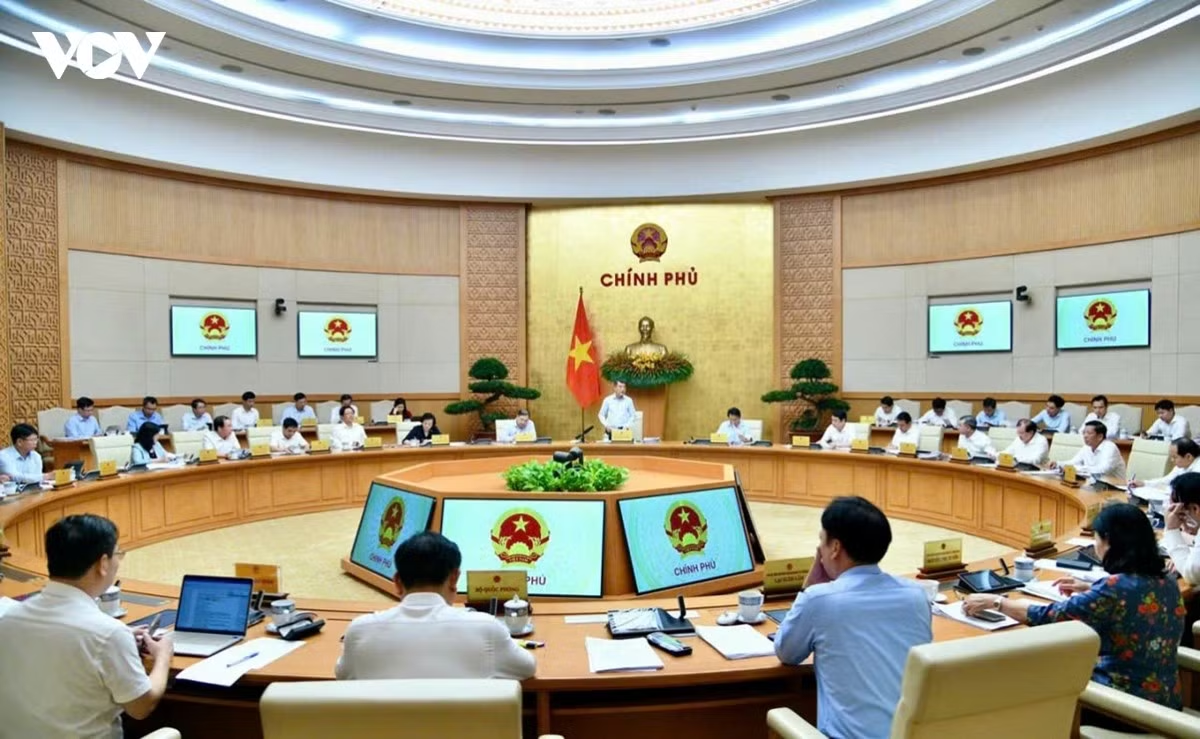
Prime Minister Le Minh Hung chairs the Government’s lawmaking session in Hanoi on June 27
Addressing proposed amendments to banking legislation, the Prime Minister urged policymakers to strike a balance between safeguarding financial stability and maintaining sufficient flexibility for monetary policy management. He said issues such as credit growth limits, prudential ratios and short-term capital requirements for medium- and long-term lending should be regulated through government decrees rather than fixed in law, allowing adjustments in line with macroeconomic conditions.
He also instructed relevant agencies to continue improving the legal framework for the stock market and the corporate bond market in order to enhance transparency and facilitate healthy capital mobilisation.
Regarding amendments to 10 laws in the agriculture and environment sectors, the Prime Minister reiterated the importance of decentralisation, reducing business conditions and, above all, ensuring that technical standards and technical regulations do not create new administrative procedures.
The same principle, he said, should guide amendments to laws governing technology transfer, telecommunications, electronic transactions, radio frequencies and the prevention of the proliferation of weapons of mass destruction. Legal reforms, he noted, must be consistent with Vietnam’s international commitments while avoiding additional compliance costs for citizens and businesses.
For the Law on Publishing, the Prime Minister called for legal provisions to support the development of integrated publishing and media groups, facilitate the adoption of AI in publishing, and uphold the principle of tax neutrality.
With regard to the Law on Vietnamese Guest Workers under Contract, he requested a review of regulatory gaps and an assessment of decentralisation measures to improve the effectiveness of state management in overseas labour deployment.
Concluding the session, the Prime Minister described lawmaking and the effective enforcement of legislation as core and continuous responsibilities of ministries and agencies. He instructed them to conduct a comprehensive review of the legal system, promptly propose amendments to outdated regulations, strengthen accountability among agency heads and ensure that draft laws submitted to the National Assembly are prepared on schedule and to a high standard, avoiding delays caused by prolonged inter-agency coordination.