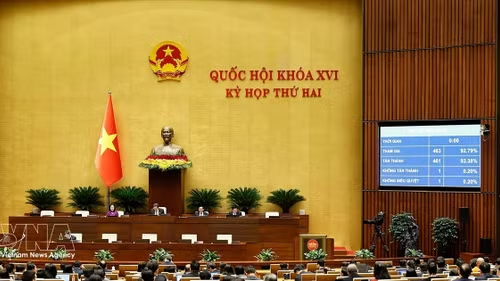
Hanoi (VNA) – The Political Bureau convened a national conference on July 1 afternoon to review the first one year and six months of implementing Resolution No. 57-NQ/TW dated December 22, 2024, on breakthroughs in the development of science and technology, innovation, and national digital transformation.

The conference was held in person at the National Assembly's headquarters in Hanoi and was connected to 3,662 locations, including ministries, central agencies, organisations, provinces, cities, communes, wards, and special zones nationwide, with a total of 568,384 delegates in attendance.
The conference was attended and chaired by Party General Secretary and State President To Lam. Also present at the event were Politburo members: Prime Minister Le Minh Hung; National Assembly Chairman Tran Thanh Man; Standing Member of the Party Central Committee's Secretariat Tran Cam Tu; Secretary of the Party Central Committee and Chairman of the Party Central Committee's Organisation Commission Nguyen Duy Ngoc, Standing Deputy Head of the Central Steering Committee for Science and Technology Development, Innovation and Digital Transformation.
Institutions must lead the way
Delivering a report at the conference, Chief of the Party Central Committee's Office Nguyen Hai Ninh said after 18 months of implementing Resolution No. 57, ministries, sectors and localities have adopted innovative and effective approaches that have generated positive momentum, while winning broad support from businesses, the scientific community and the public for policies on science, technology, innovation and digital transformation.
Ninh, who is also Deputy Head of the Central Steering Committee for Science and Technology Development, Innovation and Digital Transformation, said that as of June 29, a total of 1,937 tasks had been assigned. Of the 1,469 tasks with deadlines, 1,245, or 84.8%, had been completed, 168 (11.4%) remained on schedule, while 56 (3.8%) were overdue.
The Central Steering Committee has expanded digital monitoring and supervision of the implementation of Resolution No. 57 and related resolutions while operating an online system to receive and process feedback, proposals and recommendations on science, technology, innovation and digital transformation. To date, 1,009 out of 1,071 submissions, or 94.2%, have been handled.

Over the past 18 months, Vietnam has accelerated institutional reforms with the issuance of more than 400 legal and regulatory documents, including 30 laws, over 70 decrees, 30 resolutions, 72 prime ministerial decisions, together with numerous circulars and implementation guidelines. The reforms have removed key bottlenecks and established a stronger legal framework for science, technology, innovation and digital transformation.
Many of Resolution 57's major policies have been institutionalised, including measures to promote digital transformation, digital data, the digital technology industry, strategic technologies, innovative start-ups, venture capital investment and reforms to scientific research management.
Digital transformation has also delivered tangible results. Nationwide 5G coverage has reached 91.9% of the population, more than 71 million electronic identification accounts have been activated, and the online processing rate for administrative dossiers at the local level has climbed to 93.54%, generating annual savings worth trillions of Vietnamese dong for citizens, businesses and the State.
The report noted that Vietnam has identified 10 strategic technology groups, 30 priority product groups and 20 major national challenges. However, the number of domestically mastered technologies and commercialised products remains limited, with many initiatives still at the planning or pilot stage.
According to the report, the biggest obstacle is no longer technology itself but implementation. Data quality has yet to meet requirements, the overall public investment disbursement rate stands at just 23.35%, and many tasks have been completed administratively without producing operational products or measurable impacts.
The next phase should shift from drafting policies and action plans to delivering tangible products and measurable outcomes, with service quality for citizens and businesses, productivity gains and contributions to economic growth serving as key performance indicators, it suggested.
Science and technology to drive new development model
Ninh also announced the conclusions of the Politburo and the Party Central Committee's Secretariat following the 18-month review of Resolution No. 57, reaffirming it as a strategic resolution that positions science, technology, innovation and digital transformation as the primary drivers of Vietnam's new development model, enhancing productivity, competitiveness, self-reliance and national strength.
The Politburo and Secretariat called for greater emphasis on delivering practical results through implementation, with the early development of new products, technologies, enterprises and growth drivers. They also urged faster commercialisation of research outcomes, stronger development of technology enterprises and the formation of new value chains based on knowledge, technology and data.
Ministries, sectors and localities were instructed to prioritise basic scientific research, strengthen the country's scientific workforce, mobilise businesses, intellectuals, experts and the public, remove obstacles to the "three-party cooperation" model linking the State, research institutions and businesses, increase investment in research and development, master strategic technologies, and improve the effectiveness of international cooperation.
The Politburo and Secretariat also called for faster development of a modern national governance platform powered by science, technology and digital transformation, completion of national databases, expansion of digital operations across the political system, and the use of governance performance and public satisfaction as key evaluation criteria.
Ministries, sectors and local authorities were instructed to implement a 100-day action plan to address major digital transformation bottlenecks, including slow public investment disbursement, fragmented data systems, inadequate digital infrastructure and the gap between administrative completion and practical outcomes. They were also urged to accelerate decentralisation while strengthening supervision and accountability among leaders of agencies.
The Politburo and Secretariat further emphasised the need to reinforce cybersecurity, information security, and the protection of national and personal data by establishing effective early warning and incident response mechanisms. Agencies will be held accountable for ensuring the security and integrity of the digital systems under their management.
In addition, they called for a fundamental overhaul of leadership, implementation and evaluation methods by defining clear objectives, deliverables, timelines, responsibilities and performance indicators for each task, with the ultimate measure of success being the value created for citizens, businesses and the nation./.