Russia suspends INF nuclear deal with U.S., say President Putin

Russia has suspended the Cold War-era Intermediate-range Nuclear Forces Treaty after a similar move by the United States, President Vladimir Putin said on Saturday, also instructing the government not to initiate disarmament talks with Washington.

“The American partners have declared that they suspend their participation in the deal, we suspend it as well,” Putin said during a televised meeting with foreign and defense ministers.
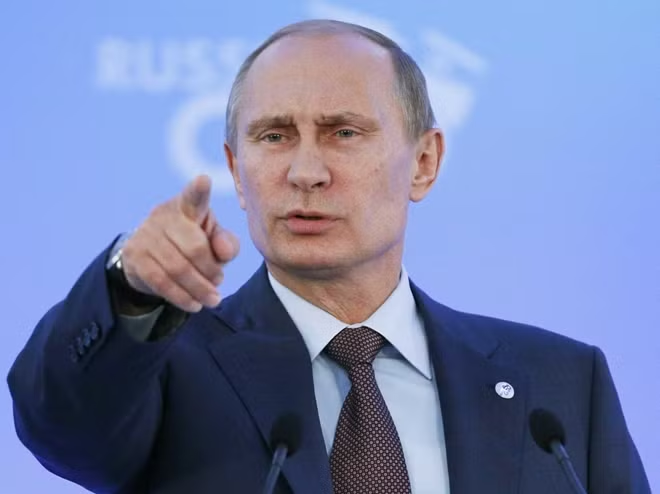
Russian President Vladimir Putin.

The United States announced on Friday it will withdraw from the INF treaty with Russia in six months unless Moscow ends what it says are violations of the landmark 1987 arms control pact.

Putin said Russia will start work on creating new missiles, including hypersonic ones, and told ministers not to initiate disarmament talks with Washington, accusing the U.S. of being slow to respond to such moves.

“We have repeatedly, during a number of years, and constantly raised a question about substantiative talks on the disarmament issue, notably, on all the aspects,” Putin said.

“We see, that in the past few years the partners have not supported our initiatives.”

During the meeting, Russian Foreign Minister Sergei Lavrov also accused the United States of violating the INF and other arms deals, such as the non-proliferation treaty.

Putin said that Russia will not increase its military budget for the new weapons and it won’t deploy its weapons in Europe and other regions unless the United States does so.

TASS: US has violated INF Treaty since 1999, Lavrov tells Putin

The United States that has announced suspension of the Intermediate-Range Nuclear Forces Treaty (INF Treaty) due to Russia’s alleged violations, has breached the provisions of the agreement since 1999, Russian Foreign Minister Sergey Lavrov told President Vladimir Putin on Saturday. 

"According to our information, the United States started violating that undated treaty (INF, came into force in 1988 - TASS) in 1999 when it began trials of combat unmanned flying vehicles with specifications similar to ground-launched cruise missiles banned by the Treaty," he said. 
Reuters/TASS

Other News

Vietnam supports UNESCO's people-centred approach, multilateral cooperation: official

Vietnam supports UNESCO's people-centred approach, multilateral cooperation: official

Van affirmed Vietnam’s support for the UNESCO80 reform roadmap, focusing on the organisation’s core mandate, priority areas, interdisciplinary approach, and the special status of the Vietnam National Commission for UNESCO, and UNESCO representative offices, alongside efforts to diversify resources and strengthen global partnerships to enhance the organisation’s effectiveness.

Regional media highlight significant step in Vietnam’s leadership structure

Regional media highlight significant step in Vietnam’s leadership structure

Under General Secretary and President Lam’s leadership, Vietnam is expected to maintain a balanced foreign policy, strengthen its regional standing and accelerate economic development, thereby improving living standards and creating new opportunities for international investors, according to the India-based platform Devdiscourse.

Laos identifies 10 key tasks to build independent, self-reliant economy

Laos identifies 10 key tasks to build independent, self-reliant economy

Laos will step up agricultural production to ensure food security, meet domestic demand and expand exports; encourage the development of agro-processing industries, including those related to rubber, aquatic products, cassava and sugarcane, as well as fertiliser and animal feed production, in order to increase added value and create jobs in rural areas.

Malaysia steps up cyber security resilience

Malaysia steps up cyber security resilience

To ensure accountability, Malaysia plans to finalise the Cybercrime Bill this year which addresses both cyber-dependent and cyber-enabled offences, introducing stricter penalties and prison terms to enhance deterrence.

US public opinion positive about PM Pham Minh Chinh’s visit

US public opinion positive about PM Pham Minh Chinh’s visit

Public opinion in the US is generally positive about Vietnamese Prime Minister Pham Minh Chinh’s trip to the US from September 17-23 to attend the 78th session of the United Nations General Assembly, which took place immediately after the upgrading of the Vietnam - US relations to a comprehensive strategic partnership on the occasion of US President Joe Biden’s official visit to Vietnam.