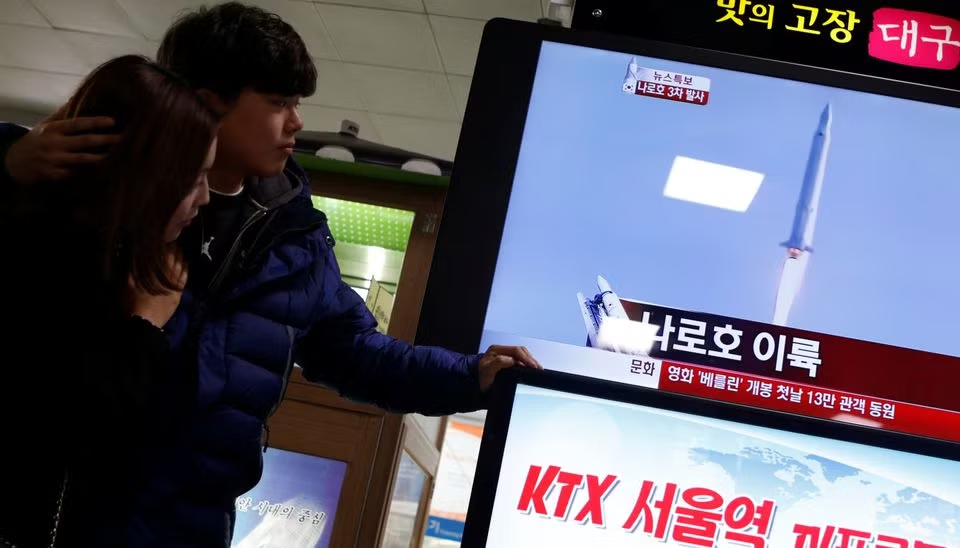
S.Korea prepares to launch first domestically produced space rocket

South Korea is scheduled to conduct its first test launch into space of a domestically built rocket on Thursday in a major step toward jumpstarting the country’s space programme.

S.Korea prepares to launch first domestically produced space rocket -0
S.Korea prepares to launch first domestically produced space rocket

 South Korea is scheduled to conduct its first test launch into space of a domestically built rocket on Thursday in a major step toward jumpstarting the country’s space programme.

The three-stage KSLV-II NURI rocket emblazoned with South Korea's flag stood on its launch pad at the Naro Space Center ahead of its scheduled 5 p.m. (0800 GMT) blast-off carrying a dummy satellite.

The NURI, or "world", rocket is designed to put 1.5-ton payloads into orbit 600km to 800km (373 miles-497 miles) above the Earth. South Korea's future plans call for launching surveillance, navigation, and communications satellites, and even lunar probes. 

The launch had tentatively been scheduled for an hour earlier, but officials said they faced delays in inspecting valves on the craft. Weather conditions were also being monitored amid reports of high winds in the upper atmosphere.

"The rocket itself has no issue," Yong Hong-taek, first vice minister of science and technology, told a briefing at the space centre.

Overseen by the Korea Aerospace Research Institute (KARI), the 200-ton rocket was moved to its launch pad on Wednesday and raised into position.

"All preparations like umbilical connection and confidential inspection have been done," the Science and Technology Ministry said in a statement.

The rocket's three stages are powered by liquid-fuel boosters built by an affiliate of South Korea's Hanwha conglomerate, with a cluster of four 75-ton boosters in the first stage, another 75-ton booster in the second stage, and a single 7-ton rocket engine in the final stage.

Space launches have long been a sensitive issue on the Korean peninsula, where North Korea faces sanctions over its nuclear-armed ballistic missile programme.

South Korea's plans call for launching a range of military satellites in the future, but officials deny that the NURI has any use as a weapon itself.

The country's last such rocket, launched in 2013 after multiple delays and several failed tests, was jointly developed with Russia.

Having its own launch vehicle will give South Korea the flexibility to determine payload types and launch schedules, as well as protect "confidential" payloads such as spy satellites, officials told Reuters.

Reuters

Other News

Vietnam supports UNESCO's people-centred approach, multilateral cooperation: official

Vietnam supports UNESCO's people-centred approach, multilateral cooperation: official

Van affirmed Vietnam’s support for the UNESCO80 reform roadmap, focusing on the organisation’s core mandate, priority areas, interdisciplinary approach, and the special status of the Vietnam National Commission for UNESCO, and UNESCO representative offices, alongside efforts to diversify resources and strengthen global partnerships to enhance the organisation’s effectiveness.

Regional media highlight significant step in Vietnam’s leadership structure

Regional media highlight significant step in Vietnam’s leadership structure

Under General Secretary and President Lam’s leadership, Vietnam is expected to maintain a balanced foreign policy, strengthen its regional standing and accelerate economic development, thereby improving living standards and creating new opportunities for international investors, according to the India-based platform Devdiscourse.

Laos identifies 10 key tasks to build independent, self-reliant economy

Laos identifies 10 key tasks to build independent, self-reliant economy

Laos will step up agricultural production to ensure food security, meet domestic demand and expand exports; encourage the development of agro-processing industries, including those related to rubber, aquatic products, cassava and sugarcane, as well as fertiliser and animal feed production, in order to increase added value and create jobs in rural areas.

Malaysia steps up cyber security resilience

Malaysia steps up cyber security resilience

To ensure accountability, Malaysia plans to finalise the Cybercrime Bill this year which addresses both cyber-dependent and cyber-enabled offences, introducing stricter penalties and prison terms to enhance deterrence.

US public opinion positive about PM Pham Minh Chinh’s visit

US public opinion positive about PM Pham Minh Chinh’s visit

Public opinion in the US is generally positive about Vietnamese Prime Minister Pham Minh Chinh’s trip to the US from September 17-23 to attend the 78th session of the United Nations General Assembly, which took place immediately after the upgrading of the Vietnam - US relations to a comprehensive strategic partnership on the occasion of US President Joe Biden’s official visit to Vietnam.