 |
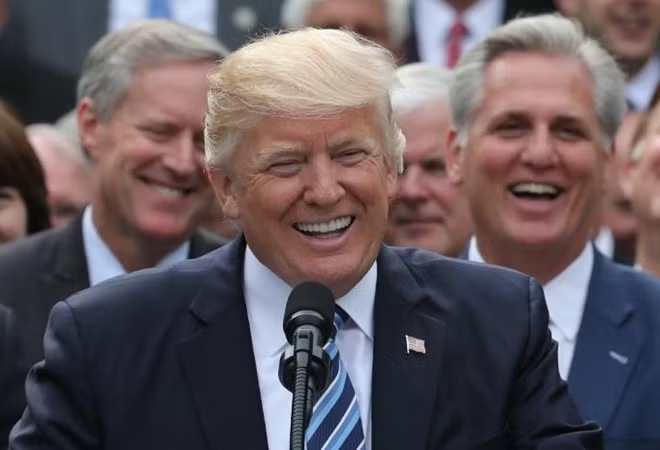
| U.S. President Donald Trump (C) stands between House Freedom Caucus Chairman Rep. Mark Meadows (L) and House Majority Leader Kevin McCarthy (R) as they listen to House Majority Whip Steve Scalise (front) talk as Congressional Republicans gathered with the president in the Rose Garden of the White House after the House of Representatives approved the American Healthcare Act, to repeal major parts of Obamacare and replace it with the Republican healthcare plan, in Washington, U.S., May 4, 2017. REUTERS/Carlos Barria |
Some lawmakers and aides in the U.S. House of Representatives were hesitant to credit Trump or his softer approach with Thursday's 217-213 vote rolling back President Barack Obama's signature 2010 healthcare overhaul.
Several aides emphasized the role of House Republican leaders and Vice President Mike Pence in bridging differences between the party's moderates and hardline conservatives.
Others said they saw a different Trump at work this week versus March 24, when he backed a bill that collapsed and again in April when his fellow Republicans failed a second time.
Representative Mark Sanford, a Republican member of the conservative House Freedom Caucus, said on Thursday that in March the White House threatened to work against his re-election bid if he balked at supporting the healthcare bill.
This time Trump, who took office in January, was "largely absent," Sanford said, adding: "They got it clear that threats were not going to work with me."
In White House talks with Republican Representatives Fred Upton and Billy Long, Trump helped to nail down critical moderate votes.
A senior White House official said Trump worked the phones this time and realized it had been a mistake to set a deadline the first time. Trump spoke with Speaker Paul Ryan, the leading House Republican, during late-night calls.
In conversations with lawmakers, Trump kept the focus on meeting a Republican promise from the 2016 election campaign to roll back a federal government healthcare law that they view as too costly and over-reaching.
Any plan to overhaul Obamacare faces a tougher battle in the 100-member U.S. Senate, where Republicans hold a slimmer majority. While Republicans control both the White House and Congress, senators are traditionally less easily moved by presidential pressure than members of the House.
Democrats in both houses remained firmly opposed to a bill they said would deprive millions of Americans of healthcare coverage. "The bill is going nowhere fast in the United States Senate," said Senate Democratic leader Chuck Schumer.
PRE-EXISTING MEDICAL CONDITIONS A KEY
House Republicans joined an exuberant Trump for a victory lap in the White House Rose Garden after the vote. Turning to Ryan, Trump reminded him of the criticism the speaker faced when the healthcare bill stalled in the House the first time.
“For the last week, I’ve been hearing, ‘Paul Ryan doesn’t have it ... Then today, I heard Paul Ryan is a genius,’” Trump said.
A key turning point came on Monday, when Upton and four other Republican lawmakers met to discuss how the rollback bill could be changed to better protect people with pre-existing medical conditions, a concern for Republican moderates.
No amendment had been hammered out by Tuesday and Upton, an influential moderate, said he opposed the bill, as did Long, a close Trump ally. Trump called them both to the White House.
At their meeting on Wednesday, Upton and Long reminded Trump of his promise in a weekend television interview that the Republican plan would protect people with pre-existing medical conditions. They pressed him to stand by that commitment and it worked. Trump endorsed their amendment to add some money to the Republican bill for that purpose.
White House spokeswoman Sarah Huckabee Sanders said Trump had 15 to 20 meetings or calls with House Republicans ahead of the vote. She said the president was "directly engaged."
If Senate Republicans can pass a bill, a House-Senate panel of negotiators likely would have to iron out the differences and present a compromise version for both chambers to pass.
"My only concern is the U.S. Senate," said Republican Representative Dave Brat, a Freedom Caucus member. "If they come back with any big changes that will make life a little tough."
Brat said Trump's role will be important. "The new variable is President Trump. If he gets out there and puts a little heat on it," then a Senate-House compromise is possible.