St. Petersburg Metro bombing: What we know so far

More than a day since a deadly blast rocked a train car in the St. Petersburg Metro, investigators have established and reported on some of the details pertaining to the apparent terrorist attack. RT wraps up what is known about the incident so far.

How it happened

At around 2:40pm local time on April 3, an improvised explosive device went off inside a train car as it was moving between the underground transit system’s Tekhnologichesky Institut and Sennaya Ploshchad stations. The driver continued on to the Sennaya station, where commuters began carrying the victims of the blast out of the mangled car.
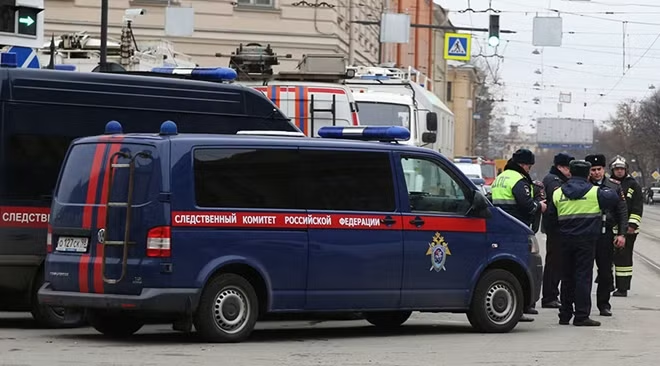
Witnesses at both stations reported on the incident, initially leading to speculation that there had been two separate explosions. However, investigators later confirmed that only one explosion had taken place.

A separate improvised explosive device (IED) found at the Ploshchad Vosstania station was diffused by the law enforcement.

Death toll

According to the latest casualty figures provided by healthcare officials, 14 people were killed and 49 injured, including 10 victims who are still in serious condition.

Citizens of Latvia, Belarus, Kazakhstan and Uzbekistan are among the blast survivors, though the majority of the injured, 42, are residents of St. Petersburg.

Identification of those killed in the blast is currently underway.

Bombs

There were two bombs involved in the metro attack. One went off in the train car and another was found in a bag at a different station and defused by law enforcement. Photos of the disabled IED that were leaked online show a container disguised as a fire extinguisher, apparently filled with explosives, which has packaged ball bearings wrapped around it, presumably to make it deadlier.

According to medical reports, the bomb that detonated inside the car also contained ball bearings, indicating that it may have been of similar design. The defused bomb was estimated to hold explosives packing the power of one kilogram of TNT.

Perpetrator

The bomb was set off by a suicide bomber whose remains were found at the scene, according to Russia’s Investigative Committee. The attacker has been identified as 22-year-old Akbarzhon Dzhalilov, a Kyrgyz-born Russian citizen of Uzbek ethnicity. The investigators believe he also left the second IED before boarding the train, but are looking into other possibilities as well.

So far, the authorities have not reported that Dzhalilov had links to any radical organizations, and a motive for the bombing has not been given.


RT

Other News

Vietnam supports UNESCO's people-centred approach, multilateral cooperation: official

Vietnam supports UNESCO's people-centred approach, multilateral cooperation: official

Van affirmed Vietnam’s support for the UNESCO80 reform roadmap, focusing on the organisation’s core mandate, priority areas, interdisciplinary approach, and the special status of the Vietnam National Commission for UNESCO, and UNESCO representative offices, alongside efforts to diversify resources and strengthen global partnerships to enhance the organisation’s effectiveness.

Regional media highlight significant step in Vietnam’s leadership structure

Regional media highlight significant step in Vietnam’s leadership structure

Under General Secretary and President Lam’s leadership, Vietnam is expected to maintain a balanced foreign policy, strengthen its regional standing and accelerate economic development, thereby improving living standards and creating new opportunities for international investors, according to the India-based platform Devdiscourse.

Laos identifies 10 key tasks to build independent, self-reliant economy

Laos identifies 10 key tasks to build independent, self-reliant economy

Laos will step up agricultural production to ensure food security, meet domestic demand and expand exports; encourage the development of agro-processing industries, including those related to rubber, aquatic products, cassava and sugarcane, as well as fertiliser and animal feed production, in order to increase added value and create jobs in rural areas.

Malaysia steps up cyber security resilience

Malaysia steps up cyber security resilience

To ensure accountability, Malaysia plans to finalise the Cybercrime Bill this year which addresses both cyber-dependent and cyber-enabled offences, introducing stricter penalties and prison terms to enhance deterrence.

US public opinion positive about PM Pham Minh Chinh’s visit

US public opinion positive about PM Pham Minh Chinh’s visit

Public opinion in the US is generally positive about Vietnamese Prime Minister Pham Minh Chinh’s trip to the US from September 17-23 to attend the 78th session of the United Nations General Assembly, which took place immediately after the upgrading of the Vietnam - US relations to a comprehensive strategic partnership on the occasion of US President Joe Biden’s official visit to Vietnam.