Thailand may not form new government in 2017

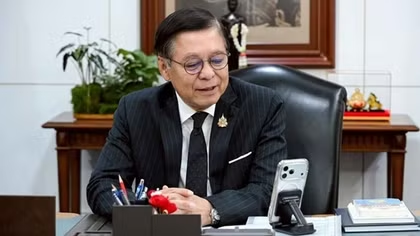
Thailand’s Deputy Prime Minister Wissanu Krea-ngam said on November 23 that the country's new government may not be formed by the end of the year 2017, despite the fact that the general election will definitely take place next year.

Over the year, Thai Prime Minister General Prayut Chan-o-cha has repeatedly maintained that the next election will be held in 2017, following the post-coup road map for a return to democracy. 
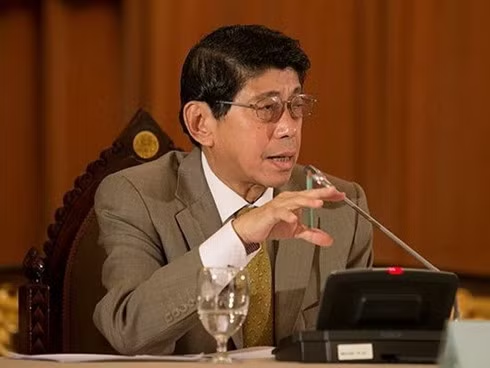
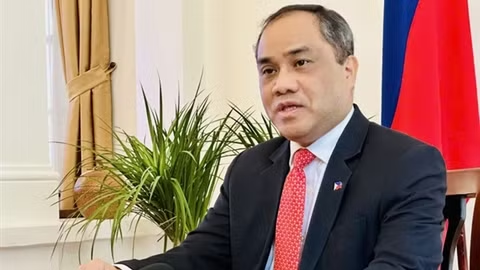
Thailand’s Deputy Prime Minister Wissanu Krea-ngam.

However, Wissanu said “unforeseeable factors” could make it unlikely for a new administration to be formed within 2017. He added that it would take about two months for official election results to be announced after the vote. 

After the election results are announced, there will be a process concerning the opening of Parliament to select a new prime minister, he said.     

About the next year general election, Wissanu said that under the new electoral system, unprecedentedly, a single ballot will be used for both constituency and party-list MPs.   

“Due to the new voting and vote-count systems, the political party with the most votes will not be guaranteed to form the government,” the Thai Deputy PM said.  

As required by the new charter of Thailand, 10 organic bills must be completed within eight months after the charter is promulgated, with the key organic bills concerning political parties, the election of MPs, the appointment of senators and the Election Commission.

According to Wissanu, once the organic laws are completed, the government will be able to announce a general election within five months.
VNA

Other News

Vietnam supports UNESCO's people-centred approach, multilateral cooperation: official

Vietnam supports UNESCO's people-centred approach, multilateral cooperation: official

Van affirmed Vietnam’s support for the UNESCO80 reform roadmap, focusing on the organisation’s core mandate, priority areas, interdisciplinary approach, and the special status of the Vietnam National Commission for UNESCO, and UNESCO representative offices, alongside efforts to diversify resources and strengthen global partnerships to enhance the organisation’s effectiveness.

Regional media highlight significant step in Vietnam’s leadership structure

Regional media highlight significant step in Vietnam’s leadership structure

Under General Secretary and President Lam’s leadership, Vietnam is expected to maintain a balanced foreign policy, strengthen its regional standing and accelerate economic development, thereby improving living standards and creating new opportunities for international investors, according to the India-based platform Devdiscourse.

Laos identifies 10 key tasks to build independent, self-reliant economy

Laos identifies 10 key tasks to build independent, self-reliant economy

Laos will step up agricultural production to ensure food security, meet domestic demand and expand exports; encourage the development of agro-processing industries, including those related to rubber, aquatic products, cassava and sugarcane, as well as fertiliser and animal feed production, in order to increase added value and create jobs in rural areas.

Malaysia steps up cyber security resilience

Malaysia steps up cyber security resilience

To ensure accountability, Malaysia plans to finalise the Cybercrime Bill this year which addresses both cyber-dependent and cyber-enabled offences, introducing stricter penalties and prison terms to enhance deterrence.

US public opinion positive about PM Pham Minh Chinh’s visit

US public opinion positive about PM Pham Minh Chinh’s visit

Public opinion in the US is generally positive about Vietnamese Prime Minister Pham Minh Chinh’s trip to the US from September 17-23 to attend the 78th session of the United Nations General Assembly, which took place immediately after the upgrading of the Vietnam - US relations to a comprehensive strategic partnership on the occasion of US President Joe Biden’s official visit to Vietnam.