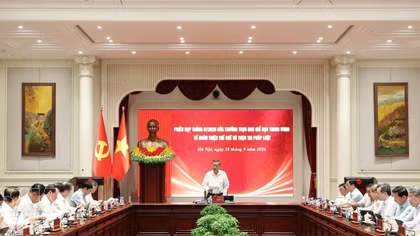
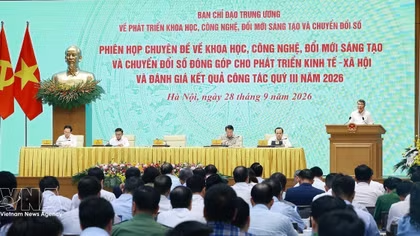
Party General Secretary and State President To Lam has expressed hope that media outlets and each journalist will turn revolutionary traditions into a driving force for innovation.
In an article marking the 101st anniversary of Vietnam Revolutionary Press Day (June 21, 1925-2026), the leader said he believes Vietnam’s revolutionary press will continue to make significant contributions to the nation, serving the people in the digital era. The Vietnam News Agency (VNA) respectfully introduces a translation of the article.
VIETNAM’S REVOLUTIONARY PRESS IN DIGITAL ERA
To Lam
General Secretary of the Communist Party of Vietnam Central Committee
President of the Socialist Republic of Vietnam
After more than a century of accompanying the nation, Vietnam’s revolutionary press is entering a new stage of development, marked by profound changes across almost every aspect. The digital space has become an indispensable component of daily life. Digital technologies, big data, artificial intelligence (AI), social media, and cross-border communication platforms have fundamentally transformed the way information is created, distributed, received, and verified.
Today, people study, work, communicate, conduct business, seek entertainment, express their views, and engage in social issues through online platforms. The rapid and diverse flow of information offers tremendous opportunities for the dissemination of knowledge, the promotion of social democracy, and innovation. The Party’s major guidelines, the State’s new policies, and positive information can now reach tens of millions of people simultaneously through a wide range of formats and channels. Technology has brought the press closer to the people and enabled it to receive feedback more quickly.
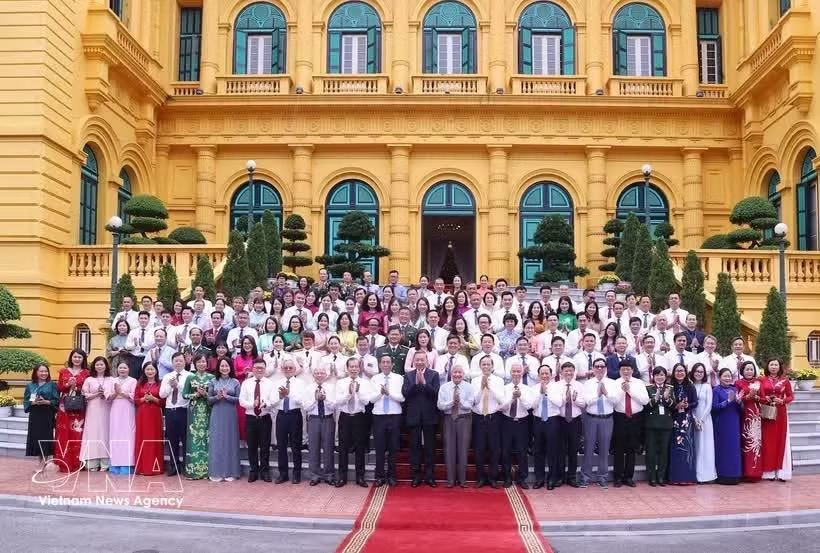
However, the online environment has also made the information landscape more complex, increasingly susceptible to fleeting emotions, misinformation, algorithmic manipulation, and the deliberate dissemination of misleading content. Fake news, half-truths, ambiguous information, fabricated images and audio, AI-generated content, copyright infringement, cyberattacks, and data theft are becoming ever more sophisticated. False information can spread widely before the truth has a chance to be verified. Manipulated or selectively edited statements can damage the reputation of individuals and organisations, and may even erode public confidence in the policies of the Party and the State.
In the new communications order, the press no longer enjoys a near-monopoly over the dissemination of information. By the end of 2025, Vietnam had approximately 85.6 million Internet users, equivalent to 84.2% of the population, and around 79 million social media user identities. According to the latest statistics, Vietnamese users maintain about 110 million accounts on domestic social media platforms and approximately 203 million accounts on foreign social media networks. Such a digital environment provides the press with unprecedented opportunities to reach wider audiences, while at the same time requiring it to compete directly with the vast volume of content generated every hour and every minute by platforms and users alike. In the digital space, almost every individual can act as a source of information. Social media accounts can wield influence over specific communities.
However, these changes do not diminish the role of Vietnam’s revolutionary press. On the contrary, the more abundant information becomes, the more society needs trusted sources to distinguish what is true, what still requires verification, and what may merely reflect crowd sentiment or deliberate manipulation. This demands professionalism, a serious commitment to journalistic ethics, and resilience under all forms of pressure. Journalism must be a place where the public turns for reliable verification, not one that simply follows trends. Society needs a trusted source to understand the truth accurately. Citizens need to know what has happened, why it happened, who is affected, where responsibility lies, and what evidence-based solutions are available.
The digital space also requires journalistic works that are rich in data, diverse in content, innovative in presentation, and profound in policy analysis. Many of today’s issues – from digital transformation, green transition, and administrative reform to social welfare policies and fluctuations in the global economy – are difficult to comprehend through fragmented pieces of information alone. Therefore, the responsibility of the press is not merely to be faster, but above all to be more accurate, more insightful, and more useful.
From this requirement, digital transformation in journalism cannot be reduced to launching additional online platforms, opening social media accounts or investing in modern equipment. It requires a comprehensive overhaul of leadership thinking, newsroom models, production workflows, data management, content distribution, audience measurement, media economics and professional culture. Digital journalism is not traditional journalism operating on a new platform; it is a new way of organising journalism in a new environment.
Within newsrooms, every story should be treated as an information product with clearly defined objectives. Regardless of format or platform, all content must adhere to the same standards: accuracy, humanity, verification and accountability. Serious journalism on a publication's main platform cannot be accompanied by lower standards elsewhere. The more platforms journalism operates across, the more consistent its professional standards must be.
In the digital era, data has become a pillar of journalism. Data is more than a collection of figures; it is the foundation for verification and a tool for producing and presenting journalistic products in a more persuasive and comprehensive manner. Major and reputable news agencies and organisations around the world are investing heavily in developing data and dedicating substantial human resources to data-related work. Well-developed and effectively managed data enhances credibility and enables media organisations to identify issues at an early stage.
Another major issue is maintaining proactiveness in the face of cross-border digital platforms. Journalism must reach audiences wherever they are, across all platforms, but it cannot become dependent on external algorithms. News organisations that focus solely on clicks and recommendation systems risk losing access to audience data, control over content distribution, brand identity and resilience when algorithms change. Mastering the cyberspace means leveraging global platforms while simultaneously building proprietary channels, loyal audience communities, independent datasets and trusted brands.
Against this backdrop, greater awareness of national information sovereignty is essential. The revolutionary press must remain a leading force in safeguarding that sovereignty. Protecting information sovereignty does not mean closing off from the world. Vietnam needs a strong digital external communications press that is multilingual, multimedia and capable of conveying the country's messages to global audiences through modern storytelling while preserving a distinctly Vietnamese identity. The country's renewal achievements, cultural values and foreign policy of independence, self-reliance, self-strengthening, peace, friendship, cooperation and development should be communicated through engaging content supported by compelling data.
To fulfil this mission, journalism requires resources for sustainable development. A digital journalism economy is not at odds with the goals and orientations of revolutionary journalism. Without adequate resources, media organisations will struggle to invest in technology, protect copyrights, train human resources and retain skilled professionals. However, commercial activities must serve journalism's mission rather than drive it towards sensationalism, clickbait, invasions of privacy or the commodification of political and social information. New revenue streams should be developed through digital subscriptions, copyright licensing, data services and specialised content products. Without a healthy business model, journalism will find it difficult to maintain investment in high-quality reporting, investigative journalism, in-depth analysis, fact-checking and copyright protection.
Copyright protection must also be rigorously enforced in both the digital and AI environments. Journalistic content is the product of creative effort, reporting, verification, editing, financial investment and legal responsibility. Unauthorised copying, manipulation, aggregation and commercial exploitation will undermine the economic foundations of journalism. Protecting copyright means protecting legitimate labour and safeguarding the quality of information in society.
Ultimately, everything comes down to people. Every policy direction and strategy depends on humans. Journalists in the digital era must be able to work with data, digital tools, social media, open-source information and information security standards. The more tools are available, the stronger their professional mettle must be. They must avoid the tendency to publish first and verify later, or allow social media to lead editorial decisions. Journalists cannot sacrifice credibility for views. Before publishing any journalistic works, they should be able to answer three questions: Is it accurate? Is it necessary? Does it benefit society?
Leaders of press agencies must also adapt. In a digital newsroom, an editor-in-chief is no longer simply a gatekeeper of content, but a strategist responsible for products, data, audiences, technologies and human resources. Press agencies need a new working culture: they must be professional, disciplined in verification, quick-witted in response, open to innovation and willing to experiment without compromising standards. Continuous retraining should become a routine task, focusing on digital verification, data security, multi-platform journalism, AI ethics and compliance with intellectual property regulations.
As the Press Law No. 126/2025/QH15 takes effect on July 1, 2026, completing the institutional framework for digital journalism is essential. The legal framework must protect lawful journalistic activities, encourage innovation, create favourable conditions for digital newsrooms, digital media economics and data journalism, safeguard copyright and promote the responsible use of AI. At the same time, press discipline must be strictly maintained, with violations involving information, professional ethics or the misuse of journalism for personal gain addressed promptly.
Another urgent task is to build information verification capacity on a national scale. Strong coordination is needed among management agencies, leading press agencies, technology experts, training institutions, platform companies and the community to detect, verify, warn against and counter false information, fabricated statements, fake imagery of state agencies and coordinated disinformation campaigns. Such a network must operate rapidly, follow clear procedures and rely on data and evidence to earn public trust.
Throughout the process of transforming the press sector, the public must be placed at the centre. Today’s digital audiences do not simply receive information; they regularly provide feedback, ask questions, conduct their own verification, contribute data and demand greater transparency. The press must listen to the public without chasing every passing emotion, encourage constructive debate while refusing to tolerate harmful content. To better engage younger audiences, the press may innovate in language, formats and platforms, but it must never lower professional standards.
Vietnam’s revolutionary press in the digital era must therefore strike a balance between political mettle and technological capability, between revolutionary ideals and innovative mindset, between fighting spirit and humanity, between national responsibility and international integration. Mastering the digital space cannot be achieved through slogans alone. It must begin with every newsroom, every verification process, every data repository, every journalistic product, every training programme and every interaction between journalists and the public.
On the occasion of Vietnam Revolutionary Press Day, I hope that press agencies and every journalist will transform the revolutionary tradition into a driving force for innovation. Press agencies should evolve into modern digital newsrooms, centres of data and knowledge, and trusted sources of information for the people. Journalists should continue to serve as frontline defenders on the ideological, cultural and digital information front, demonstrating strong mettle, pure ethics, profound humanity and technological expertise. With this direction, I am confident that Vietnam’s revolutionary press will continue to make meaningful contributions to the cause of serving the Fatherland and the people in the digital age.