- Trump slaps travel restrictions on North Korea, Venezuela in sweeping new ban
- Defying Trump, Iran says will boost missile capabilities
- Saudi Arabia suspends any dialogue with Qatar
- Qatar restores ties with Iran, ignoring demands of Arab neighbors
Ghani is expected to agree to the closure, but a final decision has not yet been reached. The issue was raised at a meeting between the two leaders on Thursday.
The Afghan leadership sees the 36-strong informal delegation in Doha – which the Taliban calls its ‘political office’ – as doing nothing to facilitate peace talks, merely conferring political legitimacy on a group Kabul views as no more than a tool of Pakistan.
Trump is said to be hostile to the maintenance of the Taliban office for several reasons. He portrays it as a failed initiative of his predecessor that had not led to the peace negotiations Barack Obama had hoped for. Meanwhile, the Saudi and Emirati monarchies have been pressuring for its closure since its inception, seeing it as a symbol of Doha’s diplomatic prestige and US-Qatari ties.
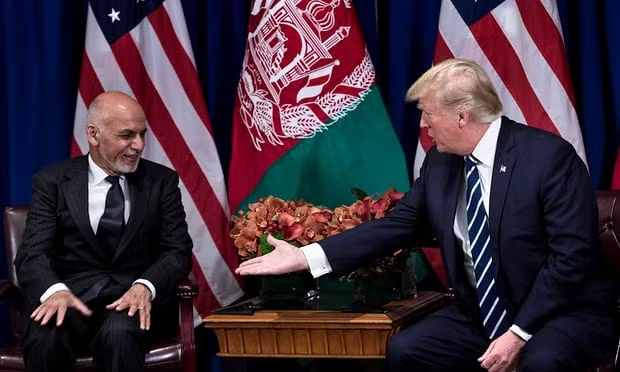 |
| Trump with Ashraf Ghani, the Afghan president, at the UN last week. Photograph: Getty Images |
A request to close the office would have to be formally initiated by Kabul, but the ultimate decision would lie with the Qatari government.
According to one source close to the diplomatic exchanges, the office has become collateral damage of the continuing Saudi-Qatari standoff. Saudi Arabia and three other countries - Bahrain, Egypt, and the United Arab Emirates – have been locked in a dispute with Qatar since June because of claims that Qatar supports Iran and Islamists and funds terrorism. Qatar has denied the claims.
Trump has offered to mediate in that dispute while indicating strongly he shared Riyadh’s view of the dispute. The US president is believed to have raised the issue of the Taliban office at a meeting last Tuesday with the emir of Qatar, Tamim bin Hamad al-Thani.
In February, Ghani told the Qatari foreign minister during a security conference in Munich that the Taliban office should be closed.
It is not known whether Tamim agreed to close the office, but he is eager to cultivate support from Washington at a time when his country has been subjected to a crippling economic blockade by hostile neighbours.
The Taliban’s political commission established a permanent presence in Doha in 2011, soon after making its first secret contacts with the US in Germany. It became the point of contact for Taliban diplomacy from then on, though an attempt in 2013 to open a formal embassy collapsed in the face of fierce opposition from Kabul.
The Taliban were quickly forced to remove their flag and nameplate, but the compound has remained as an informal delegation in Doha for diplomatic contacts. Those contacts have not led to substantive peace talks, but have been a channel for humanitarian agreements aimed at reducing the toll the 16-year war has taken on civilians.
It was instrumental in a 2014 prisoner exchange in which the US transferred five Taliban members from Guantánamo Bay to Qatar, in return for a captured US army sergeant, Bowe Bergdahl.
“I am concerned that if the Taliban political commission is closed down in Doha, hardliners in the movement will exploit this to claim that the US is uninterested in peace. It will provide these hard-liners with the perfect excuse to stay out of peace talks and fight on,” said Michael Semple, an expert on the region and visiting research professor at Queen’s University Belfast.