 |
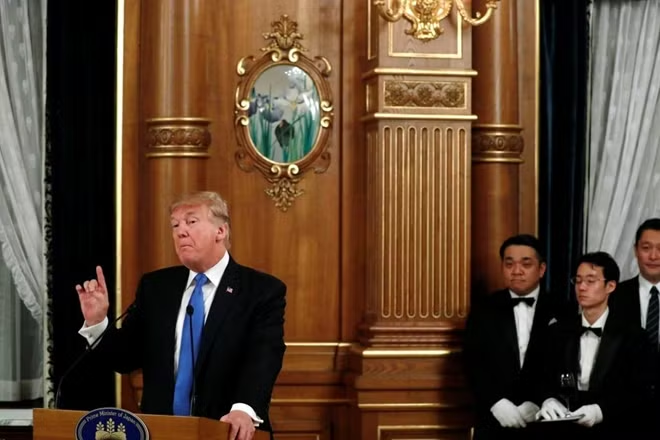
| Waiters hold U.S. President Donald Trump's Diet Coke as he delivers remarks before his toast to Japan's Prime Minister Shinzo Abe during an official dinner in Trump's honor at Akasaka Palace in Tokyo, Japan November 6, 2017. REUTERS/Jonathan Ernst |
North Korea is pursuing nuclear weapons and missile programs in defiance of U.N. Security Council sanctions and has made no secret of its plans to develop a missile capable of hitting the U.S. mainland. It has fired two missiles over Japan.
Trump, speaking after a summit with Japanese Prime Minister Shinzo Abe, repeated his mantra the “era of strategic patience” with North Korea was over, and said the two countries were working to counter the “dangerous aggressions”.
Trump also pressed Japan to lower its trade deficit with the United States and buy more U.S. military hardware.
“He (Abe) will shoot them out of the sky when he completes the purchase of lots of additional military equipment from the United States,“ Trump said, referring to the North Korean missiles. ”The prime minister is going to be purchasing massive amounts of military equipment, as he should. And we make the best military equipment by far.”
Abe, for his part, said Tokyo would shoot down missiles “if necessary”.
Trump was replying to a question that was posed to Abe - namely how he would respond to a quote from Trump from a recent interview in which he said Japan was a “samurai” nation and should have shot down the North Korean missiles.
Japan’s policy is that it would only shoot down a missile if it were falling on Japanese territory or if it were judged to pose an “existential threat” to Japan because it was aimed at a U.S. target.
The U.S. president is on the second day of a 12-day Asian trip that is focusing on North Korea’s nuclear missile programs and trade.
“Most importantly, we’re working to counter the dangerous aggressions of the regime in North Korea,” Trump said, calling Pyongyang’s nuclear tests and recent launches of ballistic missiles over Japan “a threat to the civilized world and to international peace and stability”.
“Some people said that my rhetoric is very strong. But look what’s happened with very weak rhetoric over the last 25 years. Look where we are right now,” he added.
North Korea’s recent actions have raised the stakes in the most critical international challenge of Trump’s presidency.
The U.S. leader, who will visit South Korea on the trip, has rattled some allies with his vow to “totally destroy” North Korea if it threatens the United States and with his dismissal of North Korean leader Kim Jong Un as a “rocket man” on a suicide mission.
Abe, with whom Trump has bonded through multiple summits and phone calls, repeated at the same news conference that Japan backed Trump’s stance that “all options” are on the table, saying it was time to exert maximum pressure on North Korea and the two countries were “100 percent” together on the issue.
Chinese Foreign Ministry spokesman Hua Chunying, in response to Abe’s comments, said that the North Korean “situation” was “already extremely complex, sensitive and weak”.
“We hope that under the present circumstances, all sides’ words and actions can help reduce tensions and reestablish mutual trust and getting the North Korean nuclear issue back on the correct track of dialogue and negotiations,” she said.
TRADE DEFICITS
Trump said he was committed to achieving “free, fair, and reciprocal” trade and wants to work with Japan on this issue.
“America is also committed to improving our economic relationship with Japan,” Trump said. “As president, I‘m committed to achieving fair, free, and reciprocal trading relationship. We seek equal and reliable access for American exports to Japan’s markets in order to eliminate our chronic trade imbalances and deficits with Japan.”
Earlier, speaking to Japanese and U.S. business executives, Trump praised Japan for buying U.S. military hardware.
But he added that “many millions of cars are sold by Japan into the United States, whereas virtually no cars go from the United States into Japan”.
Japan had a $69 billion trade surplus with the United States last year, according to the U.S. Treasury Department. The United States was Japan’s second biggest trade partner after China, while Japan was the United States’ fourth largest goods export market in 2016.
EMPEROR, ABDUCTEES
Japanese officials have countered U.S. trade complaints by noting Tokyo accounts for a much smaller slice of the U.S. deficit than in the past, while China’s imbalance is bigger.
In a second round of economic talks in Washington last month, U.S. Vice President Mike Pence and Japanese Finance Minister Taro Aso, who doubles as deputy premier, failed to bridge differences on trade issues.
The two sides are at odds over how to frame future trade talks, with Tokyo pushing back against U.S. calls to discuss a bilateral free trade agreement.
Trump also said earlier that an Indo-Pacific trade framework would produce more in trade that the Trans-Pacific Partnership pact pushed by his predecessor but which he announced Washington would abandon soon after he took office.
The 11 remaining nations in the TPP, to which Japan’s Abe is firmly committed, are edging closer to sealing a comprehensive free trade pact without the United States.
Trump met Emperor Akihito, exchanging a handshake and nodding, before his lunch and talks with Abe.