 |
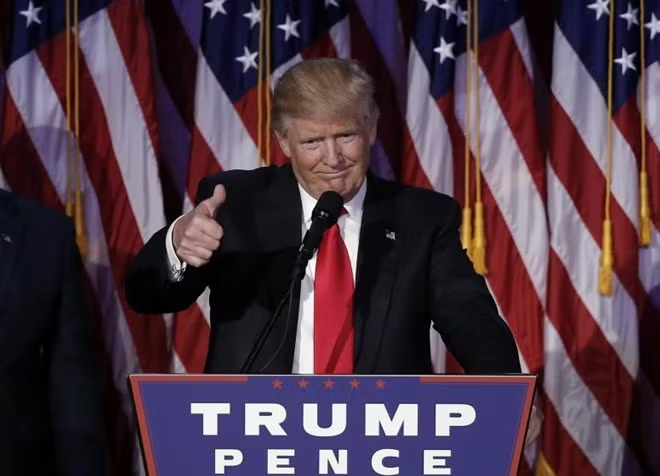
| Donald Trump officially win election as the next president. Photo by Reuters. |
Trump, who is set to take office on Jan. 20, garnered more than the 270 electoral votes required to win, even as at least half a dozen U.S. electors broke with tradition to vote against their own state’s directives, the largest number of “faithless electors” seen in more than a century.
The Electoral College vote is normally a formality but took on extra prominence this year after a group of Democratic activists sought to persuade Republicans to cross lines and vote for Democratic nominee Hillary Clinton. She won the nationwide popular vote even as she failed to win enough state-by-state votes in the acrimonious Nov. 8 election.
Protesters briefly disrupted Wisconsin's Electoral College balloting. In Austin, Texas, about 100 people chanting: “Dump Trump” and waving signs reading: “The Eyes of Texas are Upon You” gathered at the state capitol trying to sway electors.
In the end, however, more Democrats than Republicans went rogue, underscoring deep divisions within their party. At least four Democratic electors voted for someone other than Clinton, while two Republicans turned their backs on Trump.
With nearly all votes counted, Trump had clinched 304 electoral votes to Clinton's 227, according to an Associated Press tally of the voting by 538 electors across the country.
"I will work hard to unite our country and be the President of all Americans," Trump said in a statement responding to the results.
The Electoral College assigns each state electors equal to its number of representatives and senators in Congress. The District of Columbia also has three electoral votes. The votes will be officially counted during a joint session of Congress on Jan. 6.
When voters go to the polls to cast a ballot for president, they are actually choosing a presidential candidate's preferred slate of electors for their state.
The "faithless electors" as they are known represent a rare break from the tradition of casting an Electoral College ballot as directed by the outcome of that state's popular election.
The most recent instance of a "faithless elector" was in 2004, according to the Congressional Research Service. The practice has been very rare in modern times, with only eight such electors since 1900, each in a different election.
The two Republican breaks on Monday came from Texas, where the voting is by secret ballot. One Republican elector voted for Ron Paul, a favorite among Libertarians and former Republican congressman, and another for Ohio Governor John Kasich, who challenged Trump in the race for the Republican nomination.
Republican elector Christopher Suprun from Texas had said he would not vote for Trump, explaining in an op-ed in the New York Times that he had concerns about Trump's foreign policy experience and business conflicts.
On the Democratic side, it appeared to be the largest number of electors not supporting their party's nominee since 1872, when 63 Democratic electors did not vote for party nominee Horace Greeley, who had died after the election but before the Electoral College convened, according to Fairvote.org. Republican Ulysses S. Grant had won re-election in a landslide.
Four of the 12 Democratic electors in Washington state broke ranks, with three voting for Colin Powell, a former Republican secretary of state, and one for Faith Spotted Eagle, a Native American elder who has protested oil pipeline projects in the Dakotas.
Bret Chiafalo, 38, of Everett, Washington, was one of three votes for Powell. He said he knew Clinton would not win but believed Powell was better suited for the job than Trump.
The founding fathers "said the electoral college was not to elect a demagogue, was not to elect someone influenced by foreign powers, was not to elect someone who is unfit for office. Trump fails on all three counts, unlike any candidate we’ve ever seen in American history," Chiafalo said in an