- Outspoken general named Trump's top security adviser
- Trump's pick for national security adviser turns down offer: White House official
- Minister of Public Security welcomed National Security Adviser of Philippines
McMaster is joining the White House staff with views on Russia, counterterrorism, strengthening the military and other major security issues that diverge not only from those of the Trump loyalists, but also from those the president himself has expressed.
A military intellectual whose ideas have been shaped more by experience than by emotion, more by practice than by politics, and more by intellect than by impulse may also find himself in political terrain that may be as alien, and perhaps as hostile, to him as the sands and cities of Afghanistan and Iraq were.
McMaster will not be alone, however. His prominent administration allies include Defense Secretary Jim Mattis; Marine General Joseph Dunford, the chairman of the Joint Chiefs of Staff; and Senator John McCain, chairman of the Senate Armed Services Committee; as well as many of the soldiers who have served with him.
White House press secretary Sean Spicer said on Tuesday that Trump told McMaster "he's got full authority to structure the national security team the way he wants."
Trump, however, already has taken the unusual step of adding Steve Bannon, his chief strategic adviser known for right-wing ideological views, to the White House National Security Council.
"The real potential for flashpoints is with some of the people that Steve Bannon has brought into the administration ... people who see things very ideologically," said Andrew Exum, a former Army officer and Defense Department Mideast policy official and McMaster friend for more than a decade.
Trump's early missteps on immigration and other issues "have strengthened the leverage available to not only H.R. McMaster, but also Defense Secretary Mattis and Secretary (of State Rex) Tillerson potentially," Exum said.
One of the first tests of McMaster's influence will be the administration's review of U.S. policy in Syria, and more broadly against Islamic militancy. The review's results are due early next week, Pentagon officials said on Tuesday.
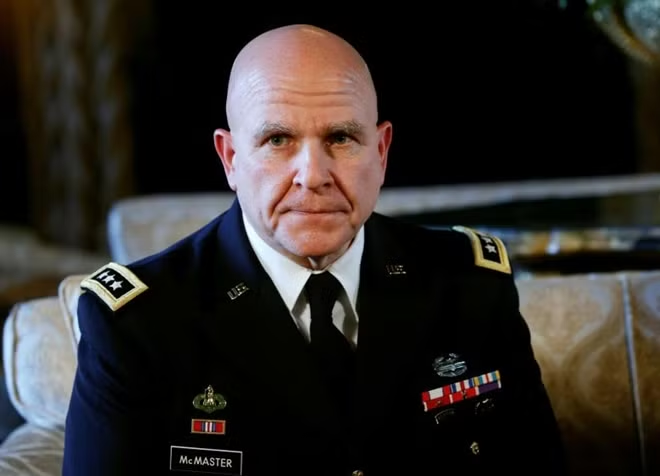 |
| Newly named National Security Adviser Army Lt. Gen. H.R. McMaster listens as U.S. President Donald Trump makes the announcement at his Mar-a-Lago estate in Palm Beach, Florida U.S. |
Bannon said last June that the United States and its European allies are fighting a "global existential war" against Islam.
McMaster's approach to defeating Sunni Muslim militants has been more nuanced, resting largely on separating extremists from the vast majority of the local population.As commander of the Army's 3rd Armored Cavalry Regiment, then-Colonel McMaster prepared his troopers for retaking the city of Tal Afar on the Iraqi-Syrian border in 2005 by having some of them dress in traditional Arab dishdashas, recruiting Arab-Americans to play the part of locals, and teaching his troops how to determine if a household was Sunni or Shiite by looking at the pictures hung on the walls.McMaster ordered his soldiers never to call the Iraqis they encountered "hajjis," which many Americans used as a derogatory term for the Muslim pilgrimage to Mecca.
Writing in the journal Military Review, he warned that emphasizing force, as Trump has done in his vows to bomb Islamic State into oblivion, could backfire."In Iraq, an inadequate understanding of tribal, ethnic, and religious drivers of conflict ... sometimes led to military operations (such as raids against suspected enemy networks) that exacerbated fears or offended the sense of honor of populations in ways that strengthened the insurgency," he wrote.
That is not to say McMaster is a shaved-headed intellectual hesitant to use force. Twenty-one of his troopers were killed in action in Tal Afar, and one unit suffered 40 percent casualties.
RUSSIA TEST
A second early test for McMaster will be Russia policy.
Unlike his predecessor, Michael Flynn, and Trump himself, McMaster regards Moscow as an adversary rather than a potential partner.Last May, at the Center for Strategic and International Studies think tank, McMaster cited Russia's annexation of Crimea and support for rebels in eastern Ukraine as evidence of a broader effort "to collapse the post-World War Two, certainly the post-Cold War, security, economic, and political order in Europe and replace that order with something that is more sympathetic to Russian interests."A third area where McMaster's thinking differs from the president's rhetoric is the size and shape of the U.S. military.
Trump has promised to add tens of thousands more soldiers, expand the Navy to 350 ships from 282, and "provide the Air Force with the 1,200 fighter aircraft they need," according to his campaign website.In his scholarly 2015 Military Review article, which has 39 footnotes, including one citing Greek historian Thucydides' account of the Peloponnesian War, McMaster argued that "promising victory delivered rapidly from stand-off range, based on even better surveillance, intelligence, information, and precision strike capabilities" is a fallacy that "confuses targeting enemy organizations with strategy."The question now is whether McMaster's views will have sufficient force to alter the course of U.S. policy set by the president and his closest aides.
"The real challenges he's going to confront, I think, are not the challenges of strategy and the global responsibilities of the world's only superpower," said John Nagl, a retired Army colonel who helped rewrite U.S. counterinsurgency doctrine for the Iraq and Afghanistan wars.
"He knows how to deal with those things." Nagl continued. "The challenges he's going to confront are moral, dealing with an administration that has not always been clear in its support for American values."
Whatever his odds, McMaster took the job not simply because his commander-in-chief could order him to do it.
"Those who ignore history are doomed to repeat it," he once said. "Those who ignore them are doomed to watch."