- Britain's May to launch EU divorce proceedings on March 29
- China invites Britain to attend new Silk Road summit
- Britain to leave EU market as May sets 'hard Brexit' course
- Britain, US sending planes, troops to deter Russia in the east
The U.S. Department of Homeland Security said passengers traveling from a specific list of airports could not bring into the main cabin devices larger than a mobile phone such as tablets, portable DVD players, laptops and cameras.
Instead, such items must be in checked baggage.
Although civil liberties groups raised concerns that U.S. President Donald Trump was seeking another limit on movement after a travel ban from Muslim-majority countries was challenged in the courts, Britain took similar steps.
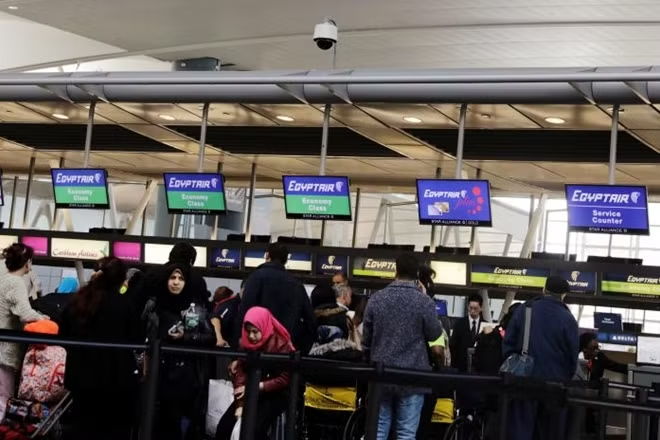 |
| Travelers wait to check in at an Egypt Air counter at JFK International Airport in New York, U.S., March 21, 2017. REUTERS/Lucas Jackson |
A spokesman for British Prime Minister Theresa May said there would be curbs on electronic items in the cabin on flights from six countries in the Middle East. The foreign office said the measures would be implemented by March 25.
The moves were prompted by reports that militant groups want to smuggle explosive devices inside electronic gadgets.
The ban would continue for the "foreseeable future," a U.S. government official said on Tuesday, adding that it was possible it could be extended to other airports and other countries.
White House spokesman Sean Spicer declined to talk about the intelligence that prompted the new steps or explain why some countries were left off the list.
Senator Bill Nelson, a Florida Democrat, said he "spoke to the intelligence community over the weekend, and this is a real threat."
U.S. officials say militant groups are known for innovative bomb designs, including embedding them inside computers. Yemen-based Al Qaeda in the Arabian Peninsula (AQAP) also has boasted of one of the world's most feared bomb makers, Ibrahim Hassan al-Asiri.
French and Canadian officials said they were examining their arrangements but neither government was taking additional security measures at this stage.
The airports covered by the U.S. restrictions are in Cairo; Istanbul; Kuwait City; Doha, Qatar; Casablanca, Morocco; Amman, Jordan; Riyadh and Jeddah, Saudi Arabia; and Dubai and Abu Dhabi in United Arab Emirates.
The affected airports are served by nine airlines that fly directly from those cities to the United States about 50 times a day, senior government officials said.
The carriers -- Royal Jordanian Airlines, Egypt Air, Turkish Airlines, Saudi Arabian Airlines, Kuwait Airways, Royal Air Maroc, Qatar Airways, Emirates and Etihad Airways -- have until Friday to adopt the new policy, which took effect on Tuesday.
No U.S. airlines are on the list because there are no direct flights on them between the United States and the cited airports, officials said.
Britain said its restrictions would apply to direct flights from Turkey, Lebanon, Jordan, Egypt, Tunisia and Saudi Arabia.
The British regulations affect British Airways, easyJet, Jet2, Monarch, Thomas Cook, Thomson, Atlas-Global, Pegasus, EgyptAir, Royal Jordanian, Middle East Airlines, Saudia, Turkish Airlines and Tunisair.
IAG-owned British Airways advised customers departing from affected airports to arrive in good time at check-in.
Shares in IAG turned lower after the UK announcement, with easyJet also ending the day in negative territory.