Trump will leave tariffs on $200 billion worth of Chinese imports at 10 percent at the beginning of the new year, agreeing to not raise them to 25 percent “at this time”, the White House said in a statement.
 |
| U.S., China agree trade war ceasefire after Trump, Xi summit |
“China will agree to purchase a not yet agreed upon, but very substantial, amount of agricultural, energy, industrial, and other product from the United States to reduce the trade imbalance between our two countries,” it said.
“China has agreed to start purchasing agricultural product from our farmers immediately.”
The two leaders also agreed to immediately start talks on structural changes with respect to forced technology transfers, intellectual property protection, non-tariff barriers, cyber intrusions and cyber theft, services and agriculture, the White House said.
Both countries agreed they will try to have this “transaction” completed within the next 90 days, but if this does not happen then the 10 percent tariffs will be raised to 25 percent, it added.
The Chinese government’s top diplomat, State Councillor Wang Yi, said the negotiations were conducted in a “friendly and candid atmosphere”.
“The two presidents agreed that the two sides can and must get bilateral relations right,” Wang told reporters, adding they agreed to further exchanges at appropriate times.
“Discussion on economic and trade issues was very positive and constructive. The two heads of state reached consensus to halt the mutual increase of new tariffs,” Wang said.
“China is willing to increase imports in accordance with the needs of its domestic market and the people’s needs, including marketable products from the United States, to gradually ease the imbalance in two-way trade.”
“The two sides agreed to mutually open their markets, and as China advances a new round of reforms, the United States’ legitimate concerns can be progressively resolved.”
The two sides would “step up negotiations” toward full elimination of all additional tariffs, Wang said.
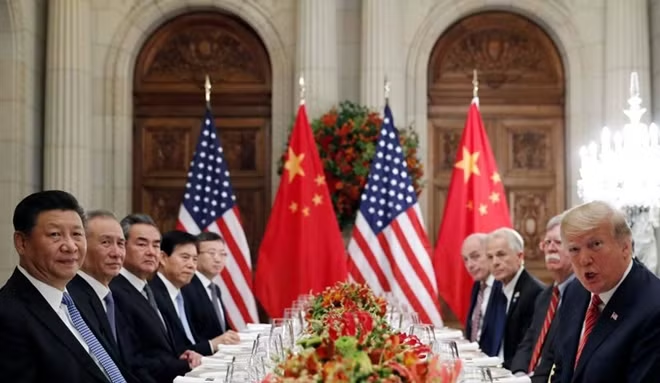
The announcements came after Trump and Xi sat down with their aides for a working dinner at the end of a two-day gathering of world leaders in Buenos Aires, their dispute having unnerved global financial markets and weighed on the world economy.
After the 2-1/2 hour meeting, White House chief economist Larry Kudlow told reporters the talks went “very well,” but offered no specifics as he boarded Air Force One headed home to Washington with Trump.
China’s goal was to persuade Trump to abandon plans to raise tariffs on $200 billion of Chinese goods to 25 percent in January, from 10 percent at present. Trump had threatened to do that, and possibly add tariffs on $267 billion of imports, if there was no progress in the talks.
With the United States and China clashing over commerce, financial markets will take their lead from the results of the talks, widely seen as the most important meeting of U.S. and Chinese leaders in years.