U.S. Defense Secretary Mattis to press European allies on military spending

U.S. Secretary of Defense Jim Mattis will press European allies on Wednesday to stick to a promise to increase military budgets as the United States offers an increase in its own defense spending in Europe.
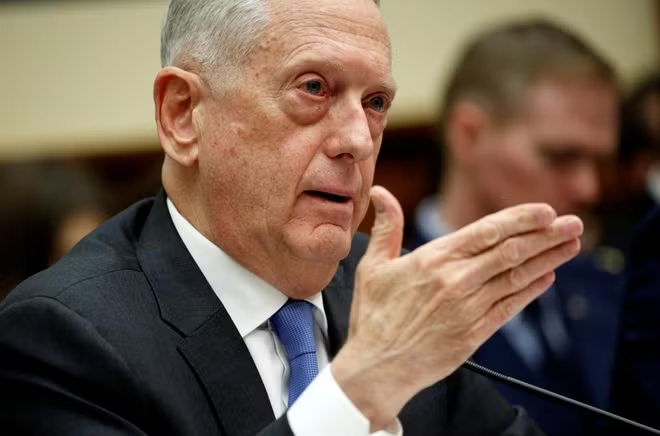
U.S. Defense Secretary Jim Mattis testifies to the House Armed Services Committee on "The National Defense Strategy and the Nuclear Posture Review" on Capitol Hill in Washington, U.S., February 6, 2018. REUTERS
U.S. Defense Secretary Jim Mattis testifies to the House Armed Services Committee on "The National Defense Strategy and the Nuclear Posture Review" on Capitol Hill in Washington, U.S., February 6, 2018. REUTERS 

For the first time, NATO countries have submitted plans to show how they will reach a target to spend 2 percent of economic output on defense every year by 2024, after Trump threatened to withdraw U.S. support for low-spending allies.

Fifteen of the 28 countries, excluding the United States, now have a strategy to meet a NATO benchmark first agreed in 2014 in response to Russia’s annexation of Ukraine’s Crimea region, following years of cuts to European defense budgets.

It is unclear whether that will be enough to impress U.S. President Donald Trump when he attends a NATO summit in July.

While France plans to increase defense spending by more than a third between 2017 and 2025, Spain has said it will not meet the 2024 target, while Belgium and Italy are also lagging.

A multi-billion euro projected increase in Germany will not be enough to take Berlin up to 2 percent by 2024.

Mattis is expected to take a tough stance, according to Katie Wheelbarger, principal U.S. deputy assistant secretary of defense for international security affairs.

“He will address those who don’t have national plans to meet 2 percent and suggest they really need to develop those plans,” she told reporters.

MIXED MESSAGE?

The issue of low defense spending in Europe has long been an irritant in Washington. But Russia’s military modernization, Islamist militancy and electronic warfare on computer networks have underscored Europe’s heavy reliance on the United States.

According to NATO data, Britain, Greece, Romania and the Baltic countries of Estonia, Latvia and Lithuania meet, or are close to, the 2 percent goal, while France and Turkey are among those countries set to reach it soon.

One area of tension lies in the language of the NATO spending pledge of 2014. Allies committed to “move toward” 2 percent, while Trump now says 2 percent is the “bare minimum.”

Trump has also set an example by proposing a $1.7 billion increase in military expenditure in Europe for 2019, as the United States leads NATO efforts to deter Russia.

But U.S. officials have also sown confusion about their support for a new defense pact to coordinate European Union defense policy and allow countries to club together to buy arms.

Wheelbarger warned that “we don’t want to see EU efforts pulling requirements or activity away from NATO and into the EU.” The U.S. envoy to NATO, Kay Bailey Hutchison, said there were concerns that U.S. defense companies would be shut out.

“We do not want this to be a protectionist vehicle for the EU,” she said of the proposed pact.
Reuters

Other News

Vietnam supports UNESCO's people-centred approach, multilateral cooperation: official

Vietnam supports UNESCO's people-centred approach, multilateral cooperation: official

Van affirmed Vietnam’s support for the UNESCO80 reform roadmap, focusing on the organisation’s core mandate, priority areas, interdisciplinary approach, and the special status of the Vietnam National Commission for UNESCO, and UNESCO representative offices, alongside efforts to diversify resources and strengthen global partnerships to enhance the organisation’s effectiveness.

Regional media highlight significant step in Vietnam’s leadership structure

Regional media highlight significant step in Vietnam’s leadership structure

Under General Secretary and President Lam’s leadership, Vietnam is expected to maintain a balanced foreign policy, strengthen its regional standing and accelerate economic development, thereby improving living standards and creating new opportunities for international investors, according to the India-based platform Devdiscourse.

Laos identifies 10 key tasks to build independent, self-reliant economy

Laos identifies 10 key tasks to build independent, self-reliant economy

Laos will step up agricultural production to ensure food security, meet domestic demand and expand exports; encourage the development of agro-processing industries, including those related to rubber, aquatic products, cassava and sugarcane, as well as fertiliser and animal feed production, in order to increase added value and create jobs in rural areas.

Malaysia steps up cyber security resilience

Malaysia steps up cyber security resilience

To ensure accountability, Malaysia plans to finalise the Cybercrime Bill this year which addresses both cyber-dependent and cyber-enabled offences, introducing stricter penalties and prison terms to enhance deterrence.

US public opinion positive about PM Pham Minh Chinh’s visit

US public opinion positive about PM Pham Minh Chinh’s visit

Public opinion in the US is generally positive about Vietnamese Prime Minister Pham Minh Chinh’s trip to the US from September 17-23 to attend the 78th session of the United Nations General Assembly, which took place immediately after the upgrading of the Vietnam - US relations to a comprehensive strategic partnership on the occasion of US President Joe Biden’s official visit to Vietnam.