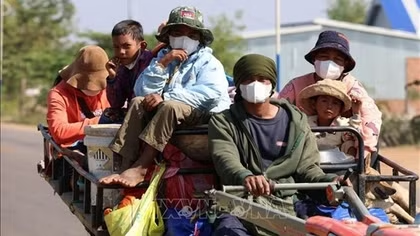
A large number of deprived people- who have suffered economically due to the novel coronavirus (COVID-19)- queue up in order to receive rice for free
The article said Vietnam has sealed its borders, quarantined masses of people, used soldiers and police to track down potential infections and fined social media users for spreading misinformation. After deploying the full arsenal, the sprawling nation of 95 million people has now gone a full week without recording a new infection.
Vietnam mobilized the entire apparatus to become involved in the battle against the COVID-19 pandemic, which received wide response from the people.
But despite their effectiveness, Vietnam’s measures are not easily replicable. Its intolerance of dissent and ability to mobilize an entire security and political apparatus — steps more common in China — meant its campaign met little of the pushback seen in Western liberal democracies.
Starting on April 23, Vietnam allowed residents across the country to resume small gatherings and restarted buses, taxis and regular domestic flights for the first time in three weeks. But with much of Southeast Asia still under lockdown, people must continue wearing masks in public, gatherings of more than 20 remain off-limits, schools will stay closed for several more weeks and international flights are still grounded.
“The numbers are stunningly low considering that Vietnam — which shares a border with China — was among the first countries where the virus spread and lacks the resources of governments more celebrated for their containment strategies, such as South Korea’s widespread testing and Taiwan’s aggressive digital surveillance,” the article said.
Its results stand out even more as other Southeast Asian countries struggle. Wealthy Singapore, once regarded as a model, has seen infections skyrocket among migrant workers living in overcrowded dormitories. Indonesia, the largest country in the region, initially ignored the threat and now has the most COVID-19 deaths in Asia after China.
“It’s pretty amazing,” said Huong Le Thu, a senior analyst at the Australian Strategic Policy Institute. “I’m cautious of calling Vietnam a success story. It’s too early to be out of the woods. But the measures have been quite effective so far.”
Experts credit Vietnam’s early, decisive steps such as swiftly banning nearly all travel from China, suspending schools in mid-January even before recording any infections, quarantining tens of thousands of people, employing distancing measures and tracing the contacts of COVID-19 patients.
“Only a few countries can control and mobilize resources on this scale,” said Le Hong Hiep, a Vietnam analyst at the ISEAS-Yusof Ishak Institute in Singapore. “In Vietnam they can do it, and partly because of a political system that’s designed to respond to such situations. It’s not always good, but in a crisis it helps.”
In recent weeks, as imported infections surged across Asia, Vietnam placed tens of thousands of incoming travelers — whether they showed COVID-19 symptoms or not — in quarantine at army barracks, university dorms and other public facilities.
“What we know now is this virus spreads from pre-symptomatic people, and if you’re only monitoring people when they get symptoms it’s too late,” said Todd Pollack, a Harvard Medical School infectious disease specialist who leads a health initiative in Hanoi.
Meanwhile, results of a 12-country opinion poll by Ipsos Business Consulting showed that "Vietnam people have a general positive sentiment towards Vietnam state measures", its country head, Mr Phong Quach, told The Straits Times. In its March 12-14 survey, well over 80 per cent of Vietnamese respondents expected things to return to normal by June, making them more optimistic than respondents in the United States, Italy, France, Russia, Japan and India.