- Trump administration proposes stricter Obamacare rules
- U.S. House votes to begin repealing Obamacare
- New Congress prepares to undo Obamacare, weigh Trump personnel picks
In a battle waged since the 2010 passage of the Affordable Care Act, Democratic President Barack Obama's signature domestic policy achievement, Republicans including President Donald Trump have long vowed to repeal and replace the law. But they failed for years to coalesce around an alternative.
With a proposal now on the table, the fate of the plan is uncertain even with Republican majorities in both chambers. Also unclear is where Trump stands on many of the details.
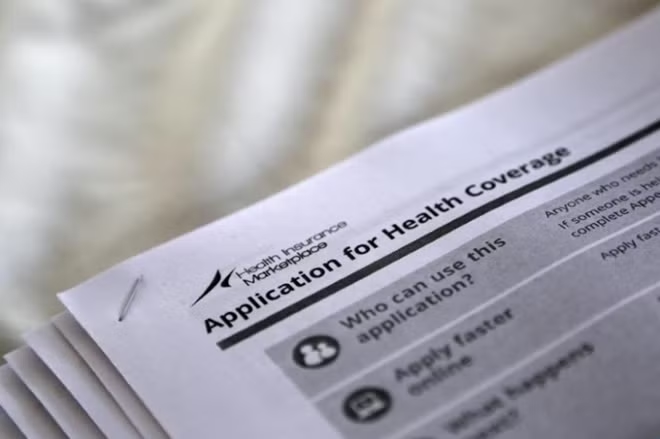 |
| The federal government forms for applying for health coverage are seen at a rally held by supporters of the Affordable Care Act, widely referred to as ''Obamacare'', outside the Jackson-Hinds Comprehensive Health Center in Jackson, Mississippi, U.S. on October 4, 2013. REUTERS/Jonathan Bachman/File Photo |
"Today marks an important step toward restoring healthcare choices and affordability back to the American people," the White House said in a statement, adding Trump looked forward to working with Congress on replacing Obamacare.
Republicans condemn Obamacare as government overreach, and Trump has called it a "disaster."
Critics complained about the penalty the law charged those who refused to buy insurance. The Republican proposal would repeal that penalty immediately.
Congressional Democrats denounced the Republican plan, saying it would hurt Americans by requiring them to pay more for healthcare, to the benefit of insurers.
Obamacare is popular in many states, even some controlled by Republicans. It has brought health insurance coverage to about 20 million previously uninsured Americans, although premium increases have angered some.
About half those people gained coverage through an expansion of the Medicaid program for the poor. The Republican proposal would end the Medicaid expansion on Jan. 1, 2020, and cap Medicaid funding after that date.
Just before the plan was unveiled, four moderate Senate Republicans jointly expressed concern that an earlier draft would not adequately protect those who got coverage under Medicaid, raising doubts about the legislation's future in the Senate.
Several Senate and House conservatives have already expressed doubt about another aspect of the plan, the offering of tax credits for the purchase of health insurance. The proposal seeks to encourage people to buy insurance with the age-based credits, which would be capped at upper-income levels.
The legislation would abolish the current income-based subsidies for purchasing insurance under Obamacare.
The proposal would protect two of the most popular provisions of Obamacare. It would prohibit insurers from denying coverage or charging more to those with pre-existing conditions, and it would allow adults up to age 26 to remain on their parents' health plans. Trump has long supported by both ideas.
The measure would also provide states with $100 billion to create programs for patient populations, possibly including high-risk pools to provide insurance to the sickest patients.