Vietnam pledges active role in global efforts for children

Congratulating Regional Director of UNICEF's Asia-Pacific Regional Office (APRO) Sanjay Wijesekera on his new appointment, Deputy Prime Minister Pham Thanh Tra highlighted the historic achievements of five decades of cooperation between Vietnam and UNICEF, describing the partnership as one built on close coordination, mutual trust and effective collaboration in protecting, caring for, educating and promoting the development of children.

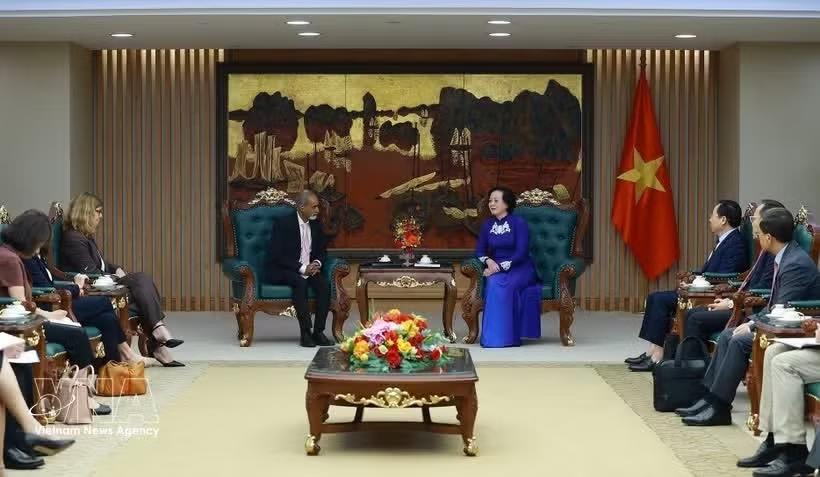
Hanoi (VNA) – Deputy Prime Minister Pham Thi Thanh Tra received Regional Director of UNICEF's Asia-Pacific Regional Office (APRO) Sanjay Wijesekera in Hanoi on August 24, affirming that Vietnam is committed to being an active member of global efforts for children, and expressing her confidence that the trusted and effective partnership between Vietnam and UNICEF will continue to flourish.
4.jpg
Deputy Prime Minister Pham Thi Thanh Tra (right) receives Regional Director of UNICEF's Asia-Pacific Regional Office (APRO) Sanjay Wijesekera in Hanoi on August 24. (Photo: VNA)

Congratulating Wijesekera on his new appointment, Tra highlighted the historic achievements of five decades of cooperation between Vietnam and UNICEF, describing the partnership as one built on close coordination, mutual trust and effective collaboration in protecting, caring for, educating and promoting the development of children.

She stressed that child protection, care and education have always been identified by the Party and State as an especially important strategic priority, as children represent the future of the nation. Investment in children is investment in the future and a cornerstone for achieving the Sustainable Development Goals.

The Deputy PM highlighted Vietnam’s recent achievements, including completing universal lower-secondary education and working towards universal upper-secondary education; reducing child malnutrition to its lowest level; continuously improving policies and institutions; and substantially narrowing development gaps among regions and disparities affecting vulnerable children, particularly those in ethnic minority and mountainous areas.

For his part, Wijesekera said Vietnam is the first country he has chosen to visit after taking up his new post. He praised Vietnam for being the first Asian country to sign the UN Convention on the Rights of the Child (CRC) in 1990, as well as for its strong political commitment and sustained, prudent investment in children over the past decades.

These long-term efforts have delivered remarkable progress in reducing child mortality and improving nutrition, healthcare, education and child protection, he said, adding that Vietnam’s experience offered valuable lessons for other countries in the region.

Wijesekera said UNICEF and its Vietnamese partners have been working to develop a new Country Programme, affirming UNICEF’s strong commitment to supporting the programme and Vietnam’s development vision on the basis of the solid foundation established through their longstanding partnership.

He outlined several priority areas for future cooperation, including expanding livelihood, employment and skills-development opportunities for young people after leaving the education system; jointly addressing climate change; improving the effectiveness of public financial management for investment in children while ensuring such investment does not create a public debt burden; and, particularly, strengthening cooperation in digital technology and artificial intelligence (AI) to improve development outcomes and protect children online from cyber threats.

Acknowledging UNICEF’s strategic recommendations, Tra noted that despite its major achievements, Vietnam still faces a number of challenges. The country has nearly 25 million children, with ethnic minority children accounting for 18.3%, while 8.4% of children live in multidimensional poverty and about 2.3% are in special circumstances.

To ensure fair, balanced and inclusive development opportunities for all children, Vietnam will review and assess the implementation of Party resolutions on social policies closely related to children, she said.

As Vietnam and UNICEF work towards adopting their 2027-2031 Country Programme, the Deputy PM proposed that the two sides focus on three strategic priorities.

First, on sharing experience and improving institutions and policies, she called on UNICEF to continue drawing on its global expertise to support Vietnam in strengthening its legal and institutional framework for children. New policies should provide multi-layered, flexible, comprehensive and inclusive support, shifting from a primarily assistance-based approach towards proactive investment in the younger generation to develop high-quality human resources and a sustainable society.

Second, on addressing technological challenges and protecting children online, she urged both sides to proactively harness opportunities offered by the digital era and AI to support children’s education and health, while preventing risks and minimising negative impacts on their mental health, nutrition and cognitive development arising from harmful online content and activities.

Third, on strengthening development and child governance capacity, Tra stressed the need to consolidate, strengthen and improve the skills of officials working on child-related issues from the central to provincial and commune levels following the restructuring of the administrative apparatus. She also called for a comprehensive and integrated child data system to support more effective management./.
en.vietnamplus.vn

Other News

Key Party leader meets Singaporean PAP Chairman

Key Party leader meets Singaporean PAP Chairman

Politburo member and permanent member of the Communist Party of Vietnam (CPV) Central Committee's Secretariat Tran Cam Tu said Vietnam-Singapore relations continue to grow as a friendly and particularly close partnership in Southeast Asia, built on high political trust, dynamic economic cooperation and close people-to-people bond.

16th NA wraps up first extraordinary session

16th NA wraps up first extraordinary session

Lawmakers passed 15 laws and six legal resolutions and gave first-round consideration to seven other draft laws. The session was aimed at clearing bottlenecks, fine-tuning the legal and institutional framework, accelerating decentralisation and delegation of authority, cutting administrative procedures, clearing barriers, unlocking resources, creating favourable conditions for citizens and businesses, and improving the effectiveness and efficiency of state management.

Lawmakers debate real estate, budget, nuclear project changes

Lawmakers debate real estate, budget, nuclear project changes

The draft revised real estate law is intended to turn Party and State guidelines into statute, codify tested resolutions that have been tested in practice, and shift power under the two-tier local administration model. It seeks to cut investment and business conditions, accelerate digital transformation, improve market transparency and predictability, strengthen market regulation, and clear practical bottlenecks to support a healthy property market.

Vietnam values relationship with US: Deputy Foreign Minister

Vietnam values relationship with US: Deputy Foreign Minister

Deputy Foreign Minister Dang Hoang Giang said Vietnam-US ties have maintained positive momentum following the February 2026 meeting between General Secretary of the Communist Party of Vietnam Central Committee and President To Lam and President Donald Trump, with regular exchanges and expanding cooperation across various fields.

Government proposes 30% income tax cut for small businesses

Government proposes 30% income tax cut for small businesses

The personal income tax payable for the 2026 and 2027 tax years is proposed to be reduced by 30% for resident individuals earning income from business activities, provided their annual revenue does not exceed 10 billion VND (about 383,600 USD).

National Assembly adds three items to agenda of first extraordinary session

National Assembly adds three items to agenda of first extraordinary session

The NA Standing Committee recommends adding three items to the agenda: separating the Ninh Thuan nuclear power project into independent projects; mechanisms and policies for sea-reclamation urban development projects to be incorporated into the draft Law on Urban Development; and a draft NA resolution on reducing personal income tax and corporate income tax for individuals and businesses.

Vietnam seeks to deepen strategic partnership with Kazakhstan

Vietnam seeks to deepen strategic partnership with Kazakhstan

Ambassador Nguyen Thanh Le affirmed that he will work closely with Kazakhstan’s Ministry of Foreign Affairs, ministries, agencies and localities to effectively implement high-level agreements, strengthen political trust and promote cooperation in trade, investment, transport and logistics, tourism, culture, education and people-to-people exchanges.

Amendments to Land Law aim to achieve three key goals

Amendments to Land Law aim to achieve three key goals

The Government has identified three major objectives: promptly institutionalising Party policies on land, private-sector development and national digital transformation; addressing urgent practical obstacles to unlock resources and support the goal of double-digit economic growth; and building a modern, streamlined and effective land management system through stronger decentralisation and administrative reform.

Draft laws must support management reform, stronger decentralisation: PM

Draft laws must support management reform, stronger decentralisation: PM

Participants looked into 11 draft laws and one draft resolution, including laws amending and supplementing several articles of laws on non-agricultural land use tax and corporate income tax; natural resources tax; securities; accounting and independent auditing; the Labour Code; and laws on archives, gender equality, Red Cross activities and employment.