Vietnamese martial arts seek UNESCO title

The People’s Committee of Binh Dinh province is currently working on submitting a request for UNESCO recognition of its traditional martial arts as an intangible part of humanity’s cultural heritage.

As part of its efforts to achieve recognition, the province has requested the Ministry of Culture, Sports and Tourism to send a dossier to the Government in order to consider and submit the proposal to UNESCO.

Binh Dinh represents one of the cradles of traditional Vietnamese martial arts, with this type of combat reaching its most glorious period during the era of the Tay Son dynasty.

During this period, tests were held and a training system was developed for both soldiers and generals. Indeed, they were thoroughly researched and applied to combat situations, with many martial arts schools opening in the province.
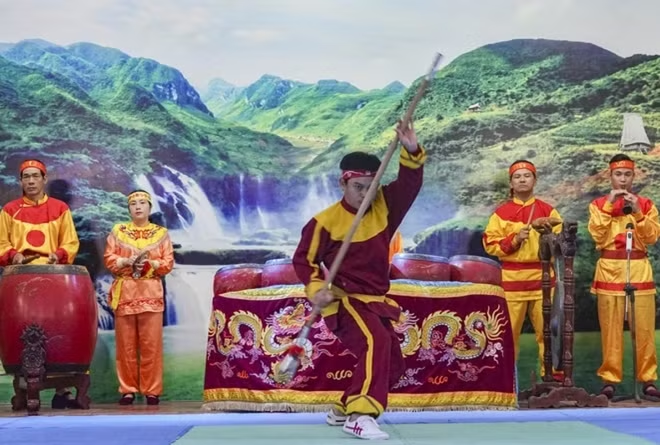
Binh Dinh martial arts seek UNESCO title as an intangible part of humanity’s cultural heritage
Binh Dinh  martial arts seek UNESCO title as an intangible part of humanity’s cultural heritage

The martial arts developed as a fusion of different kinds of local sects, leading to the creation of a more powerful form.

Most notably, peasant leader Nguyen Hue, who later became King Quang Trung in 1788, led the Tay Son insurgents in the fight against the corrupt feudal government and foreign invaders.

Legend has it that the Tay Son army never lost a battle thanks to the martial arts they practiced helping them to become invincible.

Following the death of King Quang Trung, the throne subsequently passed to King Nguyen Anh who pursued a policy of demolishing all the vestiges of the predecessor, including the practice of martial arts.

This marked the darkest period for the combat form as it gradually began to fade from importance.

Despite this decline, it remained a vital part of daily life for some and was still secretly taught and practiced by local people, and handed down to the future generations.

In the modern era, Binh Dinh now holds a special festival in honour of the famous battle fought by King Quang Trung, known as Ngoc Hoi-Dong Da, an event which occurred when he led his army to fight the invading Chinese Yuan troops in 1789.

Victory for the Vietnamese forces came on the fifth day of the first lunar month.

To mark that day, Binh Dinh province holds an annual festival during which traditional martial arts and games are performed, attracting thousands of visitors.

In 2012 the Vietnamese Government recognised Binh Dinh traditional martial arts as part of national heritage.

VOV

Other News

Vietnam secure berth at FIFA U17 World Cup 2026 for first time

Vietnam secure berth at FIFA U17 World Cup 2026 for first time

Vietnam national U17 football team secured a place at the FIFA U17 World Cup 2026 for the first time after defeating United Arab Emirates national U17 football team 3-2 on in the final Group C match of the AFC U17 Asian Cup 2026 in Saudi Arabia on early May 14 (Vietnam time).

Vietnam’s most beautiful railway station twins with French counterpart

Vietnam’s most beautiful railway station twins with French counterpart

A twinning agreement between Da Lat Railway Station in Vietnam and Trouville-Deauville Railway Station in France was signed at the French Embassy in Vietnam on May 7, creating new opportunities for cooperation in station management and operations, as well as cultural and tourism promotion between the two sides.

Hanoi gains two more craft villages in World Crafts Cities network

Hanoi gains two more craft villages in World Crafts Cities network

The recognition of Chuyen My and Son Dong craft villages as members of the World Crafts Cities network represents international acknowledgement of the cultural value, artisanal techniques, creativity and sustainable vitality of Vietnam’s traditional craft villages, he said.

Thang Long - Hanoi Festival 2026 to return in September

Thang Long - Hanoi Festival 2026 to return in September

Co-hosted by the municipal People’s Committee, the Department of Culture and Sports, and domestic and foreign agencies, the whole spectacle is meant to honour the city’s millennia-old heritage while reafffirming its strategy of establishing culture as a development engine.

Spreading Vietnamese cultural identity in digital space

Spreading Vietnamese cultural identity in digital space

In the context of deep international integration, cultural identity serves as both a “shield” against assimilation and a defining marker of a nation’s image. Protecting and promoting uniquely Vietnamese cultural values has therefore become a pressing task, particularly in an increasingly complex digital environment.

ITE HCMC 2026 to promote Vietnam’s tourism on global map

ITE HCMC 2026 to promote Vietnam’s tourism on global map

With its large scale, the ITE HCMC 2026 aims to promote tourism cooperation between Vietnam and priority markets such as Northeast Asia, Western Europe, North America, Southeast Asia, and Oceania while also boosting visitor arrivals from the Indian market

Vietnamese puppetry seeks renewal amid preservation challenges

Vietnamese puppetry seeks renewal amid preservation challenges

Although widely regarded as a cultural “speciality” attracting tourists, Vietnamese puppetry is facing multiple challenges in preservation and development, requiring renewed efforts to both safeguard its identity and adapt to contemporary cultural currents.

Project on digital transformation in cultural sector approved

Project on digital transformation in cultural sector approved

By 2030, the project targets the establishment of shared digital platforms across 100% of cultural sectors. All digitised cultural heritage will be standardised under the national data framework and shared in accordance with regulations, while 80% of public digital heritage assets are expected to receive digital identifiers to clarify ownership and management, encouraging organisations and individuals to do the same and support market development.

Vietnam eyes becoming region’s leading tourism destination

Vietnam eyes becoming region’s leading tourism destination

Vietnam has in recent years undergone a notable transformation in its tourism development strategy, placing a strong emphasis on nature-based and eco-tourism. This shift is not merely aligned with global trends, but represents a necessary step towards safeguarding valuable natural resources, while appealing to a growing segment of environmentally conscious travellers.