Vietnamese, Russian PMs hold talks in Moscow

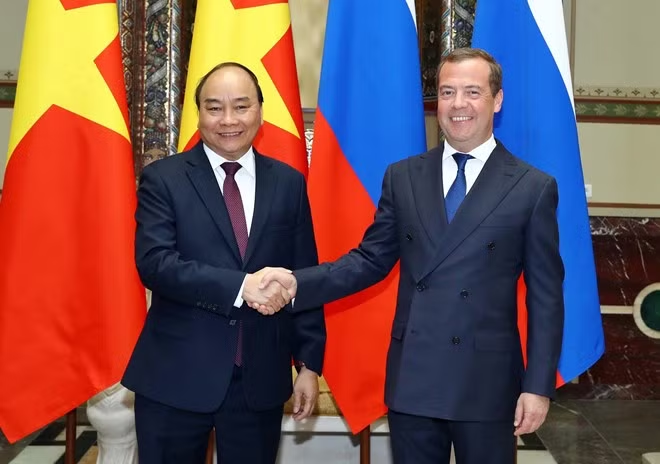
Vietnamese Prime Minister Nguyen Xuan Phuc and his Russian counterpart Dmitry Medvedev discussed measures to enhance the two countries’ cooperation during talks in Moscow on May 22.
Russian Prime Minister Dmitry Medvedev (R) welcomes his Vietnamese counterpart Nguyen Xuan Phuc in Moscow on May 22.
Russian Prime Minister Dmitry Medvedev (R) welcomes his Vietnamese counterpart Nguyen Xuan Phuc in Moscow on May 22.

The host welcomed PM Phuc’s official visit, affirming that Russia always wishes to strengthen the countries’ comprehensive strategic partnership. In return, PM Phuc reiterated that Vietnam always treasures traditional cooperation and friendship with Russia.

The two leaders highlighted the importance of organising the Vietnam Year in Russia and the Russia Year in Vietnam in 2019 and 2020, describing these as major events in bilateral ties, contributions to the time-tested friendship, and a new driving force for their cooperation.

They said political relations have continually been solidified with frequent mutual visits and meetings at all levels and through all channels.

They noted with satisfaction that as a result of the free trade agreement between Vietnam and the Eurasian Economic Union that came into force in 2016, Vietnam-Russia trade and investment have made strong progress as bilateral trade reached 4.57 billion USD (over 6 billion USD in Russian data) in 2018, up 28.6 percent year-on-year.

To further tap into their trade partnership potential, the two sides said they will continue working together to create conditions for their businesses and goods to enter each other’s markets.

The two PMs affirmed that energy is one of the most important pillars of Vietnam-Russia cooperation. They agreed to promote businesses’ cooperation in oil and gas exploration and exploitation in Vietnam’s continental shelf and Russia’s territory.

They shared the view that despite the many projects proposed and carried out, much potential remains in investment partnership between their countries. They also welcomed Vietnamese and Russian firms’ attention to collaboration in developing urban transport and railway infrastructure in Vietnam.

The leaders also agreed to accelerate the construction of a research centre for nuclear science and technology in the Southeast Asian nation.

Highly valuing the fruitful cooperation in defence-security, PM Phuc and PM Medvedev said it has helped enhance the two countries’ strategic mutual trust. They concurred in continuing to expand ties in other potential spheres such as science-technology, education-training, culture, sports, and tourism.

They also voiced their support for direct relations between Vietnamese and Russian localities, which will help diversify the all-round cooperation. Some measures were also devised to bolster labour cooperation – a potential area that matches demand on both sides.

PM Phuc took this occasion to thank Russian leaders and relevant agencies for creating conditions for Vietnamese people to live, do business, and study in the country.

At the talks, the PMs also exchanged views on many international and regional issues of shared concern, including the maintenance of peace, stability, security, safety, and freedom of navigation and aviation in Asia-Pacific, including the East Sea.

Vietnam spoke highly of Russia’s role as a powerful nation and hopes that it will continue helping ensure regional and global peace, security, and stability.

PM Phuc invited his counterpart to visit Vietnam in the near future. For his part, PM Medvedev thanked and accepted the invitation with pleasure.

Following the talks, the two leaders witnessed the signing of many cooperation documents in such fields as nuclear energy, oil and gas, construction, tourism, justice, and locality-to-locality ties.
VNA

Other News

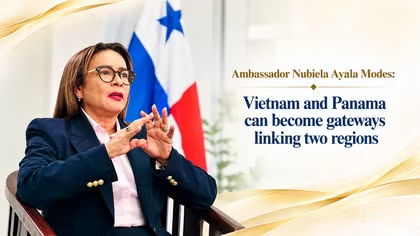
Vietnam and Panama can become gateways linking two regions

Vietnam and Panama can become gateways linking two regions

"Panama can serve as a strategic platform for Vietnamese companies seeking greater access to Latin America and the Caribbean, while Vietnam represents an important gateway for strengthening Panama’s engagement with Southeast Asia", Ambassador Nubiela Ayala Modes confirmed.

Localities committed to achieving 2026 growth targets

Localities committed to achieving 2026 growth targets

Localities nationwide hailed effective and flexible directions delivered by the Government so far this year, resulting in positive nine-month socio-economic growth, and reaffirmed their commitment to achieving targets set for the whole 2026 at an online Government-locality conference on October 3.

Creating new drivers for Vietnam-Canada cooperation

Creating new drivers for Vietnam-Canada cooperation

The elevation of bilateral ties to a Strategic Partnership shows that Vietnam and Canada increasingly view each other not simply as trading partners, but as long-term partners in addressing economic, technological and regional challenges.

Top leader asks for sports development to build national strength

Top leader asks for sports development to build national strength

The top leader applauded the efforts of ministries, sectors, localities, social organisations, coaches, athletes, experts in developing physical education and sports in recent times, stressing that Resolution No. 08 has provided an important political foundation for sports development over the past 15 years, while Conclusion No. 70 set important orientations for the new period.

Vietnam mobilises resources to affirm its leadership role in APEC 2027

Vietnam mobilises resources to affirm its leadership role in APEC 2027

PSNews - Vietnam is recognised by its partners as an influential member of the Asia-Pacific Economic Cooperation (APEC) forum, with expectations that it will continue to demonstrate leadership when it hosts APEC for the third time in 2027, according to Standing Deputy Minister of Foreign Affairs Nguyen Minh Vu.

Top Vietnamese leader receives Chairman of Japan Bank for International Cooperation

Top Vietnamese leader receives Chairman of Japan Bank for International Cooperation

General Secretary and President Lam urged JBIC to continue promoting the substantive implementation of projects under the Asia Zero Emission Community (AZEC), and step up discussions on potential cooperation within the framework of the POWERR Asia (Partnership on Wide Energy and Resources Resilience Asia) initiative, including the development of strategic energy reserves.

NA, Government's Party committees meet on legislature's second session agenda

NA, Government's Party committees meet on legislature's second session agenda

National Assembly President Tran Thanh Man coordination must go beyond finishing the agenda to improve the quality of NA decisions and Government enforcement; deal with policies rather than just paperwork, especially in the fight against corruption and other negative phenomena; and pin down final responsibility for each product, not just progress.

Prime Minister receives Cambodian Minister of Inspection

Prime Minister receives Cambodian Minister of Inspection

Prime Minister Le Minh Hung asked the two countries' inspection agencies to build on their achievements by regularly exchanging information and experience, maintaining delegation exchanges, and coordinating inspections in areas related to bilateral economic, trade and investment cooperation.

Urgent action needed to address law enforcement as weak link: Top leader

Urgent action needed to address law enforcement as weak link: Top leader

General Secretary of the Communist Party of Vietnam Central Committee and President To Lam on September 28 called for urgent and fundamental improvements in law enforcement, stressing that legislation and its enforcement must form a unified whole and ultimately serve development, protect legitimate rights and interests, and strengthen public trust.

Vietnamese, Cambodian inspectors reinforce collaboration

Vietnamese, Cambodian inspectors reinforce collaboration

The Government Inspectorate of Vietnam broadly accepted the Cambodian ministry's proposals to maintain, renew and make more effective regular meetings between professional units and training establishments, and increase exchanges of senior, expert and specialised working-group delegations.