Vietnam’s rice and coffee acutely vulnerable from El Nino: HSBC economists

In a recently published report, HSBC Vietnam posits that the recurring El Niño, after an absence of three years, could heighten the threat of droughts, water scarcities, and potential disruptions in trade across the ASEAN region.

Vietnam’s rice and coffee acutely vulnerable from El Nino: HSBC economists -0
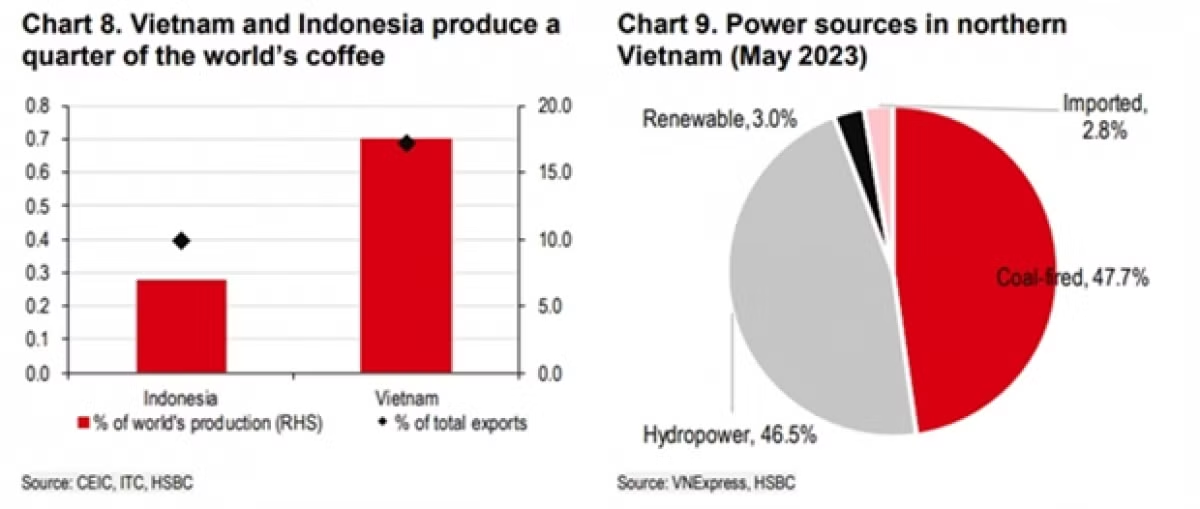
Vietnam and Indonesia supply 25% of the world’s coffee. (Source: HSBC graphic)

This report, bearing the title “ASEAN Perspectives - the arrival of El Niño", was unveiled last week.

Economists working for HSBC believe that the yield of pivotal agricultural products in Vietnam, including rice and coffee, could suffer significantly in the wake of the El Niño phenomenon.

The report underscores the primary peril posed to the agricultural sector, highlighting crops such as rice, palm oil, and coffee as particularly susceptible. However, it also draws attention to potential risks faced by the semiconductor industry.

Current severe heatwaves sweeping across ASEAN nations are suggestive of the resurgence of El Niño, a meteorological event usually correlated with drought and water shortages. The harsh manifestation of El Niño in 2015-16 had a detrimental impact on the region's economy. In its aftermath, rice production in countries such as Thailand and Vietnam dropped by more than 10%, exemplifying the potential threats posed by this phenomenon.

Whilst coffee might be considered a 'minor' commodity in comparison to others, its significance should not be underestimated, especially given the wide array of global consumers who perceive it as a daily essential. Despite the fact that it constitutes less than 1% of total exports, on a par with palm oil, Vietnam and Indonesia nonetheless supply a quarter of the world's coffee.

The majority of this contribution is in the form of Robusta beans, characterised by their bitter taste and heightened acidity. It's worth revisiting the 2015-16 period when coffee production in these economies slumped by 10%, inciting speculation regarding the potential ramifications of El Niño this time around.

More pointedly, forecasts from the USDA suggest a decline in Robusta production in Indonesia by 20% in the 2023/24 cycle, as the dry season has made an earlier appearance, impacting over 60% of the coffee-producing region.

Moreover, ASEAN's global preeminence in the palm oil market is well documented. Indonesia and Malaysia collectively generate 85% of the global palm oil supply, trailed by Thailand at 4%. Notably, palm oil accounts for 10% of total exports in each of these nations.

Whilst the El Niño phenomenon is still in its infancy, authorities in both Indonesia and Malaysia have raised alerts about potential disturbances to palm oil yields. Indonesia has declared emergency measures in seven provinces, predominantly those engaged in palm oil production.

It is noteworthy that palm oil yield traditionally experiences a drop during an El Niño year, and also contributes to air pollution as farmers resort to burning fields to make way for new crops. Concurrently, the Malaysian Palm Oil Board has cautioned that production could decrease by 1-3 million tonnes (6-17%) during this episode.

However, the impact is anticipated to be less drastic than during the 2015-16 El Niño event, which saw a reduction of 20%, due to better farming practices and enhanced labour conditions. Nonetheless, the full effect may not be evident for another 15-18 months, as per Malaysian officials, suggesting that this is a risk to monitor more closely in 2024 rather than 2023.

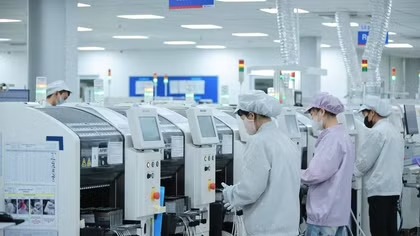
The HSBC reports indicate that the ripple effect of El Niño extends beyond the agricultural sector and could potentially cause disruptions to industrial production due to energy shortages. Both Vietnam and Malaysia offer pertinent examples of such materialised risks.

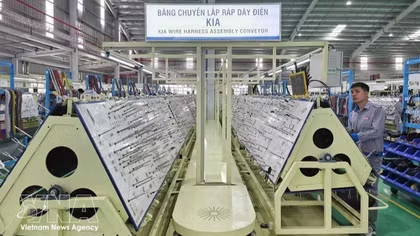
As of early June, a number of Vietnam's northern provinces, which host major electronics manufacturers such as Samsung and Foxconn, have grappled with electricity shortages.

These power disruptions are caused by a dearth of hydropower, a significant source of electricity in the region, as the heat and droughts associated with El Niño have led to reservoirs drying up, even causing major dams in the north to reach dead storage levels.

Fortunately, recent moderate rains have caused the water levels in all reservoirs across the nation to surpass the threshold required for safe electricity generation, according to state utility Vietnam Electricity (EVN).

Consequently, after several electronics manufacturers had to curtail production, power shortages have started to diminish recently, facilitating factories to extend their operating hours.

However, economists at HSBC stress that El Niño-related energy risks require closer observation, as they may exacerbate Vietnam’s manufacturing vulnerabilities, especially during a period when the country has been dealing with the escalating challenge of dwindling export orders.

Fortuitously, ASEAN policymakers demonstrate acute awareness of the implications of El Niño, issuing early warnings and proactively adopting measures to fortify against potential economic disruptions. Countries have turned to tactics such as cloud seeding, augmenting specific agricultural imports, and implementing partial manufacturing cutbacks to offset potential disruptions induced by El Niño, as indicated in the report.
VNS/VNA

Other News

Private economic sector poised for breakthrough growth

Private economic sector poised for breakthrough growth

More than a year after the Politburo's Resolution No. 68-NQ/TW on private sector development came into effect, expectations now extend beyond increasing the number of enterprises. The goal is to build a stronger business community with greater resilience, larger ambitions and the capacity to compete in global supply chains.

Vietnam remains ASEAN growth leader in 2026 despite global headwinds: WB

Vietnam remains ASEAN growth leader in 2026 despite global headwinds: WB

Vietnam is expected to remain one of ASEAN’s fastest-growing economies in 2026, supported by resilient exports, strong investment inflows and an ambitious reform agenda, despite mounting global uncertainties, according to the World Bank’s latest Vietnam Economic Update released on May 15.

Ministry establishes monitoring framework for carbon market

Ministry establishes monitoring framework for carbon market

Under a new circular, the exchange of greenhouse gas emission quotas and carbon credits is conducted on the domestic carbon credit exchange through the carbon trading system, which is interconnected with the national registration system.

Biofuel ready for nationwide rollout

Biofuel ready for nationwide rollout

For biofuels, particularly E10, to develop successfully, stronger and more coordinated policies are needed, especially pricing mechanisms capable of creating a sufficiently attractive gap between E10 and mineral-based petrol, an expert has said.

Vietnamese farm produce promoted at African investment, trade forum

Vietnamese farm produce promoted at African investment, trade forum

The 12th Africa Forum for Investment & Commerce (AFIC 12) opened in Algiers, the capital of Algeria, on May 9, drawing around 2,000 participants, including officials, economists, businesses, financial and development organizagtions from 43 African countries and international partners, including Vietnam.

Int'l medical, pharmaceutical expo opens in Hanoi

Int'l medical, pharmaceutical expo opens in Hanoi

The exhibition, which runs until May 9 at the Hanoi International Centre for Exhibition, showcases advanced products and technologies across a range of fields, including pharmaceuticals, drug manufacturing machinery and equipment, medical devices, hospital and clinic services and dental equipment.

Mega projects to transform Ho Chi Minh City urban landscape

Mega projects to transform Ho Chi Minh City urban landscape

Leading the charge in this massive building spree is the new central city square in the core of the Thu Thiem new urban area. Spanning more than 20 ha, it’s the crown jewel of the Central Square and new administrative center complex.

Vietnam establishes itself as one of region’s most dynamic manufacturing and supply bases

Vietnam establishes itself as one of region’s most dynamic manufacturing and supply bases

The country’s stable political and economic environment provides a critical foundation for long-term sourcing strategies. At the same time, Vietnam has demonstrated a strong ability to scale up manufacturing, supported by a continuously expanding industrial base capable of meeting both high-volume demand and increasingly complex technical and quality requirements.

Vietnamese pomelos gain broader access to Australian market

Vietnamese pomelos gain broader access to Australian market

The update by Australia’s Department of Agriculture, Fisheries and Forestry to its Biosecurity Import Conditions system (BICON) on April 10, officially setting out import conditions for Vietnamese pomelos, is regarded as a major milestone in market access efforts.

Vietnam's industry spearheads transition to circular economy

Vietnam's industry spearheads transition to circular economy

The circular economy is no longer just a policy choice. It has become an inevitable trend for delivering sustainable and green growth, sharpening competitiveness at home and abroad, and meeting Vietnam’s net-zero emissions target by 2050. It is now a prerequisite to sustain long-term economic expansion, particularly in industrial production and supporting industries.

Nearly 100 tonnes of Vietnamese fruits, vegetables airlifted to UAE

Nearly 100 tonnes of Vietnamese fruits, vegetables airlifted to UAE

Vietnamese fresh produce and processed foods are increasingly recognised for their quality, with items such as cashew nuts, coffee and spices gaining popularity among Middle East consumers. In 2025, Vietnam’s farm produce exports to the UAE exceeded 445 million USD, up nearly 24% year-on-year.