- Vietnam encourages Belgian investors in clean energy
- Vietnam destined to become startup destination in APEC
- Over 150 enterprises to join GROWTECH 2017
Arguments for and against
The strongest argument for the development of a national trademark is that food products produced in Vietnam do not currently have a reputation for quality, cleanliness and safety, said Dang Quyet Tien.
Mr Tien who is the deputy head of the Ministry Corporate Finance Department noted that these are all qualities that are highly valued in western markets such as the US and EU.
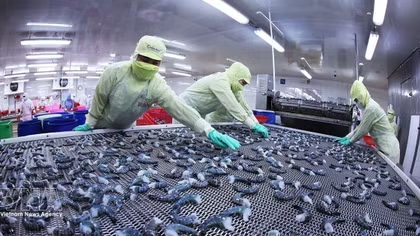
He added that consumers in these and other markets are often currently not willing to purchase farm raised fish and seafood or other produce from Vietnam.
 |
Or if they do purchase these products, they will do so only if the sales price is highly discounted, so that in effect, farmers and others in the food supply chain have very little, if any, earnings to show for their hard work.
Mr Tien argues that he is one of those who favours instituting a national brand because he believes that by doing so, the government and food sector can by working in concert elevate the image consumers in foreign markets have of the country’s produce.
In turn, he postulates, consumers in these foreign markets would be willing to pay a premium price compared to what they are prepared to pay now, which would trigger benefits up and down the ag supply chain.
In less concrete terms, he vaguely puts forth the general proposition that a national brand that differentiates the country’s products is essential for Vietnamese agriculture to remain competitive in commodity markets.
High cost and who would pay for it?
What is most often overlooked in the debate regarding a national agriculture brand is the excessive cost and who would pay for it, said Mr Tien.
This cost can be measured in diverse ways that may not be intuitive.
First, if the government and food sector working cooperatively put forth a reputation in their marketing efforts that failed to materialize, that could ultimately do irreparable harm to the entire industry.
Existing brands that currently have stellar reputations such as Vinamilk, Trung Nguyen coffee, and Phu Quoc fish sauce could suffer as a result and experience a decline in their reputation.
This would result because of the overall loss of confidence by foreign (and domestic) consumers in what they would essentially perceive as false advertising for the national brand.
A national trademark could also create confusion, said Mr Tien, by marketing efforts that attempt to create a different image than that chosen by individual companies. Dissimilar marketing efforts by segments of agriculture could render an all-encompassing effort ineffective.
In other words, the development of a national brand would of necessity need to be well executed and receive the full backing of all segments of the food and agriculture sectors to be effective.
If the national trademarking effort failed to deliver on the image that it put forth in its marketing effort that would most likely undermine the credibility of the entire industry and ruin the reputations of all the present top brands.
It is the top Vietnamese food brands that have everything to lose and very little to gain from the development of a national trademark.
The low-quality Vietnamese companies that presently have a poor reputation for food safety, among other desirable attributes would most likely not change their ways, and in the final analysis do more harm than good to the image a national brand was intended to improve.
In simple terms, the national branding effort, if it were to fail, could do more harm than good.
Key challenges
Mr Tien said that one of the key challenges to the development of a national brand is dealing with the simplistic attitude of many that sticking a made in Vietnam label on a product inherently makes them more desirable.
People who hold this attitude fail to appreciate the fact that virtually every agriculture product of Vietnam that is sold in either the US or EU, among other markets, already has this label and it has done little to nothing to benefit the national image.
There are plenty of positive characteristics of Vietnamese produce that are extremely marketable, but they need to be packaged into a comprehensive and coherent marketing campaign that is much more than sticking a label on the exterior of the packaging.
But even more fundamental to the whole question of developing a national brand for agriculture is the question of who would pay for the cost of the effort, added Mr Tien. The campaign would require sufficient and sustained funding to generate real value, and the figures would run into billions of US dollars.
There are many different models that have been proposed, ranging from complete funding by the food and agriculture sectors or a tax on the entire private sector— to complete funding by the national government.
Of course, this raises the question of why would Vietnamese companies that have successfully implemented a branding strategy for their high-quality products want to pay again for an approach that would most likely be of little and dubious benefit to them.
If might be possible that the development of a single national brand for Vietnamese agricultural and food products, could result over the longer term in establishing and maintaining a premium price for products.
But as things stand now— implementing such a plan could also just result in massive confusion.