- Crew of flight VN0054 negative for coronavirus
- Coronavirus symptoms usually take 5 days to appear, study says
- Coronavirus infects 100,000-plus worldwide, 21 cases found on ship off San Francisco
WHO director-general Dr. Tedros Adhanom Ghebreyesus made the announcement at a press conference Wednesday. “Over the past two weeks, the number of cases of COVID-19 outside China has increased thirteenfold and the number of affected countries has tripled,” he said.
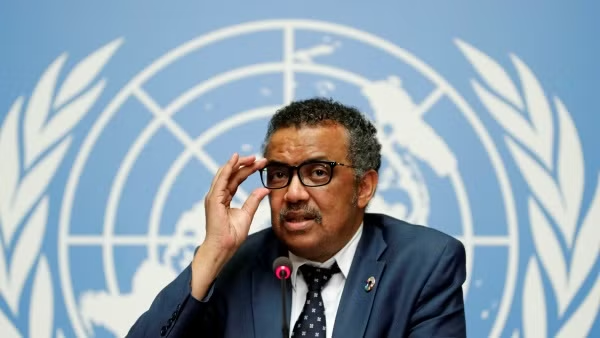 |
| WHO director-general Dr. Tedros Adhanom Ghebreyesus |
There are now more than 121,000 cases in 118 countries, according to statistics from researchers at Johns Hopkins University.
“In the days and weeks ahead, we expect to see the number of cases, the number of deaths and the number of affected countries climb even higher,” Tedros said. “We’re deeply concerned both by the alarming spread and severity, and the alarming levels of inaction.”
For these reasons, he said, the WHO determined that the disease outbreak should be called a pandemic.
The organization did not take this decision lightly, he said, adding that countries can still change the course of the pandemic.
“We have never before seen a pandemic sparked by a coronavirus,” he said. “And we have never before seen a pandemic that can be controlled.”
“If countries detect, test, treat, isolate, trace and mobilize their people in their response, then those with a handful of cases can prevent those cases becoming clusters, and those clusters becoming community transmission.”
More than 90 per cent of cases of COVID-19 are in just four countries, he noted, and both China and South Korea have recently seen declines in new cases.
Dr. Mike Ryan, WHO’s emergencies chief, gave a blunt warning about the urgency of the public health emergency.
Ryan said, “Iran and Italy are in the frontline now. They’re suffering, but I guarantee you other countries will be in that situation soon.”
He said that some countries were only testing the elderly or people who had traveled to China and urged them to update their monitoring and contact-tracing measures as well as do more to protect health workers exposed to the virus.
He said the experience with influenza led many people to the false conclusion that a pandemic was uncontrollable once it started.
The experience of South Korea, Singapore, and China in combating the new virus showed this was not true, he said.
“We have observation that tells us that there is a strong element of controllability in this disease,” he told the news conference.
“That doesn’t mean we will completely stop it but what it does mean is there is a real chance to blunt the curve, there is a real chance to bend the curve and reduce the number of cases that our health system has to cope with and give the health system a chance to save more lives,” he said.