- Human error led to Colombia soccer plane crash: authorities
- Russia finds first flight recorder from Black Sea crash jet
- Russia examines all possible reasons for Black Sea jet crash
- Russian plane with military band crashes en route to Syria
The plane, a Tupolev-154 belonging to the Defence Ministry, disappeared from radar screens two minutes after taking off on Sunday from Sochi in southern Russia, killing dozens of Red Army Choir singers and dancers en route to Syria to entertain Russian troops in the run-up to the New Year.
The three black box flight recorders from the aircraft were found on Tuesday, Russian news agencies said, amid unconfirmed reports that authorities had grounded all aircraft of the same type. The Defence Ministry confirmed one box had been found.
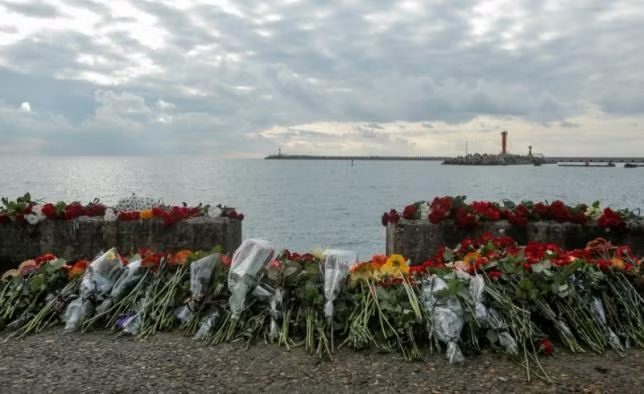 |
| Flowers in memory of passengers and crew members of Russian military Tu-154, which crashed into the Black Sea on its way to Syria on Sunday, are placed at an embankment in the Black Sea resort city of Sochi, Russia, December 26, 2016. REUTERS/Maxim Shemetov |
The Life.ru news portal, which has close contacts to law enforcement agencies, said it had obtained a readout of one of the pilot's last words, indicating a problem with the wing flaps: "Commander, we are going down," the pilot was reported to have said.
There was no official confirmation of the readout.
The Interfax news agency separately cited an unnamed investigative source as saying preliminary data showed the wing flaps had failed and not worked in tandem.
As a result, the aging Soviet-era plane had not been able to gather enough speed and had dropped into the sea, breaking up on impact.
If confirmed, the technical failure will raise questions about the future of the TU-154, which is still actively used by Russian government ministries but not by major Russian commercial airlines.
Interfax cited an unnamed source as saying Russia had grounded all TU-154 planes until the cause of Sunday's crash became clear. There was no official confirmation of that.
The Defence Ministry says the jet, a Soviet-era plane built in 1983, had last been serviced in September and underwent more major repairs in December 2014.
Russian pilots say the TU-154 is still flightworthy, though major Russian commercial airlines have long since replaced it with Western-built planes. Experts say only two are registered with Russian passenger airlines with the rest registered to various government ministries.
The last big TU-154 crash was in 2010 when a Polish jet carrying then-president Lech Kaczynski and much of Poland's political elite went down in western Russia killing everyone on board.
The Defence Ministry said search and rescue teams had so far recovered 12 bodies and 156 body fragments.