- Russian scientists create new breakthrough material for nuclear reactors
- Russia will not support U.S. bid to change Iran nuclear deal: Lavrov
- Trump issues ultimatum to 'fix' Iran nuclear deal
- North Korea says new ICBM puts U.S. mainland within range of nuclear weapons
It represents the latest sign of hardening resolve by President Donald Trump’s administration to address challenges from Russia, at the same time he is pushing for improved ties with Moscow to rein in a nuclear North Korea.
The focus on Russia is in line with the Pentagon shifting priorities from the fight against Islamist militants to “great power competition” with Moscow and Beijing.
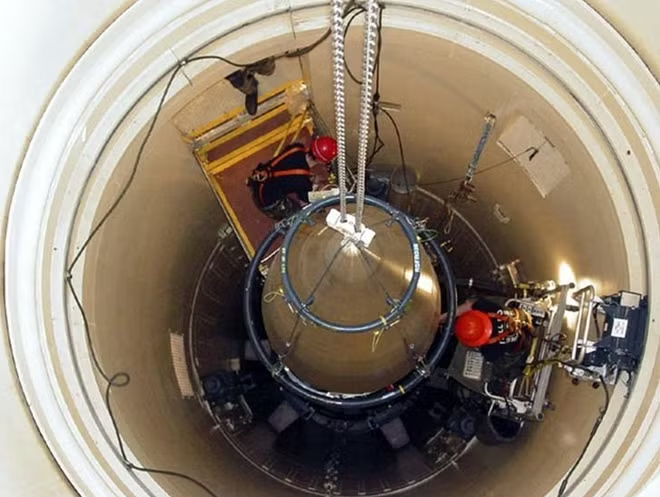 |
| With an eye on Russia, U.S. to increase nuclear capabilities |
“Our strategy will ensure Russia understands that any use of nuclear weapons, however limited, is unacceptable,” the document, known as the Nuclear Posture Review, said.
The rationale for building up new nuclear capabilities, U.S. officials said, is that Russia currently perceives the United States’ nuclear posture and capabilities as inadequate.
By expanding its own low-yield nuclear capability, the United States would deter Russia from using nuclear weapons, U.S. officials argue.
Low-yield nuclear weapons, while still devastating, have a strength of less than 20 kilotons. The atomic bomb dropped on Hiroshima had about the same explosive power.
The argument for these weapons is that larger nuclear bombs are so catastrophic that they would never be used and do not work as an effective deterrent. With less power and destruction, the low-yield option would potentially be more likely to be used, serving as an effective deterrent.
The Pentagon document, which is largely in line with the previous review in 2010, said the United States will modify a small number of submarine-launched ballistic missile warheads with low-yield options.
In the long term, the U.S. military will also develop a new nuclear-armed sea-launched cruise missile. The missile could have the less powerful option, but a decision has not been made, and will take up to a decade to develop, officials said.
Greg Weaver, deputy director of strategic capabilities at the Pentagon, said the United States would be willing to limit developing the missile if Russia would “redress the imbalance in non-strategic nuclear forces.”
Weaver said the most difficult task for those working on the review was trying to address the gap between Russian and American non-strategic nuclear weapons.