The PCI report has been produced annually since 2005 to assess the ease of doing business, economic governance, and administrative reform efforts by the provincial and city governments in Vietnam in order to promote the development of the private sector.
U.S. Ambassador to Vietnam Daniel J. Kritenbrink commented: “This year, the PCI index reached an all-time high since we began the exercise in 2005. The PCI report has become a highly respected and impactful report that promotes economic reforms to encourage transparency, robust investment, trade, and economic growth. I am very pleased to announce that USAID will be renewing the PCI program for another three years.”
The 2018 PCI Report is the 14th iteration and is based on responses from over 12,000 enterprises, including nearly 11,000 domestic private enterprises from 63 provinces and cities and more than 1,500 foreign invested enterprises in 20 provinces in Vietnam.
 |
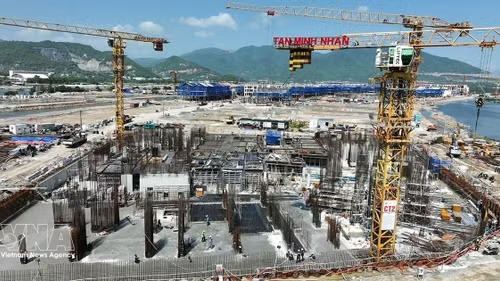
Quang Ninh Province maintains the top ranking with 70.36 points in a 100 point scale, followed by Dong Thap (70.19 points), Long An (68.09 points), and Ben Tre (67.67 points). The other half of the top ten include Da Nang, Binh Duong, Quang Nam, Vinh Long, Hanoi, and Ho Chi Minh City. The provinces and cities that find themselves in the high and mid performance tier are Can Tho, Lao Cai, Vinh Phuc, Tay Ninh, Bac Ninh, Hai Phong, Khanh Hoa, Thai Nguyen, Nghe An, and Binh Dinh.
The 2018 PCI survey results showed noticeable improvement in some areas of provincial business environment, including declining informal charges, less biased business environment, and encouraging progress in administrative reforms. However, constant efforts by provincial governments are required to create a more enabling environment.
Transparency has yet to be improved, labor quality and business support services must be further enhanced, and administrative procedures need to be accelerated in areas such as business registration, land, taxes, social insurance, market management, transportation, and construction.
The level of business optimism demonstrated in the PCI and PCI-FDI business thermometers remains relatively high with 49 percent of surveyed private firms and 56 percent of surveyed foreign invested enterprises planning to expand their operations in the following two years. Despite this fact, however, there are signs of an increase in the percentage of firms having difficulties in their business activities, most of which are micro- and small-sized enterprises. In this process, the role of provincial governments matter more than ever.
Dr. Vu Tien Loc, President and Chairman of Vietnam Chamber of Commerce and Industry, noted: “Vietnam's national competitiveness will largely be determined by the quality of provincial economic governance and the business enabling environment. Therefore, the proactive and pioneering efforts of local leaders, coupled with the diligence and professionalism of provincial civil servants, will decide the speed and direction of Vietnam’s future development. The PCI, thus, serves as a source of encouragement from the business community for a strong transition from the local level in Vietnam.
Like last year, the foreign invested enterprises also reported positive insights about the business environment in Vietnam. The time costs for regulatory compliance have been reduced, informal charges have been significantly lessened, and harassment related to inspections has diminished. Infrastructure enhancements in Vietnam are also acknowledged.
However, several areas require the government’s immediate attention, such as customs clearances, social insurance, taxes, and inspections. In addition, labor quality, especially high-skilled labor supply, remains a bottleneck in the investment environment in Vietnam, as perceived by foreign invested enterprises.
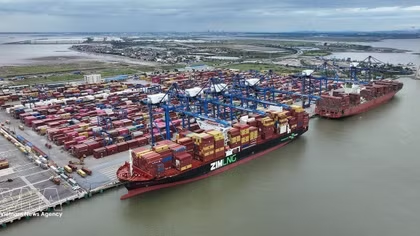
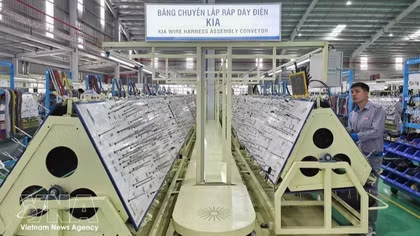
This year’s edition features a special chapter to analyze the ability of Vietnamese private enterprises to integrate into global value chains. The results showed limited global integration of domestic firms. One of the factors hindering this process is the absence of an effective mechanism to ensure contract enforcement. This is the area where breakthroughs in innovations are needed.
What needs to be done in the future is to keep businesses well informed and updated on domestic legal regulations as well as international commitments on available dispute settlement mechanisms. Friendly and explicit guidelines on commercial arbitration should be developed to make it easier for businesses to best employ it.
An effective dispute resolution mechanism should be built and placed as one among the pillars to enhance Vietnam's competitiveness along with improvements in infrastructure, human resources, and regulatory and governance reforms.