- Amendments to enterprise, investment laws must promote SOE efficiency
- Southern region attracts strong wave of investment from RoK
- Deputy PM urges quicker disbursement of public investment
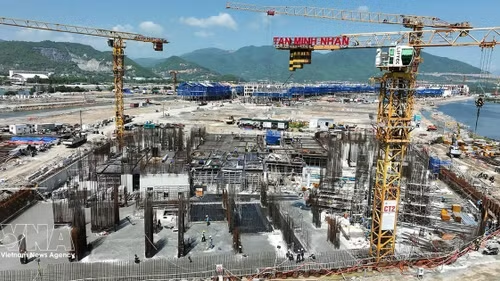
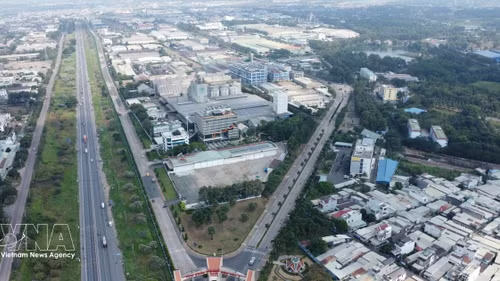
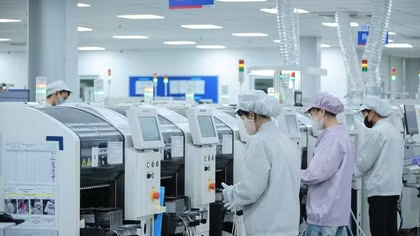
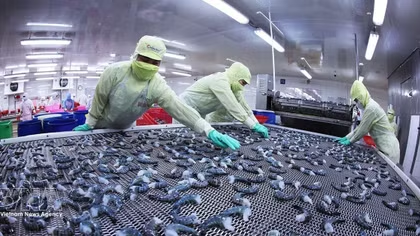
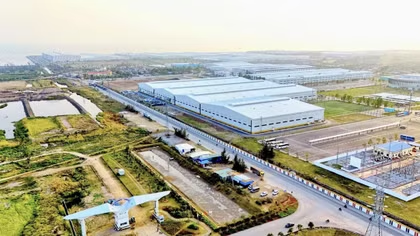
In late February 2019, the southern province of Dong Nai welcomed a new project from the Republic of Korea’s Changshin Vietnam Inc., which kicked off the construction of its $100 million footwear factory at Tan Phu Industrial Park. The new 14.3-hectare project follows Changshin’s previous successful investments. It is expected to produce 27 million pairs of shoes per annum and employ around 12,000 labourers when it is put into operation next year.
The Changshin funding is significant to Dong Nai as it is the biggest foreign-invested project in the province so far this year. Also note-worthy is the number of jobs that will be created, addressing an area where Vietnam is thinking of adopting a new approach in its next-generation foreign direct investment (FDI) attraction strategy by 2030 in labour-intensive sectors like footwear and garments.

New issues, new strategy
Key global trends have been gathering momentum to bring about the Fourth Industrial Revolution. In turn, Vietnam’s new socio-economic development plan and FDI attraction strategy may also be changed to adopt to the new situation.
In this new FDI landscape, low wages are no longer an advantage for Vietnam, unable to compete with other nations in terms of cheap and skilled workforce. The average wage, in India for example, is far less than in Vietnam. When it comes to FDI attraction in hi-tech, Vietnam is much less appealing than India.
Simon Nihal Bell of emerging market investment consultants Armillary said, “If Vietnam continues to base strategy on cheap wages, it will lose. As salaries go up, Vietnam will no longer be successful in attracting people to set up factories here to make T-shirts and phones at a low cost. Vietnam needs to work out how to attract people to make things because of skills and high quality, excellent business environment, and accepting high wages.”
According to Nguyen Mai, chairman of the Vietnam Association of Foreign-invested Enterprises, funding from the EU and the US are currently lagging behind those from other Asian countries. Thus, Vietnam would need to create a new FDI approach to change the situation. “Together with labour, Vietnam needs to take a new approach in the new FDI attraction strategy to bring added value to the economy and better protect the environment as climate change is becoming an increasingly dire threat,” he told VIR.
Investment incentives are another issue that needs a rethink. The International Finance Corporation, a member of the World Bank Group, said in a recent report that given Vietnam’s interest in growing FDI in more innovative, hi-tech fields, the use of tax exemptions and concessionary rates is likely to create a higher cost to the government while delivering fewer of the benefits.
“Not all FDI priority sectors should necessarily receive incentives. Incentives should be focused on investors who will be most responsive, based on their motivations and an analysis of the cost-benefit trade-off,” the report said.
Aware of these issues, Vietnam has been working on adjustments to its new strategy, with new changes in labour quality, investment incentives, links between domestic and foreign-invested enterprises, environmentally-friendly technology, and more, towards increasing competitiveness and productivity, thus better adapting to the new development period.
As shown in the latest version of the strategy, there is a new approach in the pipeline to tackle these issues. In particular, cities and provinces which have difficult socio-economic conditions will be oriented to attract FDI in labour-intensive sectors and outsourcing and assembling at higher levels.
Furthermore, there will be a policy to ensure high-quality supply of disciplined human resources with professional and foreign language skills to replace cheap labour. Also, labour requirements will be supplemented in line with new-generation free trade agreements (FTAs).
The conditions for the investment incentives will focus on output quality and contributions to the domestic sectors: value chain, added value, application and transfer of high-tech, research and development, and innovation, instead of location, sectors, and investment scale.
Evidently, the new FDI strategy’s expected change in the approach to labour will be a strong message for foreign investors like Changshin Vietnam who are doing and will do business in labour-intensive sectors like footwear and garments, urging them to change.
Harmonising old and new
Despite all this, as old-generation FDI still contributes a great deal to Vietnam’s economic development, harmonising old and new FDI is the million-dollar question.
Vietnam has seen FDI movement between the earlier stage of FDI attraction and the current period in manufacturing and processing, mining, and agro-fishery-forestry.
“In the early stages of FDI attraction, investment in the manufacturing and processing industry mainly focused on hydropower, coal-fired power, oil and gas, apparel, and footwear, as well as motorbike and automobile assembly. During that period, the country licensed many projects on coal and bauxite mining, and introduced policies to boost operations in the extractive mining industry,” Mai said.

“In the new situation, Vietnam cannot focus on attracting FDI into these sectors anymore. Vietnam has no way but to find new potentials to ensure the country’s sustainable development and cope with Industry 4.0 which requires a strong focus on technology and human resources,” he added.
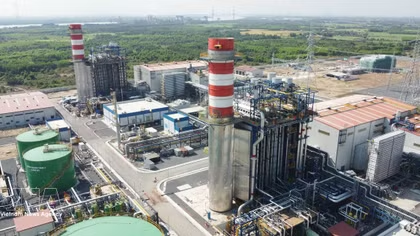
Looking at the energy sector as an example, in the past, Vietnam mainly focused on the development of coal-fired and hydropower to generate electricity. Mai, however, said that there is now no room left for FDI in small- and medium-sized hydropower projects.
He added that the country should no longer encourage FDI in coal-fired power projects. Vietnam now has to annually import tens of millions of tonnes of coal, with the figure forecast to rise to 50 million tonnes by 2030 if the country continues to generate electricity from coal.
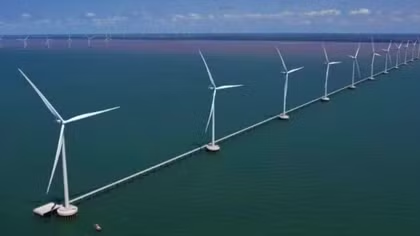
Aware of environmental pollution, many countries have removed this kind of energy from their future plans. Thus, Vietnam should encourage FDI in renewable energy where it has advantages, such as wind, solar, and tidal power generation.
In a similar situation, the steel and cement markets are becoming saturated amid growing environmental pollution concerns. In one example, Vietnam’s annual crush and cull of limestone for cement production – 100 million tonnes, equal to the size of a mountain – has endangered native species like the silvery langur, which makes its home on limestone hills.
Industry insiders said that Vietnam should attract FDI in sectors where the country boasts strong advantages and where foreign investors can offer high-tech, new branding, new marketing, and high value that domestic counterparts cannot. These include hi-tech and IT, processing and manufacturing, supporting industries, tourism, and hi-tech agriculture.
“Vietnam now has 700,000 small- and medium-sized enterprises, which should be given priority rather than have FDI flow across all sectors both domestically and further afield in equal measure. Then we can clarify which ones require co-operation with foreign companies to create value chains, and what FDI should be lured with investment incentives different from those in the past,” Mai told VIR. “Furthermore, state management should also change its approach, proactively build e-government, with Hanoi and Ho Chi Minh City being the pioneers.”
Flow direction changes
Vietnam knows what it has to do, but balancing the current development demands and sustainable development remains a headache. For example, developing renewable energy is inevitable, but the problem is that the country’s electricity demand is forecast to grow by 15-17 per cent a year in the next two decades. Meanwhile, in the national energy development strategy, renewable energy output will only make up about 5 per cent of the total by 2020.
Despite the challenges ahead, FDI flows have already started to change direction. The manufacturing and processing industry has continued to lure most foreign investors, but they are now focussing more on IT and telecoms, electronics, computers, and refrigeration to benefit from the country’s policies prioritising hi-tech and environmentally-friendly projects.
Meanwhile, FDI in oil and gas, steel, cement, textiles, and footwear has reduced due to market saturation and Vietnam’s tightening investment policies. Parallel to this movement, the value of manufacturing and processing projects also grew, with the country beginning to attract mammoth projects worth billions of US dollars from Japan and South Korea.
Now, with the new FDI strategy in the final drafting process, Vietnam is pinning its hopes on more high-quality FDI in the future, thus enabling many foreign investors like Changshin Vietnam to have a reasonable approach.