ADB affirms economic growth potential of Vietnam

The Asian Development Bank has revised up its forecast of Vietnam’s GDP growth for 2019 and 20202 from 6.8 percent to 6.9 percent and 6.7 percent to 6.8 percent, respectively, in contrary with projections for Asia.
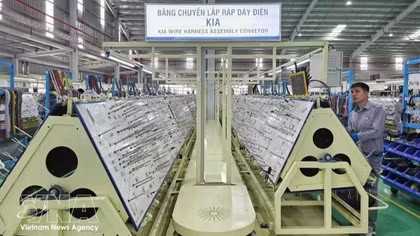
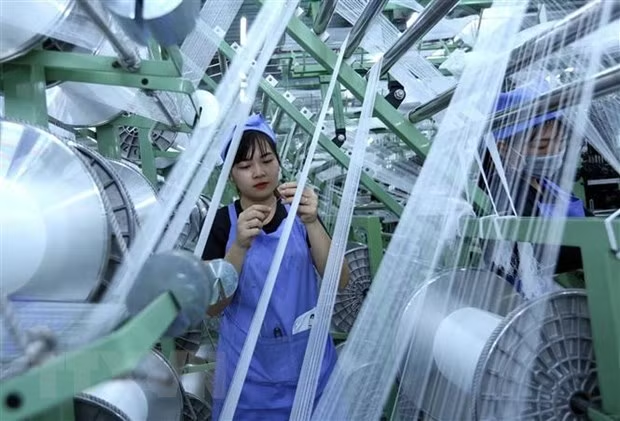
The knitted fabric factory of the Best Pacific Vietnam Co. Ltd, invested by Hong Kong (China), in the Vietnam-Singapore Industrial Park in Hai Duong province (Photo: VNA)

The knitted fabric factory of the Best Pacific Vietnam Co. Ltd, invested by Hong Kong (China), in the Vietnam-Singapore Industrial Park in Hai Duong province (Photo: VNA)

The Asian Development Bank has revised up its forecast of Vietnam’s GDP growth for 2019 and 20202 from 6.8 percent to 6.9 percent and 6.7 percent to 6.8 percent, respectively, in contrary with projections for Asia.

ADB Vietnam’s chief economist Nguyen Minh Cuong affirmed in an interview granted to Vietnam News Agency that there are many reasons for ADB to believe in the growth potential of Vietnam.

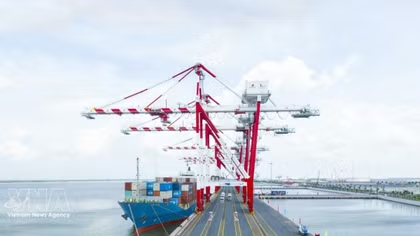
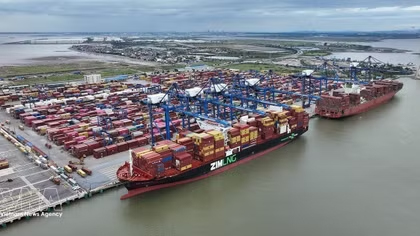
He said the forecast for Vietnam was based on the growth of domestic consumption, plus strong increases in export turnover and foreign investment in the past 11 months. Total foreign trade of Vietnam could reach 500 billion USD this year or even higher.

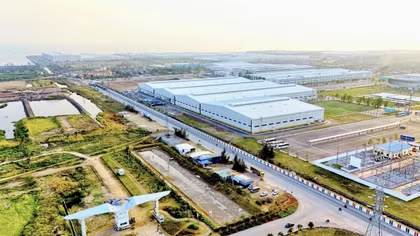
The bank also noticed the remarkable improvement in Vietnam’s business environment over the past years, along with the trend of foreign investment shifting from China to other markets, and in the context of the US-China trade dispute, Vietnam is really an attractive market for investors.

Besides, Vietnam has made noteworthy improvement in competitiveness, which made it easy to understand why the foreign investment flow into Vietnam is rising strongly.

Another important reason is the macro-economic stability in Vietnam, with low inflation rate thanks to the State Bank’s flexible and appropriate monetary policies which well support growth.

According to the expert, though public investment disbursement may remain slow, authorized agencies have put forth some drastic measures and the pace is expected to accelerate.

Asked to comment on concerns that the reform process in Vietnam is slowing down, the ADB expert said the reform is still underway effectively, adding that he hopes for stronger measures in some aspects, for example the rearrangement of State-owned enterprises, in which the current progress has not matched expectations and targets set by the State.

In the finance-banking sector, despite some positive changes such as the settlement of bad debt or credit risk control in accordance with Basel II-stand, the reform pace is under expectation, calling for stronger measures, especially in handling bad debt.

Cuong affirmed that there are not many reasons for us to worry about Vietnam’s reform progress, explaining that besides internal factors, Vietnam’s reform is driven by many external factors.

In the 2019-2020 period, the external factors are clear, he said, citing the country’s commitments to the Comprehensive and Progressive Agreement for Trans-Pacific Partnership (CPTPP) and the Vietnam-European Union Free Trade Agreement.

Therefore, the expert was of the opinion that the driver for reform will continue to strengthen in 2020.

Talking about solutions to promote the development of the private sector, the ADB expert said the Government plays a very important role.

Accounting for more than 96 percent of the total number of enterprises nationwide, the private sector in Vietnam is very diverse, with household businesses (which make up a big portion and contributing about 30 percent of the national GDP), small- and medium-sized enterprises (SMEs) and big private groups.

Cuong noted that the past decade has seen a strong development of large-scale private groups. The question is how to enable those large-scale private groups to create big breakthroughs for the economy while ensuring the extensive and fair development of SMEs and household businesses, he said, stressing that that is the task for institutions and policies.

According to the expert, large private groups should realize that when Vietnam joins bilateral and multilateral FTAs which require the country to create a transparent and fair playground for domestic and foreign enterprises, there will be no preferential treatment or specific policies for domestic private companies. Therefore, the private sector should realize advantages and difficulties and learn how to optimize opportunities to join the global value chains.

For SMEs and household businesses, Cuong said while many used to say this sector faces difficulties and obstacles in accessing financial credit, reality and comparison with other countries in the region and the world show that regulations on collateral, feasible business plans and many other requirements of banks are similar be in any country.

He expressed his personal view that financial credit access is not the basic issue. Instead, it is the firm’s capacity to absorb capital, which depend on the firm’s administration capacity, workers’ skills, which requires attention of firms, Cuong said.

VNA

Other News

Private economic sector poised for breakthrough growth

Private economic sector poised for breakthrough growth

More than a year after the Politburo's Resolution No. 68-NQ/TW on private sector development came into effect, expectations now extend beyond increasing the number of enterprises. The goal is to build a stronger business community with greater resilience, larger ambitions and the capacity to compete in global supply chains.

Vietnam remains ASEAN growth leader in 2026 despite global headwinds: WB

Vietnam remains ASEAN growth leader in 2026 despite global headwinds: WB

Vietnam is expected to remain one of ASEAN’s fastest-growing economies in 2026, supported by resilient exports, strong investment inflows and an ambitious reform agenda, despite mounting global uncertainties, according to the World Bank’s latest Vietnam Economic Update released on May 15.

Ministry establishes monitoring framework for carbon market

Ministry establishes monitoring framework for carbon market

Under a new circular, the exchange of greenhouse gas emission quotas and carbon credits is conducted on the domestic carbon credit exchange through the carbon trading system, which is interconnected with the national registration system.

Biofuel ready for nationwide rollout

Biofuel ready for nationwide rollout

For biofuels, particularly E10, to develop successfully, stronger and more coordinated policies are needed, especially pricing mechanisms capable of creating a sufficiently attractive gap between E10 and mineral-based petrol, an expert has said.

Vietnamese farm produce promoted at African investment, trade forum

Vietnamese farm produce promoted at African investment, trade forum

The 12th Africa Forum for Investment & Commerce (AFIC 12) opened in Algiers, the capital of Algeria, on May 9, drawing around 2,000 participants, including officials, economists, businesses, financial and development organizagtions from 43 African countries and international partners, including Vietnam.

Int'l medical, pharmaceutical expo opens in Hanoi

Int'l medical, pharmaceutical expo opens in Hanoi

The exhibition, which runs until May 9 at the Hanoi International Centre for Exhibition, showcases advanced products and technologies across a range of fields, including pharmaceuticals, drug manufacturing machinery and equipment, medical devices, hospital and clinic services and dental equipment.

Mega projects to transform Ho Chi Minh City urban landscape

Mega projects to transform Ho Chi Minh City urban landscape

Leading the charge in this massive building spree is the new central city square in the core of the Thu Thiem new urban area. Spanning more than 20 ha, it’s the crown jewel of the Central Square and new administrative center complex.

Vietnam establishes itself as one of region’s most dynamic manufacturing and supply bases

Vietnam establishes itself as one of region’s most dynamic manufacturing and supply bases

The country’s stable political and economic environment provides a critical foundation for long-term sourcing strategies. At the same time, Vietnam has demonstrated a strong ability to scale up manufacturing, supported by a continuously expanding industrial base capable of meeting both high-volume demand and increasingly complex technical and quality requirements.

Vietnamese pomelos gain broader access to Australian market

Vietnamese pomelos gain broader access to Australian market

The update by Australia’s Department of Agriculture, Fisheries and Forestry to its Biosecurity Import Conditions system (BICON) on April 10, officially setting out import conditions for Vietnamese pomelos, is regarded as a major milestone in market access efforts.

Vietnam's industry spearheads transition to circular economy

Vietnam's industry spearheads transition to circular economy

The circular economy is no longer just a policy choice. It has become an inevitable trend for delivering sustainable and green growth, sharpening competitiveness at home and abroad, and meeting Vietnam’s net-zero emissions target by 2050. It is now a prerequisite to sustain long-term economic expansion, particularly in industrial production and supporting industries.

Nearly 100 tonnes of Vietnamese fruits, vegetables airlifted to UAE

Nearly 100 tonnes of Vietnamese fruits, vegetables airlifted to UAE

Vietnamese fresh produce and processed foods are increasingly recognised for their quality, with items such as cashew nuts, coffee and spices gaining popularity among Middle East consumers. In 2025, Vietnam’s farm produce exports to the UAE exceeded 445 million USD, up nearly 24% year-on-year.