 |
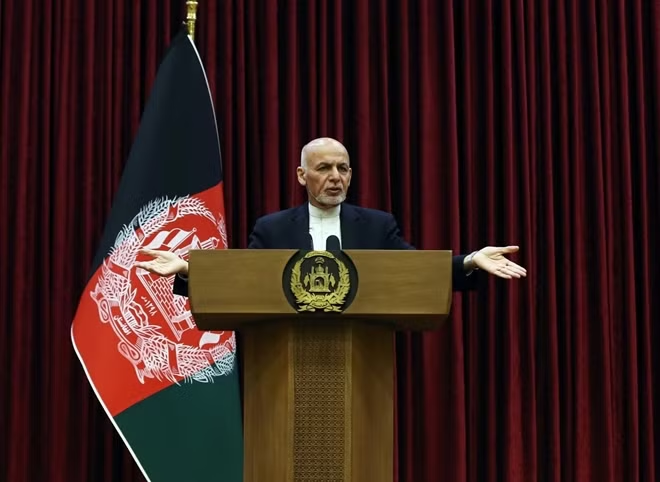
| Afghanistan's President Ashraf Ghani speaks during a news conference in Kabul, Afghanistan March 1, 2020. REUTERS/Omar Sobhani |
His remarks come against the backdrop of the difficulties U.S. negotiators face in shepherding the Afghan government and Taliban towards intra-Afghan negotiations, according to Western diplomats.
“The government of Afghanistan has made no commitment to free 5,000 Taliban prisoners,” Ghani told reporters in Kabul, a day after the deal was signed in Qatar to start a political settlement aimed at ending the United States’ longest war.
The accord said the United States and the Taliban were committed to work expeditiously to release combat and political prisoners as a confidence-building measure, with the coordination and approval of all relevant sides.
It said that up to 5,000 jailed Taliban would be released in exchange for up to 1,000 Afghan government captives by March 10.
However, on the issue of the prisoner swap, Ghani said, “It is not in the authority of United States to decide, they are only a facilitator.”
Saturday’s accord was signed by U.S. special envoy Zalmay Khalilzad and Taliban political chief Mullah Abdul Ghani Baradar, witnessed by U.S. Secretary of State Mike Pompeo.
After the ceremony, Baradar met foreign ministers from Norway, Turkey and Uzbekistan in Doha along with diplomats from Russia, Indonesia and neighboring nations, the Taliban said, a move that signaled the group’s determination to secure international legitimacy.
“The dignitaries who met Mullah Baradar expressed their commitments towards Afghanistan’s reconstruction and development... the U.S.-Taliban agreement is historical,” said Taliban spokesman Zabiullah Mujahid.
U.S. President Donald Trump rejected criticism around the deal and said he would meet Taliban leaders in the near future.
Ghani’s aides said Trump’s decision to meet the Taliban could pose a challenge to the government at a time when the U.S. troop withdrawal becomes imminent.
Under the agreement, Washington is committed to reducing the number of its troops in Afghanistan to 8,600 from 13,000 within 135 days of signing.
It will also work with allies to proportionally reduce the number of coalition forces in Afghanistan over that period, if the Taliban adhere to their security guarantees and ceasefire.
A full withdrawal of all U.S. and coalition forces would occur within 14 months, the joint statement said.
The withdrawal, however, depends on security guarantees by the Taliban who ruled Afghanistan from 1996 to 2001 and imposed many restrictions on women and activities it deemed “un-Islamic”.
After being ousted from power in 2001, the Taliban have led a violent insurgency.
The Afghan war has been a stalemate for over 18 years, with the Taliban increasingly controlling or contesting more territory, yet unable to capture and hold major urban centers.