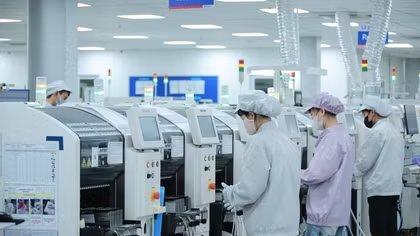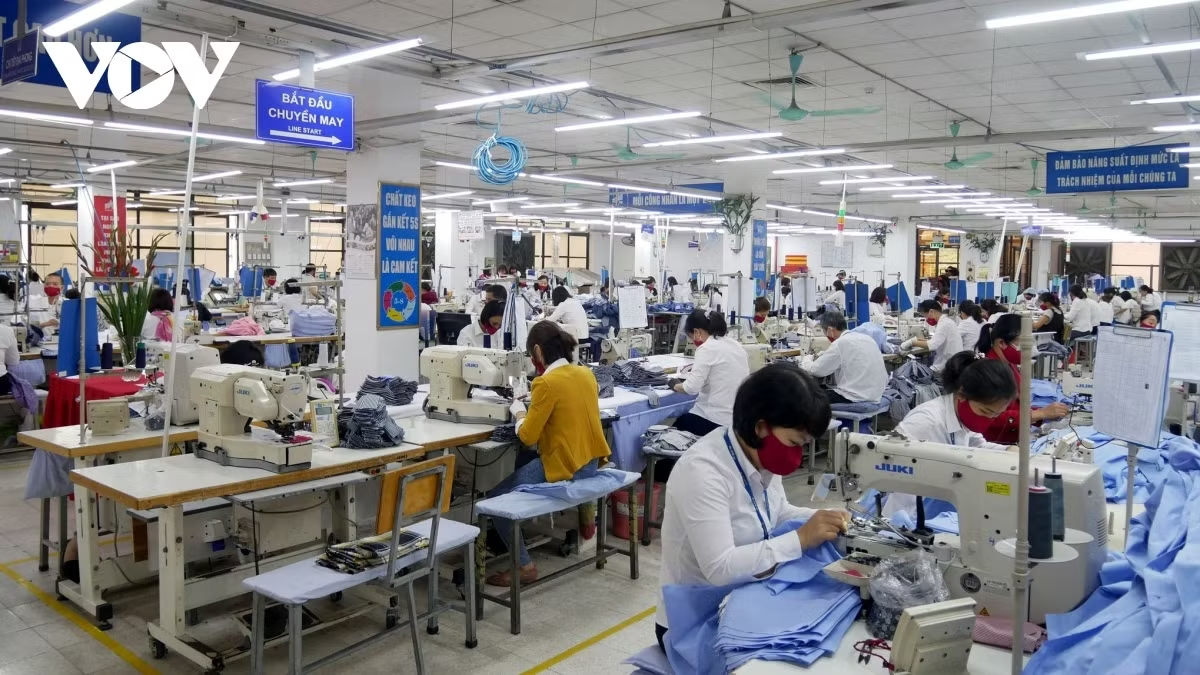
The production and business situation of textile and garment firms over the past seven months has been quite favourable as the whole sector has kept the goal of meeting this year’s export turnover of US$43.5 billion.
This remark was made by Truong Van Cam, vice president and general secretary of the Vietnam Textile and Apparel Association (VITAS), at a recent National Conference held between Prime Minister Pham Minh Chinh and businesses in order to discuss ways in which to accelerate active adaptation, quick recovery, and sustainable development.
However, according to Cam, from the second half of the year, businesses in the industry are anticipated to face many difficulties, with three major challenges in particular.
The first challenge is that some markets are continuing to apply strict anti-pandemic measures, thereby significantly impacting the supply chain of raw materials, auxiliary materials, and product consumption.
Furthermore, the military conflict between Russia and Ukraine remains complicated, coupled with high inflation rates in major textile consuming markets such as the United States and the EU which has significantly reduced the purchasing power of consumer goods, including textile and garment products.
This will therefore affect orders and unit prices of apparel enterprises from now until the end of the year, causing many firms to fall into a shortage of orders.
Textile businesses have to bear costs rising up by up to 25% because the price of raw materials, fuel, and auxiliary materials has increased rapidly since the beginning of the year. Specifically, the price of crude oil and gasoline both in the country and worldwide has fluctuated at a high level, while transportation costs are three times higher than the average over the past five years. In addition, many currencies in the region have depreciated significantly against the US$, a factor which is detrimental to exporters, Cam explained.
Moreover, challenges in major Vietnamese markets such as the US and EU also put a lot of pressure on businesses in terms of tracing the origin of cotton and cotton products, as well as plans to charge carbon fees, recycling, and reusing content, all of which are requirements for imports in the EU market, Cam went on to say.
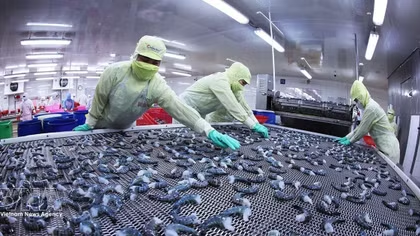
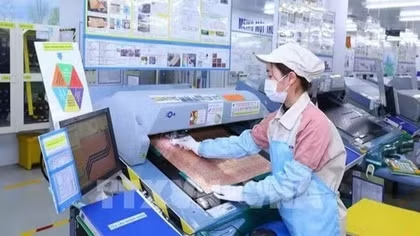
The second challenge mentioned by Cam is the labour force issue. As the textile and garment industry is a labour-intensive industry it has been greatly affected by the impact of COVID-19.
Currently, many workers who have returned to their hometown have yet to return, while recruiting new workers is also difficulty amid increasing training costs and the productivity of newly-recruited workers is low.
Another challenge presented by the VITAS representative is that many textile and garment enterprises have faced difficulties in capital for production and business. In addition, support packages of VND350,000 billion adopted by the National Assembly have been slow paced whilst the State's tax refund for businesses is also very slow, thereby making it even more difficult for local businesses.
A series of solutions proposed
Faced with these challenges, VITAS representatives have proposed to the PM, concerned ministries, and sectors, several support measures to direct them on how to reduce costs for the business community.
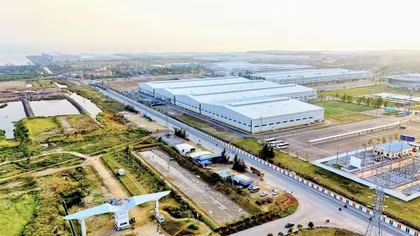
They therefore asked the Government to quickly approve the “Strategy for development of the textile and garment and footwear industry to 2030, with a vision to 2035” to facilitate the formation of large industrial parks with centralised wastewater treatment, advanced technology, and green technology. This will serve to attract investment in textile dyeing aimed at easing bottlenecks in fabric supply for garment exports and meeting origin requirements for tax incentives from free trade agreements (FTAs).
The VITAS also proposed removing the regulation placed on import tax payment on the spot for goods used for export production as this regulation causes many shortcomings whilst not encouraging manufactured goods for exports, thereby creating inequality between manufactured goods for exports and exported goods.
They proposed that the Government rapidly implement the support package for business recovery and the support package of VND350,000 billion to ensure social welfare and employment for workers. In particular, the 2% interest rate support package in line with Government Decree 31 was also asked for early implementation to help businesses overcome difficulties.
The association recommends that the Government devise a mechanism to support human resource training, outline orientations, provide risk recommendations, and deal with problems related to payment mechanisms, goods transportation, documents for exporting and importing in regional countries and around the Russia-Ukraine conflict area.
In particular, it can be viewed as necessary to co-ordinate with countries and provinces that share a border with Vietnam and have different anti-pandemic policies. This should be done in order to solve problems relating to the movement of people, vehicles, and goods to create favourable conditions for imports and exports to meet the supply of raw materials and auxiliary materials for production, while avoiding disruption of the supply chain.