ASSA 35: Social security system in 4IR

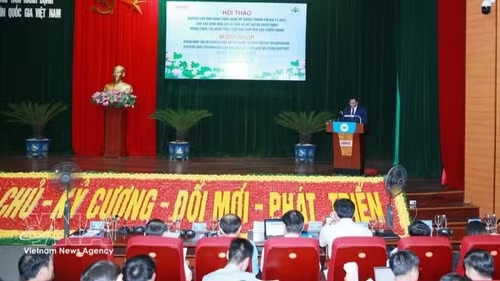
The challenges and opportunities of ASEAN social security institutions in the Industry 4.0, as well as the free flow of labour are both high on the agenda for the ongoing 35th ASEAN Social Security Association (ASSA) Board Meeting in Nha Trang city, in the central province of Khanh Hoa.
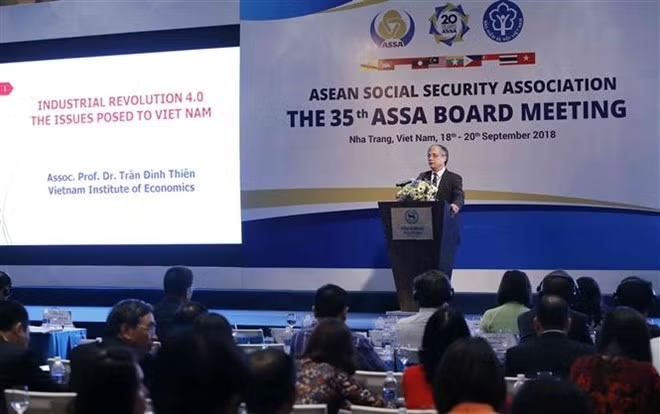
Assoc. Prof. Dr Tran Dinh Thien (Photo:VNA)

Assoc. Prof. Dr Tran Dinh Thien (Photo:VNA)

Assoc. Prof. Dr.Tran Dinh Thien, former head of the Vietnam Economics Institute, said that global digital connection through the Internet and other smart tools has opened up many chances for people to increase their general income, however, high risks are unavoidable.

In particular, cyber security risks and social security challenges are two pressing issues as the influx of new technology may cause the destruction of some especially manual jobs, it will also create further employment that requires new skills be learnt, he said.

“The requirements and conditions for renovation to social insurance activities will become vigorous and urgent,” Thien said.

He suggested that Vietnam formulate a digital transformation strategy and manage the system intelligently, adding that“the country shoulddevelopdigitally-linked infrastructure and cyber security and create digital human resources.”

Talking about the opportunities and challenges of the social security system in the context of the Fourth Industrial Revolution, Jens Schremmer, Office of the Secretary General of the International Social Security Association, said that Industry 4.0 will help promote social security, including expanding social insurance coverage. 

However, the digital economy will also create new jobs which will affect the traditional ones, thus creating gaps in social security coverage and cyber security protection, he added.

“Social security institutions will make the difference,” he said, stressing the need to shape social security for tomorrow’s society.

According to Robert Palacios, Senior Pension Economist at the World Bank, in the Fourth Industrial Revolution, changes in the labour market are predictable, requiring workers to strengthen their capacity to meet market demand.

This also poses a question of human resource training and redesigning social security policy to increase the coverage by improving the relationship between employers and employees, as well as between the Government and the informal economic sector.

“This is a race between social security and changes in the labour market,” Robert Palacios noted.

Deputy Director General of the Vietnam Social Security Tran Dinh Lieu said that the information and experiences shared at the seminar will create a basis for governments and policy makers of ASSA member countries to improve their social security policies to ensure the rights of workers, especially migrant ones, to adapt to the new requirements in the Fourth Industrial Revolution. 

“It demonstrates a high sense of responsibility of regional social security organisations to ensure the practical benefits of people in the regionin accordance with the ASEAN Vision 2025 for a more rules-based and people-centred ASEAN Community,” according to Lieu.

The ASSA was found in 1998 following the signing of a Memorandum of Agreement in Bangkok, Thailand on February 13 that year, involving heads of social security institutions from five countries - the Philippines, Indonesia, Malaysia, Singapore and Thailand. Representatives from Laos and Vietnam also attended the signing ceremony as observers. Later the year, the Vietnam Social Security became a member of ASSA.

This is the fifth time the Vietnam Social Security has chaired the ASSA Board Meeting. It undertook the chairmanship during the 2002 – 2003 term and successfully organised the ASSA Board Meeting in 1999, 2002, 2005 and 2010.ASSA members now comprise 19 social security institutions from ten ASEAN nations.


VNA

Other News

Hanoi ready to implement Capital Law 2026, unlocking new development momentum

Hanoi ready to implement Capital Law 2026, unlocking new development momentum

The effectiveness of the Capital Law 2026 will be measured not by the number of legal documents issued but by tangible improvements in governance and public administration, better services for people and businesses, faster administrative procedures, stronger investment attraction and higher economic growth.

Vietnamese students earn honours at ROBOG Asia Cup 2026

Vietnamese students earn honours at ROBOG Asia Cup 2026

Three teams from Chu Van An Secondary School in Vietnam’s Thai Nguyen province have earned First Prize honours and advanced to the quarterfinals at the ROBOG Asia Cup 2026, a regional robotics and artificial intelligence (AI) competition for students held in Hong Kong, China.

Hanoi sets out new investment blueprint with century-long development vision

Hanoi sets out new investment blueprint with century-long development vision

As of early June, Hanoi had attracted 74.6 billion USD in foreign direct investment (FDI) through more than 9,250 valid projects. FDI inflows in the first six months were projected at 3.2 billion USD, surpassing the annual target by 116%, while nearly 16,000 new businesses were established in the first five months, up 34.4% year-on-year.

Vietnam promotes legal cooperation and rule of law at global forum

Vietnam promotes legal cooperation and rule of law at global forum

Vietnam’s development and international integration have gone hand in hand with the improvement of its legal system, the incorporation of international commitments into domestic legislation, and legal reforms aimed at fostering development, openness and global integration. The country regards international law as an essential instrument for building fair, mutually beneficial relations among nations.

Hanoi to hold investment promotion event on June 29

Hanoi to hold investment promotion event on June 29

At the event, Hanoi authorities plan to grant investment policy decisions and investment registration certificates to 20 exemplary projects in the fields of transportation infrastructure, industrial parks, urban development, social housing, environment, science and technology, and foreign investment attraction.

Hanoi's Red River urban area development draws widespread attention

Hanoi's Red River urban area development draws widespread attention

Located south of the Red River and extending from the historic inner city to newly developing areas in the south and the west, the central urban area along Red River’s right bank covers approximately 45,317 hectares and is projected to accommodate around 6.365 million residents by 2045 and 6.455 million by 2065.

Hanoi's Red River urban area development draws widespread attention

Hanoi's Red River urban area development draws widespread attention

Located south of the Red River and extending from the historic inner city to newly developing areas in the south and the west, the central urban area along Red River’s right bank covers approximately 45,317 hectares and is projected to accommodate around 6.365 million residents by 2045 and 6.455 million by 2065.

Regional cooperation strengthened to combat cross-border drug crime

Regional cooperation strengthened to combat cross-border drug crime

Vietnam, China, Laos and Myanmar face common challenges as drug syndicates increasingly exploit the Mekong River, cross-border transport networks, e-commerce platforms, international logistics services, cyberspace and cryptocurrencies to organise drug transactions and smuggling operations.