Austria's conservative shift opens path to power for far right

Austria’s shift to the right in a parliamentary election has paved the way for young conservative star Sebastian Kurz to become the next leader and opened a path for the resurgent far right to return to power.

The People’s Party, which named 31-year-old Foreign Minister Sebastian Kurz its leader only in May, secured a clear victory on Sunday with a hard line on immigration that left little space between it and the anti-Islam Freedom Party (FPO).

But Kurz was still well short of a majority and only two other parties won enough seats to give him control of parliament in a coalition. An alliance with the FPO is far from certain, but it is the most likely outcome.

That prospect prompted guarded expressions of concern from European leaders including Germany’s Angela Merkel, who said the FPO’s strong showing was a “big challenge” for other parties in Austria.
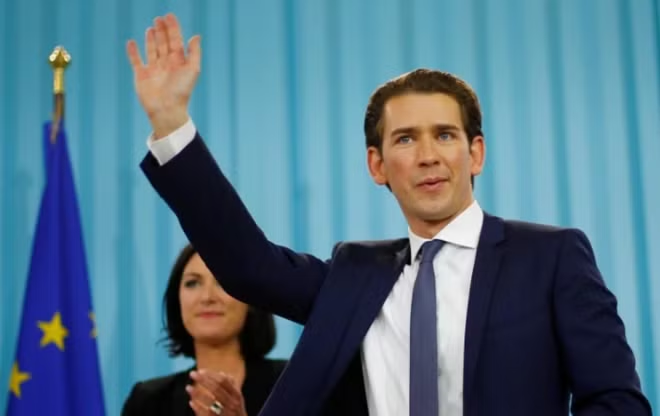
Top candidate of the People's Party Sebastian Kurz. Photo: Reuters
Top candidate of the People's Party Sebastian Kurz. Photo: Reuters

Kurz has been careful to avoid saying which coalition partner he might favour. He has said any partner must be pro-European, without saying whether that rules out the FPO, which is critical of the bloc but no longer argues against membership.

“The (election) result is above all a clear victory for the European Union, it is a clear victory for us as a pro-European force,” Kurz told Reuters.

His party’s manifesto calls for a smaller European Commission and a streamlined EU that focuses on “core competences” such as internal trade and securing the bloc’s external borders. But he declined to be drawn on specific plans.

Austria was a gateway into Germany for more than a million people fleeing war and poverty in the Middle East and elsewhere during Europe’s migration crisis which began in 2015.

It also took in more than one percent of its population in asylum seekers that year. Many voters feel the country was overrun then.

Austria’s shift to the right came after German voters last month punished Merkel’s open-door policy for migrants, pushing her conservative bloc to its worst showing since 1949 and putting the far-right AfD party in parliament.

The FPO was founded by former Nazis in the 1950s and went from minnow to political heavyweight in the 1990s under the charismatic Joerg Haider, who praised Hitler’s employment policies. It was one of the first far-right parties to enjoy mainstream success in Europe since World War Two.

When the FPO went into government in 2000 with the conservative party Kurz now leads, the rest of the European Union reacted with outrage and imposed sanctions on Austria .

The FPO is now a sister to France’s National Front and the AfD.
Reuters

Other News

Vietnam supports UNESCO's people-centred approach, multilateral cooperation: official

Vietnam supports UNESCO's people-centred approach, multilateral cooperation: official

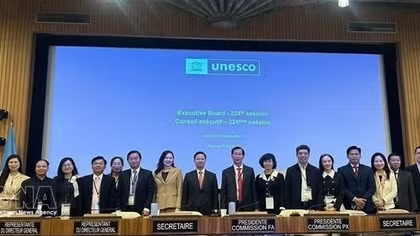
Van affirmed Vietnam’s support for the UNESCO80 reform roadmap, focusing on the organisation’s core mandate, priority areas, interdisciplinary approach, and the special status of the Vietnam National Commission for UNESCO, and UNESCO representative offices, alongside efforts to diversify resources and strengthen global partnerships to enhance the organisation’s effectiveness.

Regional media highlight significant step in Vietnam’s leadership structure

Regional media highlight significant step in Vietnam’s leadership structure

Under General Secretary and President Lam’s leadership, Vietnam is expected to maintain a balanced foreign policy, strengthen its regional standing and accelerate economic development, thereby improving living standards and creating new opportunities for international investors, according to the India-based platform Devdiscourse.

Laos identifies 10 key tasks to build independent, self-reliant economy

Laos identifies 10 key tasks to build independent, self-reliant economy

Laos will step up agricultural production to ensure food security, meet domestic demand and expand exports; encourage the development of agro-processing industries, including those related to rubber, aquatic products, cassava and sugarcane, as well as fertiliser and animal feed production, in order to increase added value and create jobs in rural areas.

Malaysia steps up cyber security resilience

Malaysia steps up cyber security resilience

To ensure accountability, Malaysia plans to finalise the Cybercrime Bill this year which addresses both cyber-dependent and cyber-enabled offences, introducing stricter penalties and prison terms to enhance deterrence.

US public opinion positive about PM Pham Minh Chinh’s visit

US public opinion positive about PM Pham Minh Chinh’s visit

Public opinion in the US is generally positive about Vietnamese Prime Minister Pham Minh Chinh’s trip to the US from September 17-23 to attend the 78th session of the United Nations General Assembly, which took place immediately after the upgrading of the Vietnam - US relations to a comprehensive strategic partnership on the occasion of US President Joe Biden’s official visit to Vietnam.