Baby born from egg-freezing technology in Vietnam

PSNews - After 5 years of marriage, Thu and her husband, residents of Ha Nam province, could hold their own child for the first time as their baby was born from the egg freezing technology performed by Vietnamese doctors.

The success has opened the door to motherhood of Vietnamese women who are unmarried, old or receiving chemotherapy for cancer treatment.

According to Do Hoai Thu, in 2013 she was diagnosed with polycystic ovary syndrome, or low fertility.
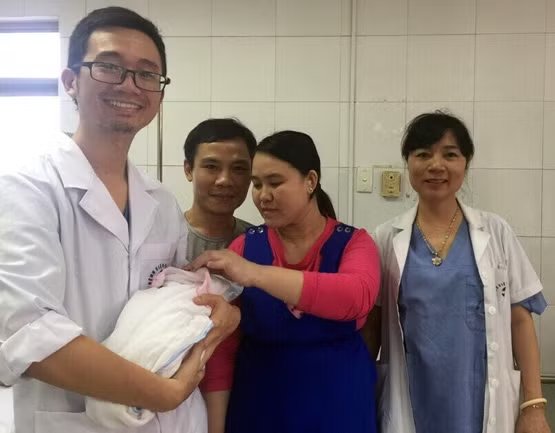
The success has opened the door to motherhood of Vietnamese women who are unmarried, old or receiving chemotherapy for cancer treatment.

After that, Thu twice experienced the IUI procedures but still failed.  Not only being treated by modern medical technologies, Thu and her husband also sought herbal medicine. However, their efforts were worthless. Recalling that period, Thu said: " I felt desperate. Then my husband comforted me a lot. "

But everything changed when Thu came to the Postal Hospital. At the hospital, Thu had her eggs frozen in June 2016 and became pregnant though in vitro fertilization using her husband’s sperm.

Finally, on March 27, 2017, Thu’s baby girl, weighing 3.2 kg, was born healthy.

The technology of freezing eggs has been brought to Vietnam since 2003 by Tu Du Hospital, Ho Chi Minh city. However, Thu’s baby is the first-ever case in Vietnam where a baby was born with the support of the technology.

According to Dr. Vuong Vu Viet Ha of the Postal Hospital, Thu's success will bring a ray of hope for many Vietnamese women with their female fertility problems as well as has opened the door to the application of the freezing egg technology to other patients.

“In some cases, this technology bears great humanitarian implications, especially when women with cancers want to have their own babies before undergoing chemotherapy and radiotherapy” said Dr. Ha, adding that the method will help them preserve eggs. When the cancer treatment is finished, they can still have children as normal woman, thanks to the technology.”
By Phung Nguyen

Other News

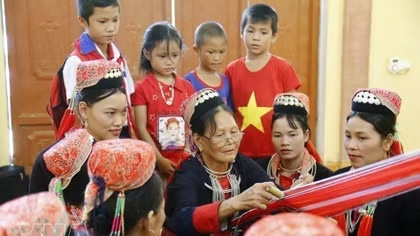
Vietnam steps up implementation of ethnic affairs strategy through 2030

Vietnam steps up implementation of ethnic affairs strategy through 2030

To accelerate the implementation of the the Ethnic Affairs Strategy by 2030, with a vision toward 2045, the Prime Minister requested ministries, agencies and local authorities to continue thoroughly carrying out the Party and State’s policies on ethnic affairs, enhancing the effectiveness of State management and strengthening oversight of policy implementation.

Security preparations reviewed for APEC 2027 in Phu Quoc

Security preparations reviewed for APEC 2027 in Phu Quoc

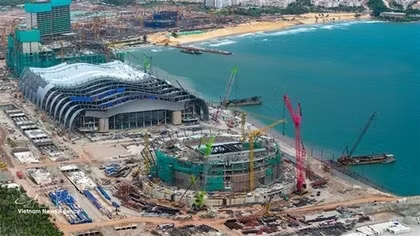
The team examined the APEC 2027 Convention Centre, where main conference activities are scheduled; Sun Serenia Hospital, designated to provide healthcare and emergency medical services for delegates; provincial road DT.975, which connects Phu Quoc International Airport to the convention centre; and the area surrounding Phu Quoc International Airport.

Hanoi accelerates seven Red River bridge projects, many exceed 70% completion

Hanoi accelerates seven Red River bridge projects, many exceed 70% completion

According to the municipal Transport Construction Investment Project Management Board, the city is simultaneously implementing seven projects, namely Tu Lien, Ngoc Hoi, Tran Hung Dao, Thuong Cat, Van Phuc, Hong Ha and Me So bridges. Construction is being carried out on multiple fronts, focusing on bored piles, pile caps, piers and superstructure works.

Dien Bien battlefield legacy powers tourism revival

Dien Bien battlefield legacy powers tourism revival

Seventy-two years after the Dien Bien Phu Victory, its legacy still reverberates. The unity, self-reliance, and resilience forged in that historic triumph remain a powerful internal engine, now propelling Dien Bien toward fast and sustainable development.

Hanoi accelerates shift to green buses, targets 100% by 2030

Hanoi accelerates shift to green buses, targets 100% by 2030

In the 2027–2030 period, the city will accelerate the transition towards the complete phase-out of fossil fuel-powered buses. The share of electric and green energy-fueled buses is projected to reach 79–89% by 2029 and 100% by 2030.

36 fishermen safely rescued after boat breaks down near Truong Sa

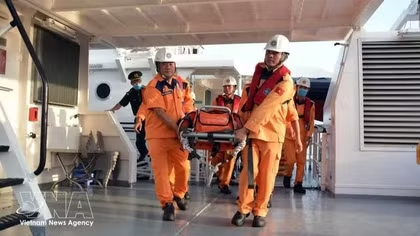
36 fishermen safely rescued after boat breaks down near Truong Sa

At 8:00 the same day, KN475 began towing the disabled fishing boat toward Da Tay A island. The towing operation was carried out safely, and by 18:30 both the vessel and its crew had arrived at the island without incident, where repairs and additional support procedures were arranged.

Vietnamese language contest in Laos strengthens youth ties, bilateral friendship

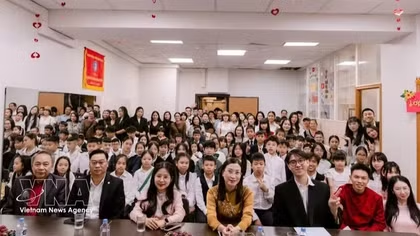
Vietnamese language contest in Laos strengthens youth ties, bilateral friendship

Held in response to the launch of the Vietnamese Language Day among overseas Vietnamese communities, the event aimed to enhance the quality of Vietnamese language teaching and learning in Laos while contributing to the great friendship, special solidarity, comprehensive cooperation and strategic cohesion between the two countries.

Vietnamese language contest in Laos strengthens youth ties, bilateral friendship

Vietnamese language contest in Laos strengthens youth ties, bilateral friendship

Held in response to the launch of the Vietnamese Language Day among overseas Vietnamese communities, the event aimed to enhance the quality of Vietnamese language teaching and learning in Laos while contributing to the great friendship, special solidarity, comprehensive cooperation and strategic cohesion between the two countries.

Hanoi launches 10 electric bus routes from April 1

Hanoi launches 10 electric bus routes from April 1

By the end of April, the number of buses using electricity and other green energy sources in the city is expected to reach 822, including 683 electric buses and 139 compressed natural gas (CNG) buses, representing 42.1% of the total number of vehicles.