 |
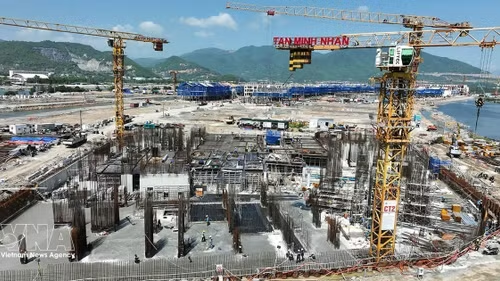
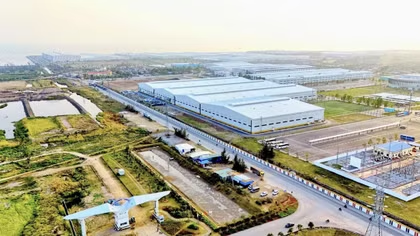
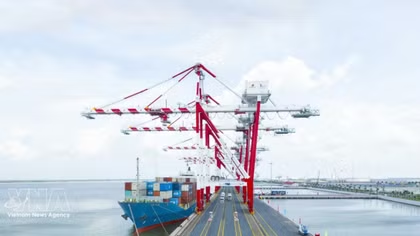
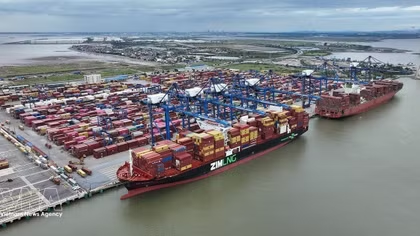
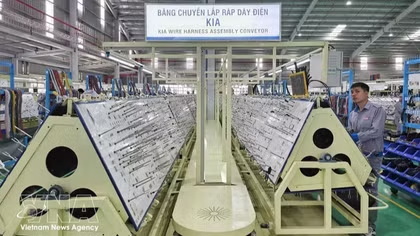
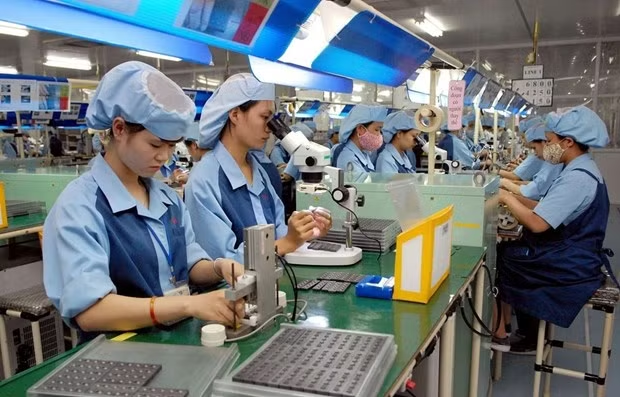
| Private enterprises have enough experience and abundant resources, and can operate flexibly to carry out major projects, helping the Government reduce public debt while better tapping private capital sources. (Illustrative image. Source: VNA) |
Breakthrough changes in mechanisms, policies are needed for the private economic sector’s development, experts said.
More than 30 years after the launch of Doi Moi, the private economic sector has emerged as one of the important driving forces of the national economy, participating increasingly deeper and more extensively into most economic fields, contributing significantly to the national budget and creating jobs for millions of workers.
National Assembly deputy Nguyen Nhu So of Bac Ninh province cited statistics that showed the non-State sector invested 624.6 trillion VND (approximately 27 billion USD on current exchange rate) into the economy in the first 9 months of 2019, up 16.9 percent year on year, and the highest among all economic sectors. The private economic sector also accounts for more than 40 percent of the GDP and creates 1.2 million jobs each year.
However, the NA deputy said the sector’s development is mainly based on its own potential without any drastic change.
He noted that despite Vietnam’s improvement in the World Economic Forum’s competitiveness rankings to the 67th place in 2019, the number of enterprises that suspended operation pending dissolution in the first nine months of the year rose 6.3 percent.
“This fact prompts the question that whether the business environment is really ideal for the development of private enterprises,” the deputy said. He said unofficial costs and too many regulations put a great burden on enterprises.
“There must be breakthrough changes in terms of mechanisms and policies to remove obstacle to the private economic sector’s development,” he said.
The NA deputy suggested that the State should support the sector in management, land, credit and human resources.
According to Chairman of the Vietnam Chamber of Commerce and Industry (VCCI) Vu Tien Loc, there is a major contradiction in the private economic sector. He said the more than 700,000 official private enterprises contribute only one quarter of the sector’s 40 percent-share in the GDP, and the remaining three quarters are contributed by more than 5 million business households.
“No other market economy has such a big semi-official and unofficial sector,” Loc said. He said individual business households are essentially a kind of micro enterprises, but they do not have any clear legal status, resulting in limited business rights. The State’s management of those households is not transparent, and they do not receive any support.
“We cannot solve this issue by abolish them or force them to transform into enterprises. Instead we should give them a legal status by including them into the regulating scope of the Law on Enterprises, ensuring they are treated equally with micro, small and medium-sized enterprises,” Loc said.
Chairman of the BRG group Nguyen Thi Nga was of the view that institutional reform is the key for the private economic sector to grow and establish their role and position.
She stressed that the Government should ensure equal competition among, as well as give equal incentives to, all economic sectors.
The business woman urged allowing private enterprises to participate in fields where State is still holding monopoly such as railway, electricity transmission and aviation infrastructure.
“Private enterprises have enough experience and abundant resources, and can operate flexibly to carry out major projects, helping the Government reduce public debt while better tapping private capital sources,” Nga said.
She urged the Government to further simplify administrative procedures, saying that there are still many problems with those procedures, causing difficulties and waste of time and resources for enterprises while creating loopholes for negative phenomena.
Along with the development of the private economic sector, many private enterprises and groups have emerged, making their names known in the world. A suitable legal framework is needed for those economic groups so as to create the favourable conditions for the rise of more strong groups while keeping along the Party’s guideline.
Chairman of the Vietnam Association of Foreign-invested Enterprises Nguyen Mai recommended that the State should devise policies to assist economic groups in building and developing trademarks, establishing their position in the world market hi-tech agriculture, industry and modern services.
He also urged completing laws relating to capital mobilization, accumulation and concentration, thus creating a legal corridor for economic groups’ operation.
At the Vietnam Private Economic Sector Forum 2019, Prime Minister Nguyen Xuan Phuc affirmed that he and the Government always encourage startups, nurture the development of private enterprises.
Vietnam’s economy can only be strong when there are enterprises capable of competing in the global market, the PM said.