Bull market not dead as tax reform takes spotlight

The death of the Republican healthcare reform may not prove to be the knife to the heart of the bull market some had feared, but to keep the Trump Trade alive investors should temper expectations for the breadth of expected tax cuts.

Anxiety over prospects for the healthcare bill gave stocks their largest weekly drop since the November presidential election. But its failure to pass could also force the Trump administration to come up with a palatable tax reform that could deliver this year some of the stimulus Wall Street has rallied on.

The S&P 500 rose as much as 12 percent since the surprise Nov. 8 election win President Donald Trump, mostly on bets that lower taxes, deregulation and fiscal stimulus would boost economic growth and corporate earnings.
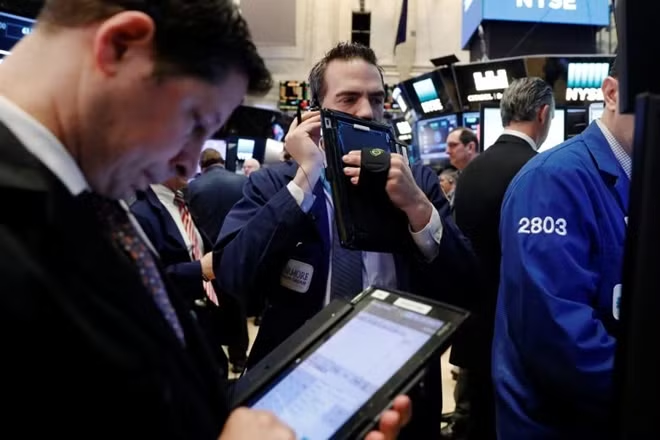
Traders work on the floor of the New York Stock Exchange (NYSE) in New York, U.S., March 21, 2017. REUTERS/Lucas Jackson
Traders work on the floor of the New York Stock Exchange (NYSE) in New York, U.S., March 21, 2017. REUTERS/Lucas Jackson

As he acknowledged defeat for the healthcare bill, Trump said Republicans would likely pivot to tax reform. Bets on that shift in focus were seen in stocks late on Friday, as the market cut its day losses when news of the health bill being pulled emerged.

"The market believes it raises the probability of a tax cut later this year since Trump is showing more strategic behavior. (It) puts the market a little more at ease," said Paul Zemsky, chief investment officer of multi-asset strategies and solutions at Voya Investment Management in New York.

On the campaign trail Trump promised to lower the corporate tax to 15 percent. In order to make the tax reform revenue-neutral, and agreeable to the most money-sensitive wing of his party, his administration counted on savings from the health bill that will no longer materialize.

"If we want to get something passed by the August break, it’s going to look a lot like tax reform light,” said Art Hogan, chief market strategist at Wunderlich Securities in New York.

"If we settle somewhere between the 25-30 percent corporate tax rate, that is far from the 15 percent offered in the campaign trail and the 20 percent currently in the House plan, (and) I think that’s where we end up."

Softer cuts in corporate taxes leave stocks vulnerable after a rally on hopes for more, he said.

"It’s not a negative, it’s just not the positive the market had priced in."

Aside from Trump's pro-growth agenda some investors have pointed to an improving global economy and expectations for double-digit growth in corporate earnings as support for the lofty valuations in stocks.

"The evidence suggests to me that there is some Trump fairy dust sprinkled on this rally. That said, the underlying fundamentals do look better," said Alan Gayle, director of asset allocation at RidgeWorth Investments in Atlanta, Georgia.

A survey on Friday showed Germany's private sector grew at the fastest pace in nearly six years in March, suggesting an acceleration in growth for Europe's largest economy in the first quarter.

Stocks could also turn to earnings to justify their price. First quarter earnings are expected to grow by more than 10 percent, according to Thomson Reuters data. In another sign of investor bullishness, February's reading on consumer confidence touched its highest level since July 2001.

If earnings fail to deliver double-digit growth, stocks could again be seen as too expensive. At $18 per dollar of expected earnings over the next 12 months, investors are paying near the most since 2004 for the S&P 500.

"The advance we’ve had and the large spike in confidence, the expectations on the economy and earnings expectations - we continue to believe it is too high," said Julian Emanuel, executive director of U.S. equity and derivatives strategy at UBS Securities in New York.

Reuters

Other News

Vietnam – one of most attractive destinations for leading US semiconductor companies: expert

Vietnam – one of most attractive destinations for leading US semiconductor companies: expert

Vietnam has built a solid semiconductor and electronics industry before joining ITSI, attracting major US semiconductor companies. Intel Products Vietnam is one of Intel's largest assembly and testing facilities worldwide, while chip design companies such as Synopsys, Cadence, Marvell and Qualcomm have established engineering and research centres in the Southeast Asian country.

Vietnam targets higher-quality FDI under Resolution 10

Vietnam targets higher-quality FDI under Resolution 10

During the first seven months of 2026, Vietnam attracted more than 38 billion USD in registered FDI, up nearly 58% year-on-year. More importantly, the increase was driven by large-scale, high-tech projects rather than a surge in the number of new investments, signalling a significant improvement in the quality of capital inflows.

Manufacturing, engineering drive hiring growth in H1: report

Manufacturing, engineering drive hiring growth in H1: report

Manufacturing and engineering posted the strongest recruitment growth, with hiring demand surging 70% year-on-year, driven by production expansion, supply chain restructuring and sustained investment inflows in high-tech manufacturing.

Government proposes special mechanisms to unblock APEC 2027 projects in Phu Quoc

Government proposes special mechanisms to unblock APEC 2027 projects in Phu Quoc

The projects in Phu Quoc have been implemented under tight deadlines. Since May 2025, the Prime Minister has directed preparations for APEC 2027, including accelerated infrastructure development on the special zone. An Giang province and investors have subsequently launched a number of major projects involving complex technical requirements and demanding construction schedules.

Financial market reform plan targets high, sustained growth through 2045

Financial market reform plan targets high, sustained growth through 2045

The plan seeks to develop a balanced and modern financial market that is closely integrated with regional and global markets, strengthens the mobilisation and allocation of domestic and foreign capital, and enhances the market’s role as a key provider of medium- and long-term capital for the economy and as a major driver of sustained high economic growth.

An Giang aims to become leading maritime economic hub

An Giang aims to become leading maritime economic hub

Under the province's master plan for 2021–2030 with a vision to 2050, An Giang will prioritise investment in five strategic sectors: strategic infrastructure; processing industries and clean energy; trade, services, logistics and border-gate economy; high-quality tourism; and high-tech agriculture, ecological development and the circular economy.

Lien Khuong International Airport set to reopen on August 19

Lien Khuong International Airport set to reopen on August 19

Once operations stabilise, Lien Khuong International Airport in the Central Highlands province of Lam Dong is projected to serve approximately 6,800 passengers a day, nearly 1,000 more than before its temporary closure. Passenger throughput during the final four months of 2026 is forecast to reach around 816,000.

Global buyers turn to Ho Chi Minh City for sourcing

Global buyers turn to Ho Chi Minh City for sourcing

The growing number of international retailers and importers choosing Ho Chi Minh City as a sourcing destination underscores the city's transformation from a trade promotion venue into a regional procurement hub.

PM's conclusions set to clear bottlenecks, spur corporate growth

PM's conclusions set to clear bottlenecks, spur corporate growth

The PM called on the business community, business associations and the Vietnam Chamber of Commerce and Industry (VCCI) to strengthen self-reliance, innovation and competitiveness by improving governance, adopting advanced technologies, enhancing product quality and using capital more efficiently.

Incentive policies for high-tech agricultural zones

Incentive policies for high-tech agricultural zones

Under Decree No. 263/2026/ND-CP, qualified projects are given priority to participate in State support programmes as well as funds and policies on research and development, technological innovation, technology transfer, human resource training, investment promotion and trade promotion.